Larger vessels set to increase cargo volumes
Updated: 2011-12-14 13:21
By Zhou Siyu (China Daily)
|
|||||||||||


BEIJING - The race to build and buy bigger ships never seems to end.
The present trend can be traced back to the latter half of 2010 as shipping companies across the world started using larger vessels. In the container-shipping sector, the climax of the race came in February when Maersk Line Ltd, the world's largest container operator by capacity, ordered 20 of the largest-ever container carriers, vessels designed to carry 18,000 containers each.
|
 |
|
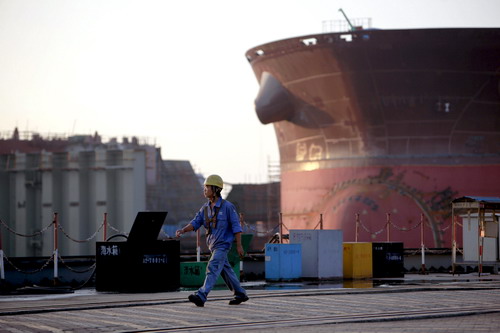
A worker walks past a ship under construction at the China State Shipbuilding Corp's Longxue Shipyard in Guangzhou, Guangdong province. The trend is for shipping companies around the world to use larger vessels.[Photo/Bloomberg] |
China Shipping Group (CSG), a State-owned conglomerate, is the latest follower in the trend. In November, the group made an order worth $1.13 billion for 12 container carriers, each with a capacity of 10,000 containers. The group also announced plans to order four 45,000-deadweight-ton bulk carriers.
CSG is keen to use larger vessels because they reduce the transportation costs for each container and therefore generate more profit.
"Economies of scale and cost-effective transportation have always ruled in the industry. It is a natural development to remain competitive," said Torben Skaanild, secretary-general and chief executive officer of the Baltic and International Maritime Council (BIMCO), the world's largest association of shipowners.
"But heavy investment is needed to stay in the race when business conditions are harsh, as they are especially now," Skaanild added.
This year has turned out to be a difficult one for shipping companies. More than two-thirds of shipping lines across the world have reported losses, industry data showed.
The fragile world economic recovery, surging oil prices and the excessive number of vessels available have exacerbated the problems facing the industry, according to the companies themselves and analysts. The current vessel overcapacity can be directly traced back to an order binge during the years of optimism immediately prior to the global economic meltdown in 2008.
Given the current situation, the introduction of new tonnage has prompted concerns. "We need to maintain a reasonable development for the shipping industry as a whole. To rush into the trend for larger vessels will make the situation even worse," said Wei Jiafu, chairman of China Ocean Shipping (Group) Co (COSCO), another of China's major State-owned shipping conglomerates.
Some observers had expected less fierce competition in the industry, as small shipping companies were forced out of the game. But that scenario is unlikely to happen. "The tonnage will always stay. Had there been further industrial consolidation, the vessels would have been sold at a lower price and brought back to the market on a lower cost basis. This will exert further downward pressure on freight rates for the whole industry," said Zhang Hui, an analyst with Donghai Securities Co Ltd.
The good news for the small companies is that the larger vessels are not deployed on all routes. "For the major routes, such as the Asia-Europe line, a handful of major players will dominate the market. As a consequence, competition in the minor routes will become fiercer," Zhang said.
Just as in the shipping industry, size is everything, and the larger ports will prevail. Big ports with strong facilities find it easy to accommodate larger vessels and may see growth in cargo flows as a result. However, for the smaller ports, large ships are nothing but a challenge, according to industry insiders.
Some ports will have to upgrade and invest in infrastructure to accommodate the bigger ships, and that might lead to cash flow problems, said Hans Smits, president and chief executive officer of the Port of Rotterdam Authority, the largest port in Europe when measured by throughput. "We are ready for the large ships," he said.
For dry bulk carriers and oil tankers, capacity is also expanding at a steady pace. Vale SA, the Rio de Janeiro-based miner, has invested $2.3 billion in 19 400,000-deadweight-ton megabulk carriers and will control another 16 under long-term contracts, according to the company.
The miner received the first ship in the fleet in July and had planned to sail it to China's Dalian port on its maiden voyage. But the giant vessel was diverted to Italy because of restrictions at Dalian and a request from a European customer, said the company.
"China's ports can't handle a vessel of 400,000 tons. They are too big and too dangerous," said COSCO Chairman Wei Jiafu.
However, some are trying to catch the wave. In Dongjiakou port, located in the northeastern coastal city of Qingdao, they are trying to build the world's largest deepwater port by capacity. Boasting excellent geological advantages, the port plans to become a center for bulk cargo exchange and oil storage and is expected to become operational within three years.
"Large vessels are the inevitable trend. We will be able to accommodate ships even larger than Vale's in the next few years," said Zhang Hao, vice-general manager of Qingdao Port Investment and Construction Group Co Ltd.
Related Stories
13 sailors confirmed dead in attack on Mekong River 2011-10-23 12:35
Overseas companies set to boost cruise travel 2011-10-18 14:18
Mekong needs security boost 2011-10-20 08:06
Stranded Chinese sailors in Thailand begin the journey home 2011-10-14 12:10
China demands safe return of ships, sailors 2011-10-12 20:11
Two Chinese sailors still missing: FM 2011-10-11 09:15
- China to maintain prudent monetary policy
- China to maintain firm stance on property market
- Boomtime buys lead to bust
- Lower taxes to aid economic growth
- China's housing prices to decline in 2012
- Foreign trade target 'arduous' next year
- Govt to act as export expansion slides
- Court: Shenzhen firm is owner of iPad trademark