New niche market: Affordable smartphones
Updated: 2011-12-26 13:53
By Shen Jingting and He Wei (China Daily)
|
|||||||||||


Lei finds a new niche market: Affordable smartphones
BEIJING - Lei Jun, chairman and chief executive officer of Xiaomi Corp, said he has used more than 70 mobile phones and is able to figure out whether a handset is good or not within half an hour.
|
 |
|
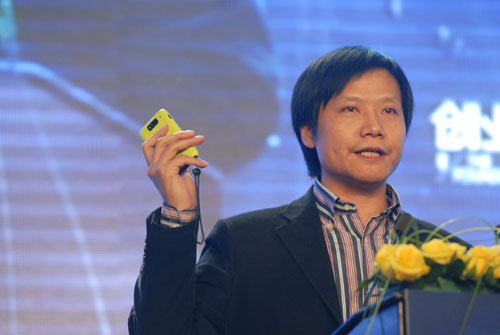
Lei Jun, chief executive officer of Xiaomi Corp, holding his company's mobile smartphone while speaking at a meeting. [Photo/China Daily] |
The mobile phone enthusiast created Xiaomi in April 2010, saying he wants to introduce extremely high quality devices to the China market at an affordable price. "Xiaomi designs products for mobile phone zealots like me," Lei said.
Since its debut on Aug 16 this year, the 1,999 yuan ($312.3) Mi-One, the first generation of Xiaomi mobile phones, has attracted great attention in China. The 1.5-gigahertz (GHz) dual-core device has a superior hardware combination and runs at a speed faster than most flagship mobile phones produced by well-known brands.
Lei said on Tuesday that Xiaomi has already gained more than 1.5 million fans. Most of them are fanatical about mobile devices, tend to be opinion leaders and like to suggest to their friends what handsets to buy.
Some followers have even made special music videos and add-ons for Xiaomi smartphones, Lei said. "Xiaomi wants to evoke some kind of 'religious fever' among our fans," Lei said at a Beijing news briefing. He admitted hardcore mobile device users have helped Xiaomi gain popularity in China in a very short period of time.
About 300,000 Xiaomi handsets were pre-ordered in the first 34 hours after Xiaomi accepted online booking from Sept 5. The company had to immediately suspend selling because stocks ran out. On Dec 18, Xiaomi resumed online sales but the 100,000-strong stockpile began to run out in just three hours.
"I thought I was fully prepared. The stockpile was supposed to last for two weeks. However, the sales went beyond my expectations," Lei told China Daily.
In order to tackle the supply problem, Xiaomi plans to engage Taiwan's Foxconn Technology Group as a phone assembler in January next year. Foxconn also assembles the iPhone series for Apple Inc.
Previously, Chinese buyers could only buy a Xiaomi phone through its official website, Xiaomi.com, or other e-commerce websites such as taobao marketplace, but now people can buy devices offline from China Unicom (Hong Kong) Ltd's outlets across China.
China Unicom, the country's second-biggest telecom carrier by subscriber numbers, announced last week that it signed a contract with Xiaomi to purchase millions of Mi-One handsets.
The level of demand has swept away any doubts that Xiaomi would succeed. Lei said Xiaomi raised about $90 million in the latest round of funding on October 20. The investors included Temasek Holdings, International Data Group (IDG) and Qualcomm Inc.
Xiaomi's total fundraising amounts to $131 million. Lei said most of the money will be working capital to produce more high-quality Xiaomi devices. Lei also revealed he has launched an investment firm, Shunwei, which controls $250 million and has invested in Xiaomi.
Shunwei, which means "doing things by following the right trend" in Chinese, is one of the essential concepts that Lei has drawn on in his nearly two decades of experience in working in China's Internet industry.
The 43-year-old entrepreneur was once among the most influential people in China's Internet industry, sharing fame with Pony Ma, chief executive officer (CEO) of Tencent Holdings Ltd, and Robin Li, chairman of Baidu Inc.
Lei became CEO of Kingsoft Corp, a leading Chinese software developer, at the age of 25. He invested in the e-commerce company Joyo.com in 1999 and sold it to Amazon in 2004 for $75 million. After leaving Kingsoft, Lei acted as an angel investor and made investments in a bunch of well-known Chinese Internet companies, including online clothes trader Vancl.com and UCWeb, a Beijing-based mobile Internet browser maker. An angel investor is an affluent individual who provides capital for a business start-up, usually in exchange for convertible debt or ownership equity.
"Setting up Xiaomi was doing the right thing at the right time," Lei said. He recalled that 10 years ago, when he predicted mobile Internet could be a major trend, forming a market even bigger than the traditional Internet market, few people really believed him. "But now, few people challenge me on that idea," he smiled.
The success of Xiaomi phones is down to three things, Lei added. First, one third of Xiaomi device-design ideas come from what users demand. Second, Xiaomi sells handsets mainly through e-commerce websites, which cuts costs and helps lower the selling price. The third reason may be the most important one - Xiaomi doesn't expect to make money from selling handsets but hopes to realize profits from providing software and related services, Lei said.
"Xiaomi has essentially imitated Apple's marketing strategy," said Shen Sui, an Internet analyst at consultancy firm iResearch. And, likewise, it aims to make a profit by combining the sales of hardware with its software, such as Miliao.
"The phone is clearly targeted at low to middle wage earners who want a smartphone but cannot afford those priced at 4,000 yuan or more. This is a niche market that is largely ignored in the smartphone sector," Shen said.
Related Stories
Unicom to sell own smartphone 2010-11-19 08:03
App finds restaurants using your smartphone 2011-09-05 21:32
E-commerce is going mobile 2011-08-29 09:52
Jobs' quit will provide more opportunities for ZTE 2011-08-26 10:08
Lenovo launches second smartphone 2011-08-09 10:34
Samsung's smartphone sales put the heat on Apple, Nokia 2011-07-26 09:27
- Weak markets pose fund investment risk
- New niche market: Affordable smartphones
- China launches super-speed test train
- PBOC urges less reliance on foreign credit ratings
- Group-buying firms look to Taobao
- Bank reserves 'may be cut again next year'
- Surplus revenue is a taxing problem
- Provincial borrowers defer loan payments