Top News
'Green' auto movement facing an uphill climb
By Tim Dunne (China Daily)
Updated: 2011-04-19 15:31
 |
Large Medium Small |
|
 |
|
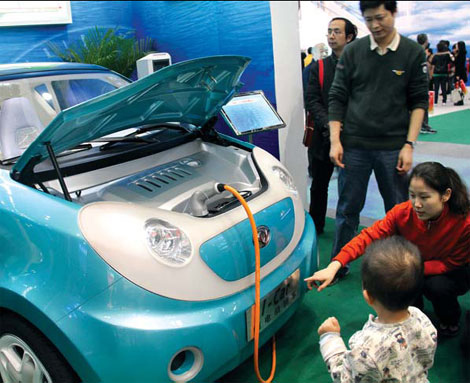
Battery weight, capacity and charging time needed are among vexing problems deterring widespread acceptance of electric cars.?[Photo / China Daily] |
Over the past several years, international media have been reporting with increasing frequency about China's intention to lead the world in the development of hybrid vehicles and electric vehicles.
Two years ago this month, a headline in the global business section of the New York Times proclaimed "China Vies to Be World Leader in Electric Cars", and reported that China's auto industry policymakers want to position China as one of the world's leading producers of green vehicles "within the next three years."
Since we are at the beginning of the third year of China's green vehicle campaign, now might be a good time to assess how much progress has been made.
The short answer is - unfortunately, not much.
Since sales volumes of hybrids and electric vehicles in China are so small, they are not widely reported, so it's difficult to say with certainty what the exact totals are.
However, based on the limited amount of published data available, and anecdotal evidence from automakers and industry experts, total sales of hybrids in China in 2010 were estimated to be in the thousands of units. By comparison, hundreds of thousands of hybrids were sold in Japan, the United States, and Europe.
Electric vehicles sold in China in 2010 are believed to be even fewer.
So what happened?
The blame for the slow start to China's electric industry does not lie within China's auto sector or at the doorstep of the country's policymakers.
Certainly, both groups are committed to making an electric vehicle solution work for China. Plans have been made, billions of yuan has been set aside to support the industry, incentives have been provided to encourage automakers to build the vehicles and for consumers to buy them.
Instead, the problem with electric vehicles is tackling a technology that engineers have been trying - and mostly failing - to make more cost-efficient, convenient and appealing to consumers for the last 100 years or so.
The drawbacks to electric vehicles are manifold, and have been recounted endlessly in numerous studies.
Electric vehicles lack driving range, require long recharging times and often feature performance compromises - for instance, inability to hold a charge in cold climates, or a lack of power over mountainous and hilly terrain, or when towing.
Moreover, there is a substantial lack of infrastructure to support widespread recharging.
While all these concerns are important, they are not the most important reason that buyers are avoiding green vehicles.
Intrigued, but balking
Based on JD Power research of new vehicle buyers in China - and in major markets around the world - while many consumers are intrigued by the idea of owning an electric vehicle, they balk when they learn about the price premium associated with these vehicles.
In China and other markets, the retail price of an electric vehicle can be double that of a similarly sized conventional vehicle. This price premium is usually met with significant resistance by consumers.
Even with government-provided subsidies, credits, rebates and other types of incentives, electric vehicles can typically cost 25 to 50 percent more than their conventional counterparts.
The path forward for growing an EV industry is not likely to be easy, but pursuit of an electric future is almost mandatory.
A report by the International Monetary Fund, issued earlier this month, warned that dwindling global oil supplies should drive oil prices upward as demand increases - especially in countries like China, where oil demand is soaring, and annual vehicle sales are expected to double in the next decade.
China today is the second largest consumer of oil in the world after the United States. In 2010, China's imports of crude oil accounted for a little more than half of the country's total oil consumption, government experts say.
Importing more than 50 percent of annual oil consumption is generally recognized by oil industry experts as an energy security issue.
The concern doesn't end there.
In 2010, the International Energy Agency estimated that growth in China's oil demand was increasing at a rate 8 times faster than global supply growth.
According to industry analysts, at the current rate of demand growth, nearly two-thirds of the oil consumed in China will have to be imported by 2020.
Since it is estimated that 60 percent of oil consumed in China today is used to power the national vehicle fleet, it is only natural to look for an alternative. That alternative is electric vehicles.
However, even if breakthroughs in electric vehicle technology can be achieved - to give them greater range, faster recharge times and better performance in suboptimal operating conditions - and even if the prices come down substantially to make them more attractive to consumers, the challenges do not end there.
Electricity would need to be produced in sufficient volume to power a growing national fleet of electric vehicles, and that electricity is created at power plants usually fired by coal.
China controls the world's largest reserves of coal, so access to coal resources is not an issue.
But is coal any better?
However, burning greater amounts of coal could create emissions that equal or exceed the emissions released by conventional internal combustion engines, causing harm to the environment.
Earlier this month, the Innovation Center for Energy and Transportation, a Beijing-based policy center, announced that it had been working on a report entitled "Electric Vehicles in the Context of Sustainable Development in China."
| |||||||


In short, the report found that electrics are not always an environmentally friendlier alternative to conventional vehicles - particularly in the case of greenhouse gas emissions - because of the quantity of emissions created at the power plants that produce the electricity needed to power the vehicles.
Certainly, there are cleaner technology alternatives to coal-fired power plants for producing electricity. Some options include wind, solar and nuclear power. But each of these comes with its own challenges.
While many questions remain about the viability of electric vehicles as a clean and sustainable successor to conventional ones, one point does seem clear: Creating an electric vehicle industry will not be an easy task.
The author is director of Global Automotive Operations at JD Power and Associates.
| 分享按鈕 |