China reports sharp drop in carbon intensity
Updated: 2011-11-10 07:25
By Li Jing (China Daily)
|
|||||||||||


BEIJING - China has become the top emitter of carbon in the world after its emissions of greenhouse gases increased by 33.6 percent from 2006 to 2010, according to a report released by Tsinghua University on Wednesday.
 |
|
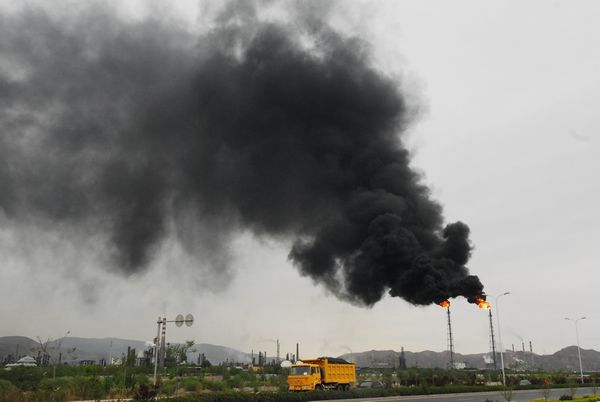
Heavy smoke rises from an oil refinery in Lanzhou, Gansu province, in May 2010. China is now the world's largest emitter of carbon. [China Daily] |
At the same time, China's carbon intensity - a measure of a country's emissions compared with each unit of its economic growth - dropped by 20.8 percent, partly because of the country's work to become more energy efficient and rely more on renewable sources of energy.
Yet, the report, which was compiled by the university's Climate Policy Initiative and is called the Annual Review of Low-carbon Development in China, gives cause for pessimism.
It says central authorities' goal of controlling coal use in the next five years will be unattainable so long as local governments remain reluctant to use less energy while they pursue economic growth.
"Local authorities still have a strong desire for economic expansion," said Qi Ye, editor-in-chief of the report.
"If you consider their growth targets together, you can see they are significantly higher than the annual growth goal of 7 percent set by the central government for the country's 12th Five-Year Plan (2011-2015) period.
"As a result, by 2015, the annual consumption of energy is expected to be equivalent to burning 4.6 billion tons of coal a year, according to the provincial targets," Qi said. "That's 500 million more tons than would be entailed by the amount of energy consumption called for in the central government's estimates."
The State Council, or China's Cabinet, on Wednesday approved a plan to contain greenhouse gas emissions in a bid to realize a 17-percent fall in carbon dioxide emission per unit of GDP by 2015.
China consumed 3.2 billion tons of standard coal in 2010, about 46 percent of what was used in the world, according to Zhang Guobao, former head of the country's National Energy Administration.
During the past five years, the country has gone from getting 68 percent of its energy from coal to getting 70 percent, despite its heavy investment in renewable energy, Zhang said.
"The growing demand for coal will put China under pressure in terms of coal mining, transportation and controlling carbon emissions," he said.
From 2006 to 2010, China spent 1.73 trillion yuan ($272.8 billion) on renewable energy and another 859.2 billion yuan on projects meant to ensure energy is used efficiently, the report said.
"Investments on such a scale - equal to about $80 billion a year - are the largest ever in the country's history and have made China a global leader in green investment," Qi said.
As a result, the country has seen its energy use for each unit of its economic growth decrease by 19.1 percent.
Even so, the country has continued to release more carbon, taking the place of the United States in 2007 as the top carbon emitter in the world, just as the US was entering into an economic downturn, Qi said.
If China fulfills predictions and continues to use more energy in the next five years, it is likely to face increasing pressure from international community to manage its emissions of greenhouse gases, Qi warned.
By 2020, China plans to reduce its carbon intensity by 40 to 45 percent below what it was in 2005.
The report is not an official announcement from the Chinese government. Even so, the editors of the report include members of the national expert committee on climate change, a think tank charged with considering the country's climate policy.
Su Wei, a leading climate negotiator for China, wrote a blurb for the 338-page report and officials from the National Development and Reform Commission, the government body that oversees matters related to climate change, were also present when the report was released.