Films continue revenue growth
Updated: 2012-01-10 07:56
By Liu Wei (China Daily)
|
|||||||||


BEIJING - Low-and medium-budget films are a rising power sharing blockbusters' glory on the Chinese film market, a senior film industry insider said.
"The rise of small- and medium-budget flicks is challenging the dominance of blockbusters in Chinese film market," said Tong Gang, director of the State film bureau, affiliated with the State Administration of Radio, Film and Television, the industry's top regulator.
 |
"A group of young filmmakers has stood out as a strong power and is contributing to the industry," he said during a news conference on Monday.
Tong specifically mentioned Love is not Blind, a romantic comedy that cost less than 10 million yuan ($1.54 million) to make but grossed 350 million yuan, praising it as "a box office miracle".
That film and some other medium-budget productions, such as Eternal Moment and The Piano in a Factory, have won over audiences through their creativity and convincing depiction of real life, Tong said.
The young competitors, as well as traditional box office winners such as directors Zhang Yimou and Feng Xiaogang, contributed to setting a record in annual box office receipts in 2011.
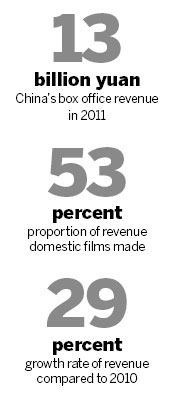
According to Tong, China's box office revenue reached 13.12 billion yuan in 2011, 29 percent more than 2010, continuing the more than 25 percent growth each year since 2003.
Domestic films make up 53.61 percent of the total revenue, while about 50 foreign films share the rest. China imports 20 foreign films on a revenue-sharing basis and about 30 with their financiers receiving a one-time fee and no cut in ticket sales.
The highest-grossing local film, according to Zhang Hongsen, the bureau's deputy director, is probably Zhang Yimou's war epic The Flowers of War, which raked in about 500 million yuan.
Last year also saw 803 new theaters and another 3,030 screens established. By the end of 2011, China had 2,800 theaters and 9,200 screens.
But the flourishing box office does not mean it is time to celebrate. The industry needs urgently up-to-date information released about box office revenue, according to Tong, of the state film bureau.
The figures are now released weekly, but Zhang said the bureau will launch a new system to collect box office receipts and release the data in a more timely manner. He did not give a specific date, though.
The bureau will also "sternly penalize" theaters that manipulate box office revenue for their own interests, said Zhang, by introducing a so-called "red/yellow card" penalty system. Those that "severely disturb a fair market" could lose their licenses, but he said that detailed measures are still to be discussed.
The bureau also points out that the film ticket price is still high in China.
According to the China Film Industry Report 2010-11, the average ticket price in 2010 was about $5.30, while the figure in the United States was $7.89.
However, $5.30 represents almost 2 percent of average Chinese city dwellers' monthly income, while $7.89 represents about one-fifth of a percent of their US counterparts' salary.
According to Tong, the bureau will issue a recommended pricing guideline for cinemas in 2012, set a maximum price and urge cinemas to increase half-price ticket deals.
Xinhua contributed to this story.
- Chinese media to get boost overseas
- Chinese writers sue Apple for copyright violation
- Shanghai equals finance, expats say
- Luxury goods: to buy or sell?
- Wen's speech lifts stock market
- Foreign auto investment no longer 'encouraged'
- Wen urges for more support to real economy
- Caterpillar expands China research center