In love with luxury amid global gloom
Updated: 2012-01-16 08:03
By Karl Wilson (China Daily)
|
|||||||||


The global economy may be in a tailspin, but Asia's affair with high-end goods continues to bloom, reports Karl Wilson in Sydney.
When Selfridges of London, one of the world's most famous department stores, opened its post-Christmas sale on Boxing Day, the mall enjoyed the most profitable period in its entire history, raking in a staggering 1.3 million pounds ($2 million) in just 60 minutes.
Asian shoppers, thousands of them, kept the tills ringing.
|
 |
|
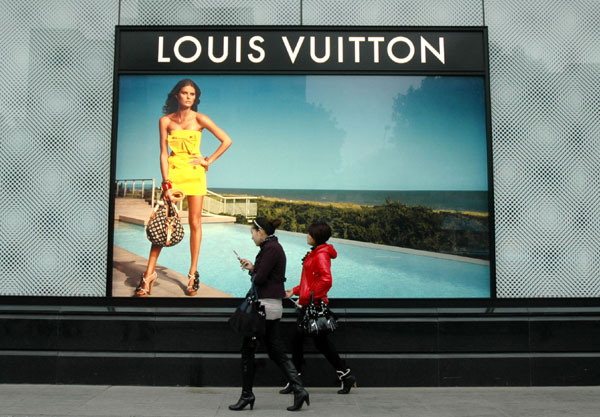
Large advertisements for luxury brands, such as this one for Louis Vuitton in downtown Wuxi, Jiangsu province, are now common in cities, big and small, across China. Qiu Daocen / for China Daily |
In a tribute to the growing clout of Asia, the Daily Mail newspaper wrote: "Thousands of Asian shoppers were to be found elbowing their way through the throng as keenly as the most bargain-savvy Brits.
"Not long ago, the number one Asian clientele would have been Japanese (but) the Pacific's financial tectonic plates have well and truly shifted. In the past 12 months, visitors from China have comfortably surpassed all the oil-rich Arab nations, Japan, Russia and the United States to become Selfridges' number one overseas nation in terms of spending power."
With the Chinese New Year edging closer, sellers across the world are gleefully rubbing their hands in anticipation of another shopping frenzy that will give a boost to both quality and quantity purchase.
The global economy may be in a tailspin, and retail outlets across Europe, the US and Australia may be crying poor, but the high-end luxury market is blooming in Asia. Whether it be the opulent fashion shopping districts of China and Hong Kong, Singapore or Japan, 2011 was a big year, and 2012 is expected to be even better for some of the world's biggest names in luxury.
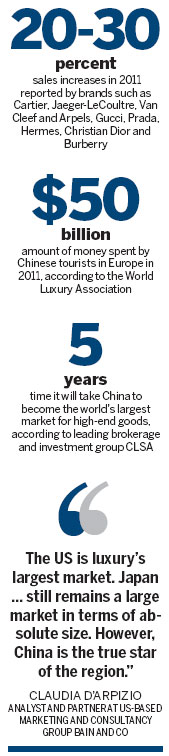
Brands such as Cartier, Jaeger-LeCoultre, Van Cleef and Arpels, Gucci, Prada, Hermes, Christian Dior and Burberry all reported significant sales increases last year - up to 20 to 30 percent - and an encore is likely in the Year of the Dragon.
|
 |
US-based marketing and consultancy group Bain and Co said the global luxury goods market last year grew by 10 percent to 191 billion euros ($242 billion), leaving far behind the 173 billion euros in 2010 and 153 billion euros in 2009.
The 10th Luxury Goods Worldwide Market Study, the global management consulting firm's survey released at the end of 2010, found that even in the mature markets of Europe and the US, Chinese tourists are driving sales rather than domestic shoppers.
In key European luxury cities such as Milan and Paris, Chinese tourists accounted for more than 50 percent of total luxury sales.
The World Luxury Association, the international nonprofit organization specializing in the management of luxury brands and market research, corroborated the study. It noted that Chinese tourists spent $50 billion in Europe last year, four times the amount they spent on luxury goods back home in 2010.
Japan led the way in luxury shopping in Asia with 18.5 percent of the global market. China followed closely behind with 12.9 percent, while South Korea (7.6 percent), Hong Kong (5.8 percent), Taiwan (3.9 percent) and Singapore (3.2 percent) formed the rest.
However, after suffering more than a decade of flat economic growth, exacerbated by a devastating earthquake and tsunami last year, many Japanese are not spending as much as they used to on luxury brands. This restraint has made analysts predict that Chinese consumers will soon overtake the Japanese, the world's second largest luxury market shopper after the US.
Many of the world's top names in luxury have refocused their attention and expansion programs away from Japan and onto China, to cash in on country's growing new rich.
Italian luxury goods trade group Altagamma said that although Japan accounts for 11 percent of the global market, attitudes toward branded goods have been shifting and Japanese consumers - who for long have equated high prices with quality - are now embracing value.
The strong yen has also hit sales. The same goods are relatively more expensive in Japan and so savvy consumers are instead opting to make their purchases abroad. Global consultants McKinsey found 17 percent of Japanese consumers bought luxury products in North America last year, compared with 10 percent in 2010.
Leading brokerage and investment group CLSA forecasts that China will become the world's largest market for high-end goods in five years.
"Luxury sales in China represent 10 percent of the global market," the group said in a report last year. "If we include sales to Chinese tourists abroad, we estimate Chinese consumers to account for 15 percent of global sales."
Given rising incomes and supportive social factors, CLSA expects Chinese customers to account for 44 percent of global luxury sales by 2020.
- In love with luxury amid global gloom
- Saudi oil refinery deal shows close ties
- China targets 10% foreign trade growth
- Hebei to build large offshore wind farm
- Antitrust filings rise 49% in '11 in China: MOC
- Lottery sales growth slows in China
- Shipbuilding orders slump on downturn
- First forex quarterly decrease in decade