Private facilities future for medicine
Updated: 2012-02-29 10:10
By Lan Lan (China Daily)
|
|||||||||


BEIJING - The futuristic four-story building in the Wangjing residential area of the capital looks like a car dealership from the outside, while the soft beige floor and curved lines of the walls and ceilings inside suggest that it might have something to do with children.
In a small office, a few people are discussing the design of a sign for the facility, a children's hospital that is set to open at mid-year.
Sponsored by the actor Li Yapeng and other investors, it will be the first non-profit charity children's hospital in China.
It has gained approval from the Beijing municipal health bureau and the opening is likely to be officially announced later this month, said sources.
The facility will provide regular fee-based services as well as free cleft-palate treatment for needy children, a charitable activity with which Li and his wife, singer Faye Wong, have been closely involved in recent years.
Seed capital will be raised by the founders, but the hospital won't distribute its profits to investors. All profits will be used for the treatment of children with cleft palate, a source involved in the preparatory work said.
Positioning the hospital as a non-profit facility could help overcome a common weakness of private hospitals - the pursuit of short-term profits, said Li Hongshan, executive vice-president of the Chinese Hospital Association.
The facility is also a signal that investors are becoming more confident as they test the waters of the Chinese healthcare market, hospitals in particular, analysts said.
"The time is ripe to enter this sector. The policy environment is welcoming and the government's decisive steps toward medical reform will continue," said Li Hongshan.
In April 2009, the central government announced a three-year plan to step up its healthcare reform at a cost of at least 850 billion yuan ($134 billion).
Part of the reform involves a higher annual subsidy of 240 yuan for rural residents, up from 200 yuan previously.
China has entered a key stage this year in its healthcare reform as it works to improve access to affordable care, said Sun Zhigang, director of the medical reform office of the State Council, at a conference in early February.
"The government will actively encourage private capital to invest in hospitals to satisfy the increasingly diversified demand for health services in China," Sun said.
Doctor flexibility
Li Hongshan said more flexible working arrangements had provided an essential precondition for new private hospitals by raising standards.
Li Yapeng's children's hospital will have about 150 doctors and other staff. Many will be experienced doctors, shared with large public hospitals, said a source.
Since March 2011, the Beijing medical authorities have allowed doctors to work at up to three hospitals, paving the way for the development of private hospitals.
The shortage of good doctors has been a bottleneck that constrained China's private medical facilities.
In the past, doctors could only work at a single hospital and veteran doctors were reluctant to move from prestigious public hospitals to private ones.
China has more than 8,000 private-sector hospitals, accounting for 36 percent of the total, but these facilities treat less than 10 percent of all patients, Li Hongshan said.
Patients would rise before dawn and line up to see doctors at public hospitals instead of going to private hospitals, which had a reputation for pursuing profit through medicine sales.
However, private hospitals are gaining wider acceptance, especially for maternity services and dental care.
Private capital
In December 2010, the government announced new policies to encourage private-sector investment in hospitals.
Priority was given to private-sector capital in opening new medical facilities, and the approval procedure for foreign-invested hospitals was simplified.
It took provincial-level authorities several months to figure out how to implement the policies, said Sofia Zheng, a partner at the market researcher Zero2IPO Group.
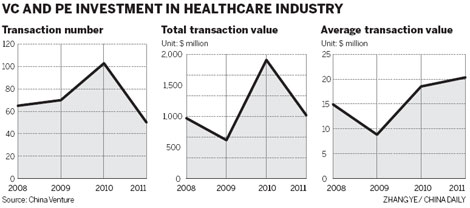
Private equity and venture capital investors have shown growing interest in investing in Chinese hospitals and some yuan-denominated funds invested in private hospitals in 2011.
Investment has focused on hospitals that specialize in obstetrics and gynecology, diabetes and cancer.
Zheng estimated that this type of facility attracted the equivalent of 1 billion yuan from PE and VC firms in the past year. .
More investment will flow into the sector this year and next, and many investment firms are seeking specialists with expertise in the medical industry, Zheng said.
Related Stories
Policy injects life to private hospitals 2012-02-27 08:04
Hospitals to trial new appointment system 2011-06-14 08:51
Hospital reforms push forward despite difficulties 2011-12-14 17:48
Private hospital starts China’s 1st medevac program 2011-04-21 10:59
- Dell introduces new business services
- Exporters urged to push for settlement in yuan
- China auto recalls up 55% in 2011
- McDonald's to raise investment in mainland
- China to reform prices in energy sector
- Lifeline thrown to Shanghai's bookstores
- Govt drive aims for fair play on taxis
- High-emission vehicles banned and fined in Beijing