Housing policies should not be relaxed
Updated: 2012-03-03 11:03
(China Daily)
|
|||||||||


Property prices and development will be one of the core issues during the sessions of the National People's Congress (NPC) and the Chinese People's Political Consultative Conference (CPPCC) National Committee.
Over-speculation in the real estate market supported by a loose credit policy from 2009 to 2011 created a huge property bubble. Responding to the public's concerns, the government has sought to return property prices to a rational level by introducing regulatory measures. However, the more bite the policies have had, the more barriers they have encountered, especially when sales declined recently and housing prices in some cities started to fall.
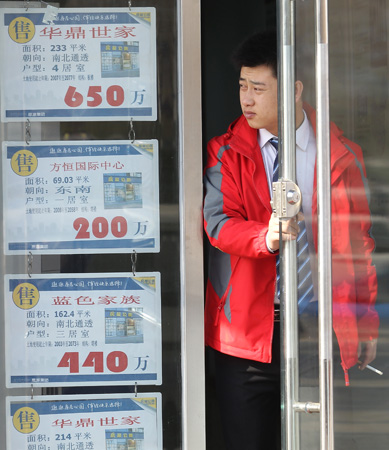 A real estate agent waits for clients in Beijing in this file photo. [Photo / China Daily]
|
Although the NPC and CPPCC this year will be an important venue for these lobbyists, it is encouraging that the government's approach to the real estate market is unlikely to change this year. The government is expected to continue its policies aimed at curbing speculation and over-investment, thereby regulating property prices down to rational levels.
Local governments and real estate developers would do better to change their policies, as it is wishful thinking to try and keep prices high based on the belief that the "rigid demand" of first-time buyers and people's desire to move up the property ladder mean that demand will always exceed supply.
It will be hard for them to realize this supposed demand because at the current price levels it is mainly speculators that are entering the market. Most non-speculative consumers are either waiting for prices to fall to more reasonable levels or, as is more often the case, they simply cannot afford to buy any at the current prices. Even when the developers do make offers to lighten the burden for non-speculative buyers, these offers are not enough to enable buyers to either enter the market or move up the property ladder.
The public and the market will be eager to learn from the NPC and CPPCC discussions how the central government intends to manage the real estate bubble in the year ahead. But it should already be clear that the central government has an unshakable attitude toward speculation in the housing market, which has been reiterated repeatedly in central documents and the speeches of government leaders.
Unfortunately, however, some specific policies that could help curb speculation have not been implemented effectively. This has encouraged the belief that the government's regulatory measures to reduce property prices are only temporary. For instance, the government could use both credit and tax policies to impose restrictions on speculation, but so far only credit policy has been implemented effectively, the tax policy still needs more workable measures.
As these tax measures have not been forthcoming, some speculators, real estate developers and local governments harbor the belief that once the rising-price trend is reversed the central government's policies will be relaxed again, so they are reluctant to exit the market with lower prices and less profits.
As long as the housing market yields high returns for floating capital, the upward pricing expectations will remain and the central government's goals of policy regulation will be difficult to achieve.
The housing market will only become rational when speculation is controlled, which will be the key point raised at this month's NPC and CPPCC sessions.
The author is a researcher with the Institute of Finance and Banking under the Chinese Academy of Social Sciences.