|
|
|
 |
|
|
|||||||||
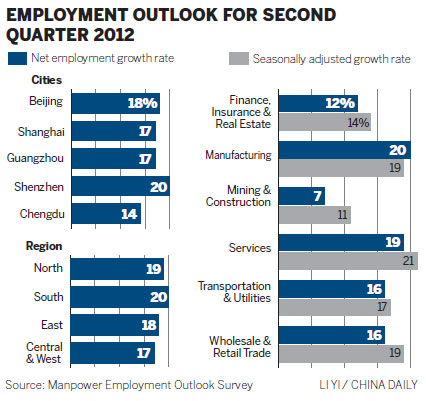
China is expected to see its worst labor shortages in the Pearl River Delta in the next three months largely because there has been a steady increase in the demand for workers in the manufacturing and services industries, a report has shown.
Chinese employers are expected to accelerate their pace of employee recruitment in the second quarter of the year, according to a Manpower Employment Outlook Survey. That study was released on Monday by ManpowerGroup China, which operates in the employment services industry.
The survey interviewed more than 65,000 employers around the world, including 4,304 employers on the Chinese mainland, in an attempt to measure their intentions to increase or decrease the size of their workforces in January.
Among the surveyed, 21 percent said they expect to have larger staffs in the next three months, 2 percent forecast a decrease, 50 percent predicted no change, and 27 percent were unsure.
"Although employers in many countries around the globe continue to be impacted by an uncertain business climate, Chinese mainland employers are buoyed by central government policies intended to boost business growth and expand domestic demand," said Danny Yuan, managing director for ManpowerGroup China. "Chinese employers remain optimistic and anticipate an active hiring pace this quarter."
Along with those hiring intentions, Yuan said, employers remain concerned about the current shortage of skilled workers. Many are having trouble finding the employees they need to perform certain tasks.
Of employers in various industries, those in the service industry said they intend to hire the most workers, leading manufacturing, wholesalers and retailers in that regard. Companies in the mining and construction industries, meanwhile, expected to make recruitments at the slowest pace, the survey found.
Companies in southern China, meanwhile, continue to have the strongest hiring intentions, especially those in the manufacturing and service industries.
In Shenzhen, the hunt for talent has been intense. Employers are scrambling to find suitable workers, the report said.
"As recently enacted minimum wage standards spread across the country, the income gap between the coastal regions and interior areas has been gradually narrowed," Yuan said. "This is having a tremendous influence on workers' decisions to relocate to work.
"We are beginning to see signs that workers in the Pearl River Delta area - primarily from the manufacturing and services sectors - may find the shrinking pay disparity a good reason to return to their original inland communities. If the talent drain away from major coastal cities continues, employers may need to explore new strategies that keep their organizations competitive in the search for the best talent."
Hu Lantian, founder of the toymaker Shenzhen PP Bear Industry Investment Co Ltd, said a labor shortage has affected the regional manufacturing industry in recent years, pushing many companies to move their factories inland.
"More and more factories are being built in labor-exporting provinces such as Henan and Jiangxi," Hu said. "Workers don't bother with leaving home to get a job anymore."
Like many manufacturers, Hu's company has put its manufacturing operation in Henan province, while continuing to do research, development and marketing at its headquarters in Shenzhen.
The competition for employees has caused labor costs to increase by about 20 to 30 percent in the past two years, she said. As long as the labor shortage persists, companies should try to put more effort into innovation rather than manufacturing, she said.
Wang Mei, a researcher with the think tank China Development Institute in Shenzhen, said the shortage is structural.
"It's true that the manufacturing and service industries have a great demand for skilled labor," she said. "Many factories have begun using mechanisms to replace labor."
Jin Bo, general manager of Arrow Ceramic's Nanxiong branch, said companies that want to hold on to staff should hire local workers. The company, which makes bathroom furnishings and related products, moved one of its factories from Shunde, Guangdong province, to the north of the province and employed 410 local workers. It lost nearly no employees following this year's Spring Festival, which ended in February.
"The workers are close to home," Jin said. "We pay good salaries. Why would they leave?"
wangzhuoqiong@chinadaily.com.cn