Greening more rooftops can help the capital clean up its air, Cheng Anqi reports in Beijing.
As public debate on air pollution heats up, many are increasingly looking to the Chinese capital's skies to cool rapid urbanization with more greenery. The Beijing municipal government has already announced plans to improve the quality of the city's air by covering 100,000 sq m of roofs with greenery by the end of this year. "Plants and water have been proven to be one of the most effective measures to degrade and dilute PM2.5," says Tan Tianying, president of Beijing Green Roof Association, referring to fine particulate matter with a diameter of 2.5 micrometers or less that are small enough to enter the smallest airways.
"If the city can make better use of building facades and rooftops for greening the environment, or add to the vertical landscape, carbon dioxide can also be greatly reduced."
 |
|
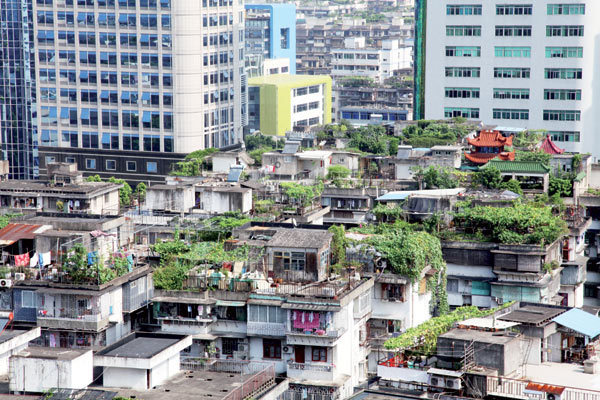
Green rooftops in cities can filter pollutants and carbon dioxide from the air and help reduce the concentration of PM2.5, the fine particulate matter that can be harmful to humans. [Photo by Yang Enuo / For China Daily] |
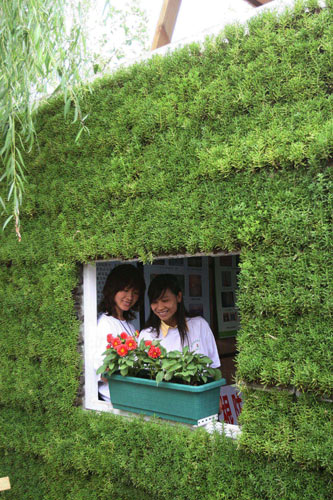
Greening rooftops in cities, or maintaining "living roofs", includes partially or completely covering them with vegetation planted over a waterproofing membrane. Similarly, the vertical landscape, designed to be modular, involves cultivating a garden that grows on walls.
Both methods can filter pollutants and carbon dioxide from the air. This can help people suffering from related afflictions such as asthma.
There are nearly 140 million sq m of bare roofs and walls that are not used for vertical landscaping in Beijing, Tan says.
The exposed spaces not only mar the beauty of the city, but also can add to an unhealthy environment.
"Vertical landscaping and green rooftops hold great potential in urban areas," Tan says. "They benefit more than just their owners."
If each person in Beijing grows just 1 sq m of green area, he says, the capital will be guaranteed with another 20 million sq m of greenery, equivalent to the park area of "dozens of Summer Palaces".
Rooftop plants can also alleviate the urban "heat island effect", Tan says. A layer of plants and earth can cut the rate of heat absorption through the roof in summer by 84 percent, he says. The greenery becomes a great way to stay cool.
Beijing also started to convert 13,000 hectares of land along its 6th Ring Road into forest this month. The green moves are part of a major development program under the capital's 12th Five-Year Plan (2011-15), which has set a target of afforesting 67,000 hectares of land.
Wang Xianmin, secretary-general of the World Green Roof Association, says that 13,000 hectares of trees can absorb 1.5 million tons of carbon dioxide and release 1.09 million tons of oxygen every year.
"The recently announced afforestation and roof greening projects are some of the greatest moves I have seen in 60 years since I've been living in Beijing," he says.
"Rooftop greening is one of the most effective ways to reduce the concentration of PM2.5."
Wang offers Canada's rooftop greening efforts as an example for Beijing.
Canada is a heavily forested country, with a total forest coverage of 44 percent, but it still promotes rooftop greening and vertical landscaping in its cities' downtown areas.
Only 3 to 5 percent of negative ions of oxygen - which are beneficial to humans - can reach the downtown areas from forest regions near cities like Toronto, Wang says.
As a result, the Canadian government calls for greening roofs to control the emission of PM 2.5 and reduce the "heat island effect".
The amount of negative ions of oxygen measured at noon one day last summer at Beijing's Tiananmen Square was merely 600 units per cubic centimeter but reached 70,000 units in Miyun district, a suburban area two hours' drive from downtown, Wang says.
In the Greater Hinggan Mountains in northeastern China, the level can easily hit 110,000.
"I hope that the successful experiences of Canada can give us some inspiration on how to improve air quality in the country," says Wang, who believes that the continuous increase in the number of vehicles is one of the major reasons behind the city's air pollution.
The number of vehicles in the country already hit 217 million in 2011, industry figures show. During a traffic congestion, Beijing, which has more than 5 million vehicles, would experience PM 2.5 levels that were up to six times of what was measured on normal days.
 |
|
Two visitors in a hut with vegetated walls at an exposition in Beijing. [Photo by Chen Xiaogen / For China Daily] |
"People often held parties on the hotel roof at night, which seldom happens today as the air pollution is getting worse," Wang says.
Beijing Asia Hotel by the 2nd Ring Road is held up as another good example of rooftop greening. The hotel turned the roofs of its office building into a chain of gardens in 2004.
As part of a pilot project in Beijing's Dongcheng district, the roof gardens also feature a 800-sq-m coverage of needle stonecrop (Sedum lineare), an attractive plant that is also popular for its ability to contain water, the hotel's guest service manager Wang Hui says.
"We regularly invite horticulturists to advise us on roof garden cultivation and maintenance," he says. "So we don't spend much money on repetitive works."
While the temperature on conventional roofs can reach 40 C at 1 pm in summer, the hotel's green rooftop is usually much cooler, Wang says.
While a number of real estate agencies believe that vertical landscaping is not worth the expense, that is a misconception because the greenery can protect buildings as well as increase the value of the property, Wang says.
The development of rooftop greenery in Beijing is held back by other wrong practices, including inadequate waterproofing that leads to leakage. All these serve to discourage more people from greening their rooftops, he says.


Copyright 1995 - . All rights reserved. The content (including but not limited to text, photo, multimedia information, etc) published in this site belongs to China Daily Information Co (CDIC). Without written authorization from CDIC, such content shall not be republished or used in any form. Note: Browsers with 1024*768 or higher resolution are suggested for this site.
License for publishing multimedia online 0108263 Registration Number: 130349