|
|
|
 |
|
|
|||||||||
It turns out that Shanghai has more rivals than it originally envisaged as it strives to realize its ambition to become a global financial hub.
Before tackling existing heavyweights, such as New York, London and Hong Kong, the eastern coastal city will first have to deal with its domestic brothers, 28 of them.
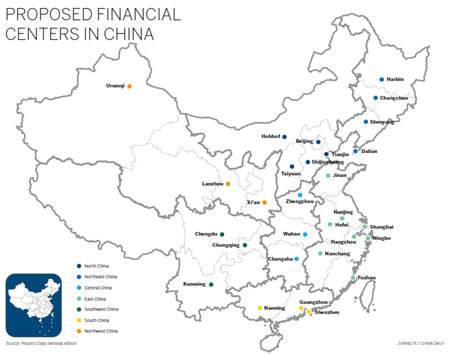
A total of 29 mainland cities, including Shanghai, have bragged about being either a national or regional leader in finance. However, with the involvement of places such as Lanzhou, an underdeveloped inland city famous mainly for lamian, or hand-made noodles, economists believe the nation is in the throes of a finance frenzy that threatens to hollow out the real economy.
Lanzhou, capital of northwestern Gansu province, has vowed to become the financial hub of the underdeveloped northwestern region. One of its goals, the city government said, is to be a "center for the banking industry" by drawing in foreign lenders and asset management companies, to compete with Shanghai.
By 2015, the city wants to have one village bank, two credit guarantee companies and three small loan companies in each and every of its counties, according to the city's development plan.
It's hard to explain why top financial talents would like to work in the counties of a city that is short of drinking water and plagued by periodic sandstorms.
But even Lanzhou has competition in the northwest. Xi'an harbors the same ambitions, perhaps on an even grander scale than its regional neighbor.
Xi'an, the capital of Shaanxi province, has set its sights on becoming an "influential" regional financial center.
The hometown of the Terracotta Warriors also wants to be the home of 50 banks with 1.8 trillion yuan ($290 billion)in deposits, 80 securities and futures companies, 45 listed companies, 45 insurance companies and 50 small loan companies by 2015.
Xi'an had a GDP of 386.4 billion yuan last year, compared with Lanzhou's 136 billion yuan. The GDP of Shanghai, whose financial industry is the strongest in the mainland, was 1.9 trillion yuan during the same period, nearly four times that of Lanzhou and Xi'an combined.
Going eastward, the competition is even more intense. Eight cities want to be East China's financial hub, while North and Northeast China have four contestants each.
In Guangdong province, two neighboring cities, Shenzhen and Guangzhou, have the same plan to lead region's finance industry.
Most recently, Shenzhen drew up a plan to pour $5.9 billion into an economic zone called "Project Qianhai", in a bid to attract Hong Kong companies, particularly from the financial sector.
Financial institutions in Hong Kong are being encouraged to set up joint ventures in securities brokerage, investment consultancy and asset management.
For now, Shanghai's financial industry remains the nation's biggest and strongest. The city ranks 10th on the Xinhua-Dow Jones International Financial Centers Development Index, with no other mainland cities higher on the list.
Shanghai's rivals are offering a host of incentives, such as low land prices and tax cuts to attract financial institutions. But economists doubt whether the cities will benefit from having more banks.
Xia Bin, a former adviser to the People's Bank of China, said that having a big financial industry attracts high-income groups, pushes up real estate prices and "squeezes out" the manufacturing industry.
"It'll be a waste if you promote the financial industry just because you want one. It's only necessary when the real economy calls for it," Xia told People's Daily.
Shi Jiayou, a government official in Anhui province who has been studying the issue, said that many cities are just indulging in window dressing to score political points.
"Many government officials don't care if their city has the conditions to become a financial center. They want it just because it sounds and looks good and would help them get promoted, even if this is at the city's loss," Shi said.
For financial institutions to cluster in a city, it has to have a strong real economy, which includes manufacturing and service sectors, a big reserve of deposits and a pool of talents, said Wang Songqi, deputy director of the Institute of Finance and Banking of the Chinese Academy of Social Science.
"With a weak real economy, financial institutions won't cluster no matter how low the land prices and taxes are," he said.
Even for Shanghai, whose plan to become a global financial hub by 2020 is supported by the State Council, the prospect of being a real financial center is remote, given that the country's currency, the yuan, is not convertible, said Xia.
"It's appropriate to develop the financial industry in Shanghai. But I don't see it becoming a global financial hub before the yuan is made fully convertible."
gaochangxin@chinadaily.com.cn