|
 |
|
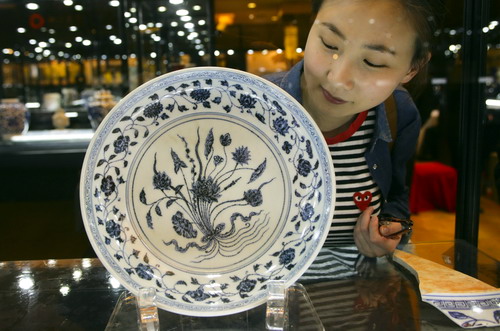
A visitor examines a plate from the Ming Dynasty (1368-1644). It is one of artworks that will be auctioned in Beijing on May 19 by the International Auction Company of China. [Photo/ China News Service] |
In addition to valuation, risk control is a crucial factor in art investment. "The more important an artwork, the easier it is to establish its authenticity," said Huang of Bonwin. "There are a number of reference points to rely on and they make it extremely hard to forge a well-known piece of art."
He said Bonwin has built an appraisal system with strict rules and procedures that prevent the company from investing in any work of art if a flaw - no matter how tiny - is detected.
BAM, which focuses on contemporary art, said it's able to confirm the authenticity of a piece either with the current owner or the artist who created it, significantly reducing the investment risk. In addition, the company requires copies of all legal documents that ensure provenance and ownership.
Dong said that returns also depend on whether a company is able to continuously increase the added valued of its artworks, because the value of a piece is closely related to its appearance at major exhibitions and inclusion in publications.
In cooperation with the China Arts and Entertainment Group, BAM founded an exhibition company to make its artworks available to a growing number of influential exhibitions overseas. That increases the added value of the artwork and can also boost its price in the primary market.
Speculative bubbles
However, the extremely high prices that some pieces fetch at auction make some observers suspect that speculative bubbles have flooded the market and will burst sooner or later. "A growing number of bubbles have appeared in the auction market, partly because the Chinese have a penchant for gambling and also because it is seen to be more civilized to speculate on art, rather than garlic," said Dong.
Having reflected on this phenomenon, industry insiders now believe that many works are seriously overvalued. But according to Professor Feng of UIBE, auction market fever does not always translate into art market frenzy. That's because auctions operate on the secondary market, while art investment funds usually acquire their works in the primary market, buying directly from artists or collectors.
The financialization of art has also brought a large number of financial professionals into the art market, which can help to prevent irrational investment.
"In the past, collectors entertained themselves in the old market. But now, as more financial institutions become involved, they require standardization. The emergence of art investment funds has played an effective role in achieving that aim, the standardization of the market," according to Dong.
She noted that the market's current trajectory is related to its relatively minor presence when compared with stocks, bonds and other investment vehicles. Currently, China still lacks appraisal institutions good enough to gain recognition from the financial agencies and the punishments for selling forgeries are not severe enough. "Although the art market is not perfect, it will mature gradually, just like the stock market," said Dong.
As an increasing number of individual investors enter the market, the financial institutions promoting art investment funds have been making greater efforts to cultivate appreciation and consumption of the arts. Believing the market has great potential, they explained that if moderately wealthy individuals purchased pieces worth 200,000 to 300,000 yuan, consumption would ripple out from them to other groups.
"The art investment market is a 'blue ocean', although it is not standardized in certain aspects," said Dong, referring to the Blue Ocean business strategy that seeks to achieve growth and profits by generating new demand in previously uncontested markets.
"The government has put great emphasis on the market and, therefore, more capital and talent will flow in. As an increasing number of elite players gather in the cultural field, it will present a great opportunity for the development of the Chinese art investment industry," she said.
Contact the reporters at zhujin@chinadaily.com.cn, peipei@chinadaily.com.cn

Copyright 1995 - . All rights reserved. The content (including but not limited to text, photo, multimedia information, etc) published in this site belongs to China Daily Information Co (CDIC). Without written authorization from CDIC, such content shall not be republished or used in any form. Note: Browsers with 1024*768 or higher resolution are suggested for this site.
License for publishing multimedia online 0108263 Registration Number: 130349