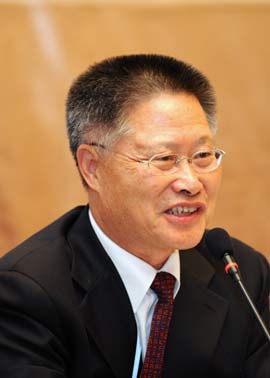
Wang Zhile, director of the research center of transnational corporations at the Chinese Academy of International Trade and Economic Cooperation
Q+A: Wang Zhile
China's inbound foreign direct investment has been falling since November, the longest period of declines since the global financial crisis. In April, China's inbound FDI fell 0.74 percent year-on-year.
As global economic prospects remain cloudy, with a risk of a deeper slowdown in the Chinese economy, worries persist over whether the drop will continue and whether the "golden era" of FDI in China is over.
China Daily reporter Ding Qingfen talked to Wang Zhile, director of the research center of transnational corporations at the Chinese Academy of International Trade and Economic Cooperation, about the issue.
Q: As labor costs rise in China, some foreign companies have moved their factories to other Asian nations with lower wages. There is concern that many others will follow suit and that China is losing attractiveness as an FDI destination. Do you have such concerns?
A: No, I never have such concerns. Labor costs are only one of the factors that contribute to the attractiveness of a nation as an FDI destination.
Others include the size of the market, government policy, infrastructure and coordinated industrial chains. China is more competitive than many other nations where labor costs are lower, if the combination of these factors is taken into consideration.
It is probably true that some foreign companies have moved their production facilities outside China to other Asian nations, but the majority of them are in labor-intensive industries. I am confident that companies, especially from market-oriented and capital-intensive industries, will continue to look at the Chinese market, focusing on the long term.
Samsung's recent decision to make its largest investment overseas in Xi'an, Shaanxi province, to produce memory chips speaks volumes about China's attractiveness.
How do you evaluate China's competitiveness?
Except for the lower labor costs and preferential policies launched in a few countries, China is far better than many of its peers, in terms of infrastructure, potential for domestic consumption and coordinated industrial chains.
More than that, China is committed to opening its market wider and creating a fairer and more transparent investment environment in the long term.
You have repeatedly emphasized China's appeal to foreign companies, but the point is, China's FDI dropped for six consecutive months through April. How do you explain the drop and is it temporary?
My guess is that the drop cannot last for long. Actually, we could attribute the drop to the weak and gloomy world business environment and the global financial crisis.
In this context, foreign companies are not willing to make new investment at the moment, and many of them are suspending their plans and closely watching the situation.
But this does not mean that they will cancel investment plans. As the global economy gradually recovers, foreign investment will again turn active.
To summarize, China's FDI could probably drop in the months ahead, but it will definitely return to growth in the near future and maintain fairly good growth.
What is your forecast for the growth of China's FDI in the next few years?
I am very positive about the prospects. I think China could maintain double-digit growth, say 10 percent, for its FDI annually.
China is now the second-largest destination for FDI worldwide, after the United States, but the scale is merely half of the United States. There is large potential for FDI to grow.
China's efforts to transform its economic growth model and its commitment to strengthening its industrial competitiveness and developing technology also provide business opportunities for foreign companies. I know a lot of executives from global companies who express strong willingness to invest in China.
Is there anything that China can do to improve its foreign investment environment?
There is always room for improvement. What I am concerned about is whether the Chinese government will stick to the policy of opening up wider to foreign companies, as it pledges.
In the new FDI development guidelines released last December, China vowed to loosen restrictions in some sectors for foreign companies, but whether the nation will actually implement the guidelines is worth watching. Also, there are many other sectors that need opening up, for example, healthcare and education.
For the Chinese government, it's time to translate words into action.
Samsung announced a $7 billion investment in Xi'an in April, the largest foreign investment project the western region has received. Will it be a trend that the region becomes a magnet for foreign companies?
Probably. Objectively speaking, some cities in China's western region are becoming more advanced to attract foreign companies - for example, Xi'an, Chengdu and Chongqing.
They have comparatively lower labor costs compared with the coastal regions, but their infrastructure is improving, their markets are expanding and they have good resources. These are all things that foreign companies want.

Copyright 1995 - . All rights reserved. The content (including but not limited to text, photo, multimedia information, etc) published in this site belongs to China Daily Information Co (CDIC). Without written authorization from CDIC, such content shall not be republished or used in any form. Note: Browsers with 1024*768 or higher resolution are suggested for this site.
License for publishing multimedia online 0108263 Registration Number: 130349