Comments()
  Print
Print  Mail
Mail  Large Medium Small
Despite its rapid development, China's rare earth industry also faces many problems, for which China has paid a big price. The following are some of the problems:
- Excessive exploitation of rare earth resources. After more than 50 years of excessive mining, China's rare earth reserves have kept declining and the years of guaranteed rare earth supply have been reducing. The decline of rare earth resources in major mining areas is accelerating, as most of the original resources are depleted. In Baotou, only one-third of the original volume of rare earth resources is available in the main mining areas, and the reserve-extraction ratio of ion-absorption rare earth mines in China's southern provinces has declined from 50 two decades ago to the present 15. Most of the southern ion-absorption rare earth deposits are located in remote mountainous areas. There are so many mines scattering over a large area that it is difficult and costly to monitor their operation. As a result, illegal mining has severely depleted local resources, and mines rich in reserves and easy to exploit are favored over the others, resulting in a low recovery rate of the rare earth resources. Less that 50 percent of such resources are recovered in ion-absorption rare earth mines in southern China, and only ten percent of the Baotou reserves are dressed and utilized.
- Severe damage to the ecological environment. Outdated production processes and techniques in the mining, dressing, smelting and separating of rare earth ores have severely damaged surface vegetation, caused soil erosion, pollution, and acidification, and reduced or even eliminated food crop output. In the past, the outmoded tank leaching and heap leaching techniques were employed at ion-absorption middle and heavy rare earth mines, creating 2,000 tonnes of tailings for the production of every tonne of REO (rare earth oxide). Although more advanced in-situ leaching method has been widely adopted, large quantities of ammonium nitrogen, heavy metal and other pollutants are being produced, resulting in the destruction of vegetation and severe pollution of surface water, ground water and farmland. Light rare earth mines usually contain many associated metals, and large quantities of toxic and hazardous gases, waste water with high concentration of ammonium nitrogen and radioactive residues are generated during the processes of smelting and separating. In some places, the excessive rare earth mining has resulted in landslides, clogged rivers, environmental pollution emergencies, and even major accidents and disasters, causing great damage to people's safety and health, and the ecological environment. At the same time, the restoration and improvement of the environment has also heavily burdened some rare earth production areas.
- Irrational industrial structure. China's rare earth industry has huge over-capacity in smelting and separating. On the other hand, the research and development of rare earth materials and components is lagging behind, its level of rare earth new materials development and end-product application technologies is significantly lower than the advanced international level, and the IPR ownership, and the production and processing technologies of new-type rare earth materials and components are relatively small in number. As a result, low-end products overflow while high-end products are in short supply. China's rare earth metals industry, relatively small in scale, features a low concentration rate with numerous businesses, but lacks large enterprises with core competitiveness. Self-discipline in the industry is also weak, and vicious competition exists to some extent.
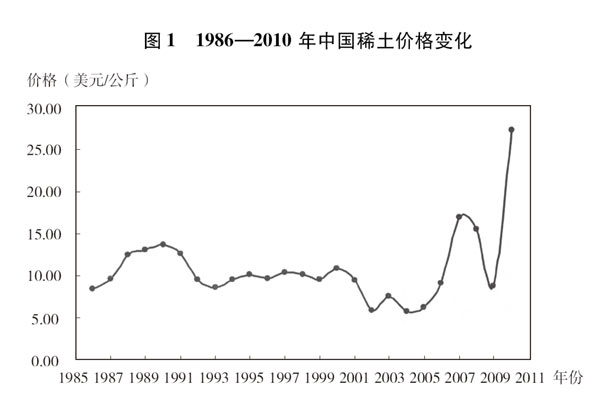
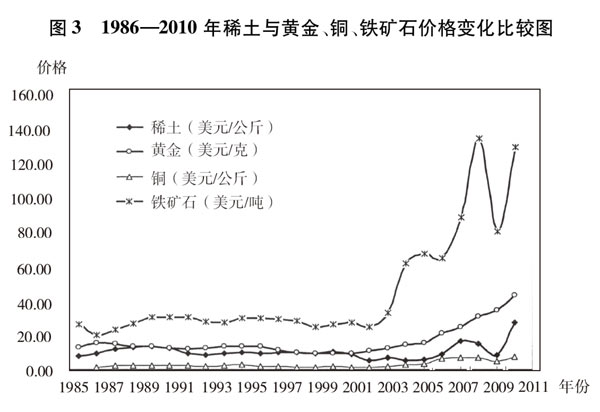
- Severe divergence between price and value. Over quite a long period of time, the price of rare earth products has remained low and failed to reflect their value, the scarcity of the resources has not been appropriately represented, and the damage to the ecological environment has not been properly compensated for. Since the second half of 2010, despite the gradual rise in the price of rare earth products, the rise has been much lower than that in the price rise of other raw materials like gold, copper and iron ore. From 2000 to 2010, the price of rare earth products rose by 2.5-fold, while that of gold, copper and iron ore increased by 4.4-, 4.1-, and 4.8-fold during the same period, respectively.
 |
|
Chart 1 Changes in the Price of China's Rare Earth Products 1986-2010 |
 |
| Chart 2 Price Rise of Rare Earth Products as Compared with That of Some Other Commodities, 2000-2010 |
 |
|
Chart 3 Price Changes of Rare Earth, Gold, Copper and Iron Ore 1986-2010 |
- Grave smuggling. Due to multiple factors, including domestic and international demand, the smuggling of rare earth products to overseas markets continues to be a problem in spite of the efforts made by China's customs listing it as a key criminal act to crack down on. From 2006 to 2008, the volumes of rare earth products imported from China, according to statistics collected by from foreign customs, were 35 percent, 59 percent and 36 percent higher than the volumes exported, as statistics released by the Chinese customs show, and the figure from foreign customs is 1.2-fold over the Chinese figure in 2011.
To address the salient problems in the development of China's rare earth industry, the Chinese government has tightened supervision over it. In May 2011, the State Council issued Guidelines on Promoting the Sustainable and Healthy Development of the Rare Earth Industry (hereinafter referred to as the "Guidelines"), attaching more importance to the protection of resources and the environment, and the realization of sustainable development. According to the "Guidelines," the government - in accordance with law - will strengthen control over the mining, production, circulation, import and export, and other links of the rare earth industry, and study and formulate as well as amend and improve related laws and regulations on the administration of this industry. The Chinese government has established an inter-departmental coordinating mechanism for the rare earth industry to make overall plans and study of the national strategy, program, plan, policy, and other important issues concerning the development of the rare earth industry. The state has also set up a rare earth office to coordinate and propose plans on the mining, production, reserve, and import and export of rare earth materials. The relevant departments of the State Council will perform their respective administrative functions accordingly. In April 2012, Association of China Rare Earth Industry was founded with official approval. It is expected to play an important role in promoting self-discipline in the industry, regulating the industrial order, and proactively carrying out international cooperation and exchanges, among other functions. A year or so has passed since the implementation of the "Guidelines," the transformation of the development pattern of China's rare earth industry has picked up speed, and significant improvement has been seen in its development order.

 Michelle Obama addresses at Democratic National Convention
 Slides of Yanbian: place, people and prosperity
 Washington to remain focused on Asia-Pacific
 RQFII target blue chips amid bear market
 Australian recall for top two exporters
 China fears new car restrictions
Copyright 1995 - 2010 . All rights reserved. The content (including but not limited to text, photo, multimedia information, etc) published in this site belongs to China Daily Information Co (CDIC). Without written authorization from CDIC, such content shall not be republished or used in any form. Note: Browsers with 1024*768 or higher resolution are suggested for this site.
License for publishing multimedia online 0108263 Registration Number: 20100000002731