"When historians look back at the end of the first decade of the 21st century, they will say that the most important thing to happen was not the Great Recession, but China's Green Leap Forward," Thomas Friedman wrote in his New York Times column after a visit to China in 2010.
If that proves true, the Green Leap Forward's frontier will be in Qinghai, a northwestern province that is on track to be the country's largest solar power generation base.
"Qinghai has the most abundant solar energy resources second only to Tibet. Combined with other conditions, Qinghai has the best comprehensive conditions for solar power generation," Xu Fushun, deputy governor of Qinghai province, said at the recently concluded Qinghai Green Economy Trade and Investment Fair.
At the fair, he also announced that another 1,000 megawatts of solar photovoltaic power was planned to be added to the grid this year.
That is an ambitious plan, given that at the end of last year, the province's total on-grid power capacity was 1,003 mW, accounting for 37 percent of China's on-grid power capacity of around 2,700 mW.
By the end of 2015, Qinghai plans to boost the installed generating capacity of solar electricity to more than 4,000 mW, almost 1.5 times the current national capacity.
This is all the more impressive if you consider that this explosive growth happened in just one year. By the end of May last year, there was only 50 mW of installed capacity in Qinghai.
In May 2011, the Qinghai government promised PV station developers 1.15 yuan (18 cents) per kilowatt-hour for electricity supplied by photovoltaic projects that became operational before Sept 30.
This meant that if a PV station was built and became operational before Sept 30, grid operators would pay the developers 1.15 yuan per kilowatt-hour, much higher than the 0.4-0.5 yuan paid for coal-fired electricity.
In hindsight, the move can be written into the history of China's PV industry's development. It created huge incentives for solar developers, long dismayed by lack of clear pricing guidance from central authorities.
"Before the move, more than 20 developers had signed project agreements. But as there was no guidance price, none of them dared to start construction," said a local industry observer who declined to be named.
According to Qinghai New Energy, a publication under the Qinghai Provincial Science and Technology Department, the pioneering promise was made after a visit by the top leaders to the National Development and Reform Commission, and got the nod from the latter.
Two months later, the NDRC set a national benchmark price for PV electricity. This price was also 1.15 yuan.
Motivated by the attractive profit margin, which some developers estimated would hit 10 percent, national power giants like China Power Investment Corp, China Longyuan Power Group Ltd, China Guangdong Nuclear Group, China Datang Group and SDIC Power Holding Co Ltd fell over one another to accelerate their projects, in an attempt to complete them before Sept 30.
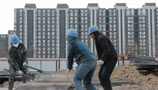
At the busiest time, 6,000 workers were working simultaneously in the vast Gobi desert day and night, Qinghai New Energy reported.
Slice of the pie
The boom was not only celebrated by large solar station developers, mostly central State-owned enterprises, but also by PV equipment manufacturers, mostly in the private sector.
Previously, excess capacity had slashed the price of solar cells by half and driven most of the manufactures into the red. For them, Qinghai's solar boom was like a shot in the arm.
Contracts provided to solar module makers are more lucrative than the industry norm, and were estimated to bring a 10 percent gross profit margin.
Among them, Yingli Green Energy, a leading PV module manufacturer, grabbed the biggest piece of the pie. It provided a 110 mW module for the 200 mW project of Huanghe Hydropower Development Co Ltd, a subsidiary of China Power Investment Corp.
Huanghe Hydropower's project is also the most ambitious of Qinghai's solar station spree.
Located in Golmud, the center of Qinghai's PV industry, the 3.2 billion yuan project is the world's largest PV farm measured by installed capacity and floor space. By the end of last year, it had been integrated into the main grid and started supplying electricity.
These great prospects have attracted numerous businesses from home and abroad.
At this year's Qinghai Green Economy Fair, it was not difficult to spot executives from domestic companies as well as foreign giants like DuPont, Dow and Applied Materials.
By the end of the fair, 42 projects involving PV electricity generation had been signed, with a total value of 13.16 billion yuan, according to the fair organizers.
Technical gap
PV power, with all its prospects, still faces a large obstacle - the power grid's ability to assimilate it. In 2011, only half of China's 2,700 mW capacity was integrated into the power grid.
PV power generation, unlike coal-fired, is volatile. And large-scale assimilation of it would disturb the whole grid. How to develop sophisticated technology to counter this poses a big challenge to grid operators, said Li Yan, an expert with Qinghai Provincial Science and Technology Department.
"The operating power grid in Qinghai is not sufficient to accept capacity of 10,000 mW, which is a 10-year goal of the province," Li said.
"How to transport the capacity through long distances is another question."
In its written reply to China Daily, the Qinghai government said it has conducted a great deal of research to tackle this threat.
Since this May, the complete assimilation of PV electricity has been realized under normal operating conditions.
And the central government has granted more than 100 million yuan to support related research projects, including grid connection technology, mega-station system components and the stations' effects on the environment.
"All projects should keep pace with the current technological levels," said Xu.
Regarding of the future of the sector, he stressed that there should be "no blindness and no recklessness".
zhengyangpeng@chinadaily.com.cn

Copyright 1995 - . All rights reserved. The content (including but not limited to text, photo, multimedia information, etc) published in this site belongs to China Daily Information Co (CDIC). Without written authorization from CDIC, such content shall not be republished or used in any form. Note: Browsers with 1024*768 or higher resolution are suggested for this site.
License for publishing multimedia online 0108263 Registration Number: 130349