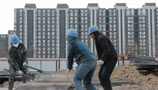
Workers at the construction site of the Chengde-Qinhuangdao expressway in Hebei province on Wednesday. A top expert from the China Center for International Economic Exchanges said that increased investment remains crucial to restore rapid economic growth.?[Photo / Xinhua]
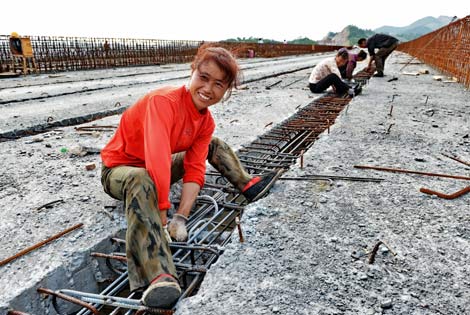
Zheng Xinli warns economy could continue to decline in third quarter
China's economy may continue to decline in the third quarter, and new, increased investment remains crucial to restore rapid economic growth, a top economist of a government think tank said on Monday.
As the year-on-year growth rate slowed for a sixth consecutive quarter to its lowest pace in more than three years to 7.6 percent in the second quarter, policymakers are paying close attention to the latest data.
"There are insufficient signs that China's economy has hit bottom," said Zheng Xinli, deputy head of the China Center for International Economic Exchanges and a guest economist of China Daily.
"Whether the economy has reached a turning point or will continue to decline in the third quarter remains unclear," he told China Daily.
"Though the labor market remains stable, businesses have already had problems. If the economy remains in a downward spiral, more social conflicts will emerge following business closedowns and a decrease of local fiscal income," Zheng warned.
The State Council is likely to meet on Wednesday to evaluate economic conditions and set the tone for monetary and fiscal policies in the second half of the year, the Chinese Securities Journal reported on Monday.
Both Premier Wen Jiabao and Vice-Premier Li Keqiang were on fact-finding trips during the weekend.
The economy still faces downward pressure, and the government should enhance policy fine-tuning, Wen said.
Most economists interviewed by China Daily, including Zheng, have ruled out a huge fiscal stimulus package, like the one rolled out in 2009 after the global financial crisis, because investment has played an overweighed role.
Investment accounted for 49.2 percent of China's total GDP in 2012, one of the highest proportions in the world.
China is trying to transform into a "consumption-driven economy", but the transition is difficult as household consumption accounted for just 34.9 percent of the GDP.
To boost consumption, programs such as "home appliances to the countryside", which encourages rural dwellers to buy domestic appliances, need to be restarted this year, suggested Zheng.
Also, China should further reduce its import taxes on luxury goods to keep the large amount of cash that Chinese consumers spend overseas in the country, he said.
But the root cause hindering consumption lies in low family income and insufficient social security.
Hopefully, consumption will get a boost from a new income-distribution plan that is expected to come out in the second half of the year, he said.
In the short term, China still needs "relatively high investment" to stop its economy from declining, he said.
However, private investment should be encouraged to play a dominant role, he said.
The country has issued a series of new rules to relax the entry requirements for private investors in sectors that include infrastructure, public utilities and financial services, but the implementation remains weak.
In big cities such as Beijing and Shanghai, facilities such as nursing homes, nurseries and parking lots are far from sufficient. The government should allow private investors to finance and operate these projects and also provide incentives such as tax breaks, he said.
The government's investment should mainly focus on public services, he said.
China should recall its experience in tackling the Asian financial crisis in the late 1990s and turn the challenges into an opportunity for laying a foundation for China's rapid growth for the next decade, he said.
During the Asian financial crisis, China built its nationwide network of freeways, and this time, the country could resume its high-speed rail construction, Zheng said.
"Investment in high-speed railways declined to about 400 billion yuan ($62.7 billion) in 2011. I think the investment scale should be resumed to more than 700 billion yuan at the peak time of previous years, as the technologies and safety standards have been improved," he said.
Zheng also suggested attracting more private investment to the railway sector by further relaxing regulations.
China is boosting railway investment this year by 9 percent to 448.3 billion yuan, Bloomberg News said on Monday. The previous plan was to spend 411.3 billion yuan.
"Despite the slower growth pace, China has yet to enter a middle-speed or low-speed era for growth. Further reforms could support China in maintaining average annual growth of 8 to 9 percent in the next 20 years," Zheng said.
lanlan@chinadaily.com.cn

Copyright 1995 - . All rights reserved. The content (including but not limited to text, photo, multimedia information, etc) published in this site belongs to China Daily Information Co (CDIC). Without written authorization from CDIC, such content shall not be republished or used in any form. Note: Browsers with 1024*768 or higher resolution are suggested for this site.
License for publishing multimedia online 0108263 Registration Number: 130349