|
 |
|
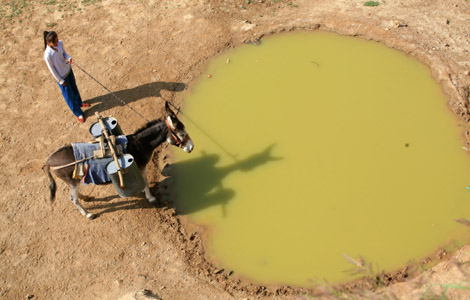
A villager waters a donkey in Haiyuan county, Northwest China's Ningxia Hui autonomous region. The region is finding ways to more efficiently use its sparse water supply. [Photo/Xinhua] |
A lack of water resources can be a make-or-break issue for a region's social and economic development. For officials, farmers and enterprises in parched areas, limited water supplies can be a frustrating and sometimes costly hurdle to overcome.
Authorities in the Ningxia Hui autonomous region say they have hit on a solution: transferring water rights for a price.
The plan consists of giving enterprises that need water the chance to invest in projects to improve irrigation channels that reduce water waste. The enterprises are then entitled to use the water saved for industrial production.
Mineral-rich Ningxia, in arid Northwest China, is surrounded on three sides by desert. Annual precipitation is usually under 300 millimeters, less than half the national average.
The Yellow River, which flows south to north through the region, gave residents hope for many years and made the region one of the four earliest irrigated areas in China during the Qin Dynasty (221-206 BC).
However, unlimited use of water from the Yellow River came to an end in 1987 when the State Council released a plan to allocate the river's exploitable water resources. Ningxia was given a quota of 4 billion cu m from a total of 37 billion cu m.
Today, agriculture accounts for more than 91 percent of the region's water consumption, yet only 44 percent is used effectively.
In 2003, the autonomous region started looking at the option of transferring water rights to meet the growing demand among enterprises.
The policy was feasible because only 18 percent of the main channels and 24.4 percent of lateral channels were paved with flagstones, so a large amount of water was seeping into the soil.
Since 2003, three projects have been completed and 13 more are under way or in the planning stages.
Energy and chemical companies have invested more than 150 million yuan ($23.58 million) to update shabby irrigation channels, and so far 54 million cu m of water has been saved and transferred.
By the end of the second phase of the project in 2015, the regional government expects to see 494 million cu m of water saved.
"Although companies have to lay out large sums before they see any water, the abundant mineral resources in this region are an incentive," said Chen Ming, deputy head of the Water Resources Department at the Ministry of Water Resources.
Ningxia Jingneng Ningdong Electric Power Generation Co invested more than 31 million yuan in 2008 for an irrigation improvement project in return for an annual quota of 3.54 million cu m from the Yellow River for 25 years.
Using its own water-saving technology, the company needs only about 2 million cu m a year. The surplus can be used to expand production, said Zhang Yulin, the company's deputy general manager.
At the start of the project, the power company paid more than 8 yuan per cubic meter for the water rights transfer, much more than using tap water, "but that's the price we have to pay if we want to exploit resources here, because this region is just so short of water", Zhang said.
Guo Hao, deputy director of the Ningxia Water Resources Department, said the current price, 17 yuan per cubic meter, includes fees for construction, operation and maintenance, renovation and compensation.
The development of the pricing system, which included only the construction fee at first, corresponds with many experts' advice to take other costs into account.
"Compensation is given to farmers in case of dry years, when irrigation water is reduced to ensure supplies for industrial consumption," Guo said. "It's calculated by the farmers' income gap between wet and dry years."
He said about two-thirds of the water that used to sink into the soil has been saved because of the water rights transfer.
Meanwhile, a 2009 study by the Ministry of Water Resources' Yellow River Conservancy Commission found that the time needed for irrigation has been reduced from 15 days to about six, saving farmers at least 270 yuan per hectare.
"We're coming up with new ideas to promote water rights transfers, such as management and technology measures, and adjustment of the crop mix," Guo said.
He and his colleagues are also taking precautions. A new national water-allocation plan will be released by the end of this year. No one knows yet whether the quota for Ningxia will be higher than in 1987, because the flow of the Yellow River is decreasing year by year.
When asked about the possibility of promoting the policy nationwide, Chen, of the Ministry of Water Resources, said certain conditions would have to be met.
"A shortage of surface water is the first," he said. "Another is that an area's mineral reserves have to be abundant to boost demand of industrial development that needs large amounts of water.
"Last but not least, regardless of the means, there has to be a high potential to save large quantities of water in the agricultural process."
wuwencong@chinadaily.com.cn

Copyright 1995 - . All rights reserved. The content (including but not limited to text, photo, multimedia information, etc) published in this site belongs to China Daily Information Co (CDIC). Without written authorization from CDIC, such content shall not be republished or used in any form. Note: Browsers with 1024*768 or higher resolution are suggested for this site.
License for publishing multimedia online 0108263 Registration Number: 130349