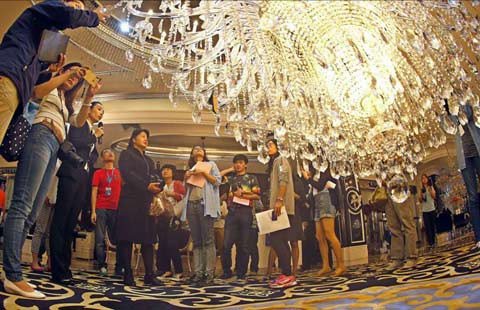
House sales in July, traditionally a slow season for the property industry, continued their rebound from June.
Experts said that if the sales boom raises prices significantly, the central government is likely to roll out policies to cool the market.
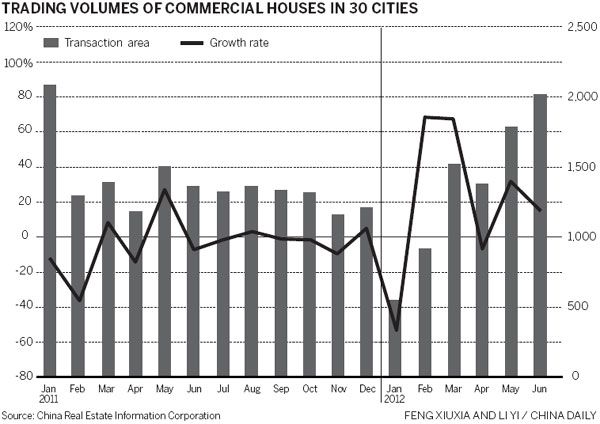
As of July 25, registered residential house sale nationally rose 6.9 percent over the same period in June, according to Centaline China Property Research. The research institution said house sales for all July may see a new monthly high this year.
First-tier cities, such as Beijing and Guangzhou, have seen a much faster recovery in house turnover. During the first three weeks of July, turnover in first-tier cities grew 29 percent compare to last year to hit 1.8 million square meters, while third-tier cities grew only 1 percent, according to Centaline. Second-tier cities posted a 37 percent growth, but in terms of turnover floor space, the growth was smaller than that of first-tier cities.
The sales rebound followed a buying spree in June.
House prices, especially in eastern cities, have stopped declining and started to rebound strongly. The average house price in eastern cities tracked by E-house China, a Shanghai-based property-research company, exceeded 13,000 yuan ($2,037) per sq m, a 6.6 percent rise over a month earlier and a 7.3 percent increase.
Zhang Tianwei, a 28-year-old employee of a Beijing technology company, has already felt the effects of the red-hot housing market.
Early this year, he spotted a project in Huilongguan, a Beijing suburb favored by the capital's average wage earners. In May, sales people told him a 90 sq m house there was 1.6 million yuan, but by July, the price had climbed to 1.9 million yuan.
Frustrated by the high price, Zhang decided to buy it anyway. But when the houses were open for sale last week, he found that there were 1,400 people waiting for the 430 houses, with the potential buyers to be decided by lottery. The few lucky winners got only three minutes to decide whether they wanted to buy a house.
"I knew the odds were slim, but I went there anyway, hoping that previously qualified people would quit," Zhang said. "It turned out that no one quit on the spot. It was crazy."
The price rebound has forced more people like Zhang to look for older houses. As a result, online registered used house sales hit 15,135 in July (as of July 28), a 26 percent rise over a month earlier, and a 76.4 percent surge compared with a year earlier.
Looming control?
The sales and price surges in some cities already have got the attention of the central government, which fears that some of its recent macroeconomic easing policies may have sent the wrong messages to the market.
To invigorate the flagging economy, China cut interest rates twice in a month. Some "fine-tuning" policies adopted by local governments have also fueled the expectation of further property market easing.
To quell those expectations, central authorities in the past 10 weeks have pledged to keep the curb policies firmly in place.
A more recent show of determination came last week, when the State Council said it has sent eight teams to 16 municipalities and provinces to inspect the implementation of housing policies.
"The central government is very likely to roll out new restrictions on the property market if two conditions are met: one, it feels the broad economy is bottoming out; two, house prices in July see a significant rebound," said He Tian, director of China Index Academy, a realty information service provider under Soufun.com, China's largest property website.
The new curb policies may involve expanding the multiple-house purchase limit, which has not been adopted in some cities; and toughening enforcement of the limit, including stricter verification of the house purchase qualification, according to He.
Some experts argued a more market-oriented approach. The Chinese Academy of Social Sciences in a recent report suggested expanding the number of cites that levy property taxes.
Currently, only two cities, Shanghai and Chongqing, have a property tax.
Hai Wen, a senior economist and vice-president of Peking University, on Monday also called on the government to promote the tax.
"What the government should do is not ask people not to buy houses, but reduce the number of empty houses (bought for investment, not being lived in). A property tax is the best way to realize this," he said.
zhengyangpeng@chinadaily.com.cn

Copyright 1995 - . All rights reserved. The content (including but not limited to text, photo, multimedia information, etc) published in this site belongs to China Daily Information Co (CDIC). Without written authorization from CDIC, such content shall not be republished or used in any form. Note: Browsers with 1024*768 or higher resolution are suggested for this site.
License for publishing multimedia online 0108263 Registration Number: 130349