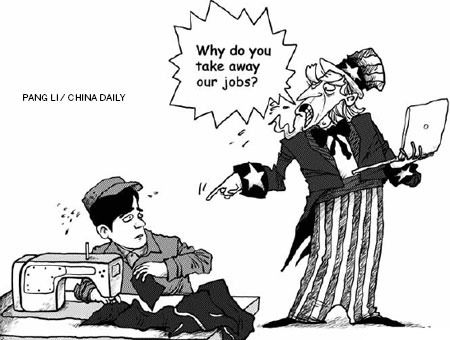
Who can create more jobs for Americans is the theme of the campaign battle for the November presidential election in the United States. With unemployment stuck at more than 8 percent and gloomy forecasts from the Organization for Economic Cooperation and Development and the International Monetary Fund, the challenge of how to create jobs in the US is a key one. Against this background much attention is being directed to the outsourcing of American jobs, especially if one candidate seems to be more directly associated with that activity.
However, is that such a shocking activity? I recall using the case study of one of the most iconic American brands, Levi's, 20 years ago to illustrate the importance of outsourcing used by the Strauss family management to turn that company around. Rising costs necessitated closing production in the US and outsourcing initially to Mexico and later beyond. China did not feature in that case study. But the main message was that the management skills saved and revived an important American brand.
Put more generally, where in a typical American multinational company's mission statement do the words "we strive to protect US jobs at all costs" appear? It is more likely for us to find "we aim to consistently provide a high return to our shareholders" and if that means switching employment between countries to increase profits, so be it. A clue is in the words "American multinational"; such companies have responsibilities toward their global workforce and, let's face it, the world needs jobs.
Travel back a couple of decades and you will see a graph of the supply source that resembles an hour glass fallen on its side when it comes to US industries like footwear and toys. The left axis would start showing sourced from China as low down and sourced from elsewhere outside then US (South Korea for example) high up, but as the years pass, China rises and the other sources fall. It is not so much outsourcing itself that has suddenly been discovered, but that so much of it has been aggregated in China in the last decade.
Is that change so bad? Are 5 million jobs outsourced a million each to five countries any less of a job loss than the whole 5 million outsourced to one? The primary advantage of one foreign country growing a higher income domestic market is that it provides opportunities for overseas domestic sales on a bigger scale than if dispersed across many countries, and thus an opportunity for American companies beyond the importing of goods to the US.
Do Americans want those low-wage basic jobs back now? Probably not, despite the idea that rising labor costs in China may make re-shoring possible. It is more likely that those jobs would be resourced to western China where labor costs are lower, or to Cambodia, Indonesia, Laos or Vietnam.
If we look far enough ahead, China and its neighbors will face the outsourcing pressure as their labor costs rise, and the Middle East and Africa could become the new home of low-cost historic manufacturing. All this means that the low-cost seeking job outsourcing is not the battle that US politicians should be looking to win.
The important battlefield will be the next generation of higher skilled, higher added-value jobs in the innovative and increasingly green industries. Solar power, wind turbines, alternative fuel vehicles, healthcare technological advances and other cutting edge areas are seen as the preserve of the advanced Western economies, especially the US with its high quality universities, support for research and development and tradition of thinking outside the box. They are the great hope of innovation driven industrial development.
But guess what? China wants those jobs too. We know China wants to move from the "made in China" to "created in China" stage and to raise the living standards of its people by getting them into higher skilled jobs. China already has taken a lead in solar and wind power and is the US' major competitor in new industries. If Americans are to have confidence in a future with plentiful well-paid jobs, their politicians need to start outlining how the US can compete for those jobs rather than how it can reclaim the old outsourced jobs.
Perhaps job outsourcing is not a good election topic, because it involves spending much more on American education, raising standards, getting more Americans familiar with international business, especially pertaining to China, and, yes, actually going for win-win cooperation with Chinese companies with money to jointly invest in new technologies in China and/or the US.
Maybe we have to wait till the US presidential election is over before the realities of partnership with China, as opposed to the pointless exercise of making China the scapegoat, will be seen as the right way of creating new jobs.
The author is an economist and director of China Programs at CAPA International Education, a US-UK based organization that cooperates with Capital Normal University and Shanghai International Studies University.
(China Daily 08/15/2012 page9)


Copyright 1995 - . All rights reserved. The content (including but not limited to text, photo, multimedia information, etc) published in this site belongs to China Daily Information Co (CDIC). Without written authorization from CDIC, such content shall not be republished or used in any form. Note: Browsers with 1024*768 or higher resolution are suggested for this site.
License for publishing multimedia online 0108263 Registration Number: 130349