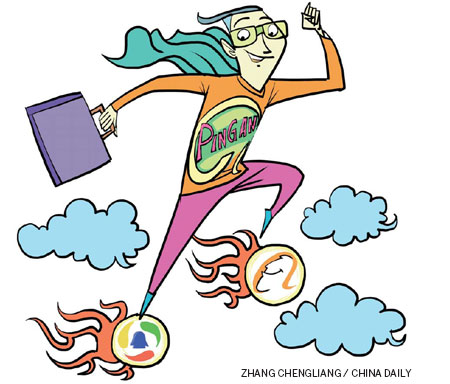
Bold joint internet venture needs to come up with a fresh, cool image
Ping An, the world's second-largest insurance company, has announced its intention to team up with the world's third-largest Internet company Tencent, and China's largest e-shopping search engine, Alibaba, to deliver Internet financial services. It is a bold and ambitious venture.
Online financial services such as e-banking are nothing new in the West. However, they do not involve any joint ventures between Internet service providers and established financial services organizations. The insurance industry has lagged behind other financial services in embracing the revolution in online communication.
Ping An's putative alliance with China's leading Internet companies represents a clear change in corporate strategy among Chinese companies and paves the way for much-needed international expansion. Only a few years ago such an alliance would have been highly unlikely.
Ping An's announcement also illustrates far more coherent strategic thinking and planning than is often associated with Chinese companies, especially the largest ones. Good management is often not so much about building on a company's strengths as about understanding weaknesses and limitations, and recognizing that in order to grow, an organization may need the help of others.
The insurance industry continues to suffer from a dull and boring image, especially with younger generations. Yet it is these generations who represent growth market opportunities.
Insurance services are also seen as "low-involvement" and "unsought" products, for which potential customers do not actively search and do not consider the "brand" important. Price and convenience are nearly always the sole consideration when deciding on an insurance service.
Tencent and Alibaba, therefore, will not only enable Ping An to reach hundreds of millions of younger potential customers, they should also allow Ping An to piggyback on the "exciting, fun and cool" image that both corporate online brands enjoy.
It would have been easy for Ping An to launch an online or e-insurance business and brand, in much the same way as most Western financial services firms have done. But this would have failed to reach, let alone connect with, China's younger and increasingly affluent urban consumers.
Instead, Ping An's association with the Tencent and Alibaba brand names and image should mark the beginning of a far more acceptable brand image for the insurance company, especially where younger generations are concerned.
However, what remains unclear is the way these organizations will fit together. Most joint ventures fail due to a clash of corporate cultures and management styles, but this may not be an obstacle here if there is little actual merging or collapsing of the organizations.
Clearly, Tencent and Alibaba provide reach to hundreds of millions of potential insurance customers, but how should Ping An present its product? Should they keep the same name and simply offer Ping An insurance via Tencent and Alibaba, or should they seek a new name or combination of names, as well as a new, more emotive brand image?
Key to financial services brand success will always be trust, which is often a derivative of "industry experience". So Ping An would be wise to retain some or all of its current corporate brand name and image.
Tencent and Alibaba have also realized that they alone could not succeed in the insurance business, or any part of the financial services industry, due to their lack of industry experience and an image associated with fun and excitement.
Any new name, especially one that does not resemble Ping An, will cause confusion, and a positive association will fail to bind in the consumer's mind. However, simply inserting the Ping An name on Tencent and Alibaba's websites may also fail to achieve sufficient association, giving the impression that this is the same old, tired, boring insurance brand.
Ping An clearly needs to build a different online insurance brand with a positive, emotional image. Simply using Tencent and Alibaba to sell a more efficient and cheaper insurance product will not achieve sustainable competitive advantage.
Brand association is key to such meaningful and emotional differentiation, which results from a combination of name, logo, color scheme and many other forms of emotional association and attachment within the consumer mindset.
While it is probably more sensible for Ping An to retain its name for this e-insurance joint venture, it is important that the look and layout of the name are not identical to the one appearing on its own website.
In order to benefit from Tencent and Alibaba's "cool, "young and fresh" image, Ping An should change the font used to present its corporate brand name on these websites, choosing something that is clearly different and resonates with younger generations, while still clearly recognizable as the established Ping An insurance brand.
A more "youthful" color or color scheme will also contribute to effective brand association. Across most cultures, "young", "fun" colors include yellows, oranges and light purples.
Even though the name, and subtle changes in its presentation and appearance, is vitally important for Ping An, it is equally crucial to have a new logo.
Because Ping An's name is instantly recognizable, it doesn't need to retain its current logo. Rather, it is free to explore ways to create a totally new one that will appear "cool" to Tencent and Alibaba's predominantly younger users.
Again, the color scheme needs to reflect a younger image, though it should not resemble too closely the one chosen for the new name.
Choosing a new logo gives Ping An the opportunity to be bold. Because the name will be prominent, it allows a logo to be devised that bears no resemblance to the current one and need not contain any lettering. The most successful emotive brands often develop this way, such as Nike's "swoosh" and Li Ning's "squirrel's tail". More serious, rational brands often rely on letters taken from the corporate brand name.
Here Ping An can follow the path of Nike and others with a fully emotive logo that is seen as "cool". Consumers remember and store pictures, not words. They also remember emotional experiences, expressions and gestures, more so than spoken words.
Finally, Ping An's new online brand building probably requires heavy public promotion by a successful Chinese sports star or entertainer. What better fit than one of China's recent Olympic gold medallists, such as the swimmer Sun Yang?
Further positioning of Ping An's online insurance brand may also require mass media advertising, perhaps with a touch of humor to resonate with the younger generation.
Ping An's joint venture with leading Internet companies could be a lead that many international insurance companies decide to follow.
The author is a researcher at Nottingham University's School of Contemporary Chinese Studies. The views do not necessarily reflect those of China Daily.
(China Daily 09/07/2012 page10)


Copyright 1995 - . All rights reserved. The content (including but not limited to text, photo, multimedia information, etc) published in this site belongs to China Daily Information Co (CDIC). Without written authorization from CDIC, such content shall not be republished or used in any form. Note: Browsers with 1024*768 or higher resolution are suggested for this site.
License for publishing multimedia online 0108263 Registration Number: 130349