Comments()
  Print
Print  Mail
Mail  Large Medium Small
Coach vantage
|
 |
|
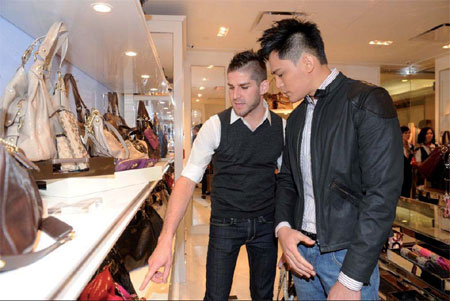
Coach Inc is one of the first companies to realize the perception of Chinese consumers and profit from its early moves. [Photo/China Daily] |
When people have higher purchasing power, it is natural for them to move up the economic ladder, says Gao Xudong, senior research fellow and vice-director of the Tsinghua University Research Center for Technological Innovation. "This is especially evident in the Chinese market," says Gao, former director of the MBA program at Tsinghua University.
"It is a rational choice for high-end brands to price higher in China," Gao says. "China is still a hierarchical society where people need brands to label their social status, and there is demand for every social class."
US leather goods maker Coach Inc was one of the first companies to realize the perception of Chinese customers and make hay from its early moves. Coach had 96 domestic retail locations in the Chinese mainland, Hong Kong and Macao as of June 30 this year and posted revenue growth in excess of 60 percent during its 2012 financial yearfrom July 2, 2011 to June 30, 2012.
The luxury goods maker says that there is a price disparity between the Chinese and US markets, but stresses that its products provide added customer values like essential luxury, status symbol and even a must-buy "local specialty", for those traveling to the US. Coach bags sell from upwards of 3,000 yuan ($475,366 euros) in China, whereas most of the bags in US outlets are priced under $300 (233 euros), or even in some cases under $100.
Jonathan Seliger, president and CEO of Coach China, says the price disparities also stem from unavoidable factors.
"In fact, price discrepancies exist in all countries for all brands," Seliger says. "There are many reasons for the price difference. This includes the cost of transportation, marketing and the opening and operation of stores."
In addition, he says: "We have been in the US for over 70 years and are the overwhelming No 1 brand there. This automatically allows for scale efficiencies. We do not yet have that in many international markets, including China."
Seliger is well aware of the purchasing agents and the queues of Chinese customers outside the Coach factory stores in the US. "We are happy to see increasing engagement with Chinese customers in both China and overseas markets," he says.
Seliger says the US company has a way to deal with this situation as it frequently updates the product lineup with new designs (almost every month). "So even those who fly frequently between China and the US may find it hard to find the very bag they are looking for in a Coach outlet," he says.
"As Coach offers monthly newness and products tailored for local markets, we believe the accessible pricing and local promotional initiatives are enough incentives to boost domestic consumption," Seliger says.
"We do not offer traditional products that last for 10 plus years like many other European brands."
At the same time, most of the Coach products in China are priced at about half the price of traditional European luxury brands.
"In terms of pricing, our products in each of the markets is priced 40-60 percent lower than most other European brands," he says. "Coach has always been positioned as an accessible luxury brand since its inception in 1941."
The unique positioning helps the US company differentiate itself from European brands which are at the top of the pyramid and target only a small group of exclusive customers, as well as the "mass market" brands that appeal to the general public.
"We work with the fast-growing middle class in China," he says. "We want to be selective but not exclusive."
According to analysts, the gift consumption tradition in China has also helped brands charge higher prices. More than 25 percent of the luxury products purchases in China are for gifts, says a recent report released by US consultancy firm Bain & Co.
Jeff Gong, director of Beijing Vogue Glamour Brand Marketing Inc, a brand consultancy, says there is a huge difference between Chinese and Western consumption behavior. "While the Europeans love to keep the good stuff for the family, Chinese people present it to guests or to others as a gift."
Dale Preston, managing director of retail measurement in China at market research firm Nielsen, says pricing varies depending on the sectors, but what people are ultimately after is "value for money", whether it is for self-use or as a gift.
"If you are a premium brand, give customers a good story and good history; while for products displayed on the shelf like a shampoo, tell them what the product can do for your hair, whether it can make your hair shinier. If the product can deliver what it promises, then the brand image will be solidified," he says.
Gao from Tsinghua University says Chinese people's penchant for high-end brands will last for some time, and hence the brands will enjoy a considerably long "golden period" in China.
"As the disparity between different social classes is huge, the social hierarchy won't disappear in a short time. So Chinese people will keep chasing after brands and those beloved brands will always remain on a high perch for a while," he says.

 Overdue loans pile pressure on lenders
 Japanese automakers face tough times in China
 Volvo plans expansion amid slowdown
Copyright 1995 - 2010 . All rights reserved. The content (including but not limited to text, photo, multimedia information, etc) published in this site belongs to China Daily Information Co (CDIC). Without written authorization from CDIC, such content shall not be republished or used in any form. Note: Browsers with 1024*768 or higher resolution are suggested for this site.
License for publishing multimedia online 0108263 Registration Number: 20100000002731