At home and in cafes, China is waking up and smelling the coffee
When Diego Panucci left home for his first trip to China in 2000, there was one very important thing he forgot in his weeks of preparation - his coffee maker. The young Italian, who came to study Chinese, was facing a year without caffeine as precious few coffee shops existed in China back then, when the growing middle classes had yet to begin developing a taste for arabica and robusta beans.
|
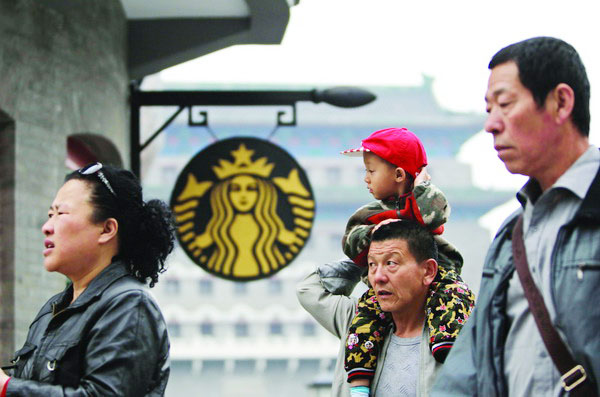 A Starbucks sign is seen in Qianmen, Beijing. The increasing interest of the Chinese consumers for coffee has created huge opportunities for coffee chains and equipment makers. [Photo / Agencies] |
"It was really killing me, and when I told the taxi driver to find a cafe, he didn't have the faintest idea what I was talking about," said Panucci, who can't begin a day without having his espresso. "I found instant coffee instead. It wasn't espresso but it was better than nothing."
But more than a decade later, with the strong forces of international companies such as Starbucks, Costa Coffee and Nestle laying the groundwork, change is brewing in China.
And Panucci no longer frets about his caffeine hits when he frequently visits the country through his job in event management.
From the proliferating coffee shops in the big cities to the coffee machines slowly infiltrating households, the home of tea is rapidly giving way to java, mocha, latte and the like.
In 2010, China's coffee consumption was estimated to be 25,000 tons, compared with more than one million tons of tea. But analysts from Barclays Capital forecast that the figure will grow by an average rate of almost 40 percent a year from 2011 to 2015.
"Average coffee consumption in China currently stands at a mere three cups per person per year, while that figure rises to 240 cups for the world's average," said Ji Ming, chief of the Beijing Coffee Industry Association. "Therefore, there's a lot of growth potential in China's coffee market."
Analysts cite Japan where love of tea runs just as deep as in China, but with promotion of coffee, its per capita annual coffee consumption has already hit 300 cups, well above the global average.
"With the current growth rate, it is only a matter of time before China zooms past Japan as the second-largest coffee consumer in the world," Ji said.
However, compared with Japan, coffee drinking in China is more about seeking a Western lifestyle or is a social trend for many young urbanites, rather than a habit.
"In China, coffee is more like a symbol of Western affluence, friendship and a bridge in connecting the people," said Raymond Tong, CEO of Pacific Coffee, the second-largest coffee chain in Hong Kong after Starbucks, and now owned by the State-backed China Resources Vanguard.
"More and more people are embracing the practice of meeting over coffee, and group networking at coffee shops to discuss business or simply for pleasure," he said.
Huang Long, the 38-year-old owner of an IT company in Beijing, said he doesn't drink coffee when he visits a coffee shop as he hasn't got used to its bitterness. But he comes to Starbucks at least four times a week to surf the Internet or meet with friends.
"I like the environment of the coffee house," he said. "It is a relaxing place to chat, hang out, and even to work.
"Besides, sitting around a coffee house with a mug in hand is just a new lifestyle affectation."


Copyright 1995 - . All rights reserved. The content (including but not limited to text, photo, multimedia information, etc) published in this site belongs to China Daily Information Co (CDIC). Without written authorization from CDIC, such content shall not be republished or used in any form. Note: Browsers with 1024*768 or higher resolution are suggested for this site.
License for publishing multimedia online 0108263 Registration Number: 130349