Comments()
  Print
Print  Mail
Mail  Large Medium Small
|
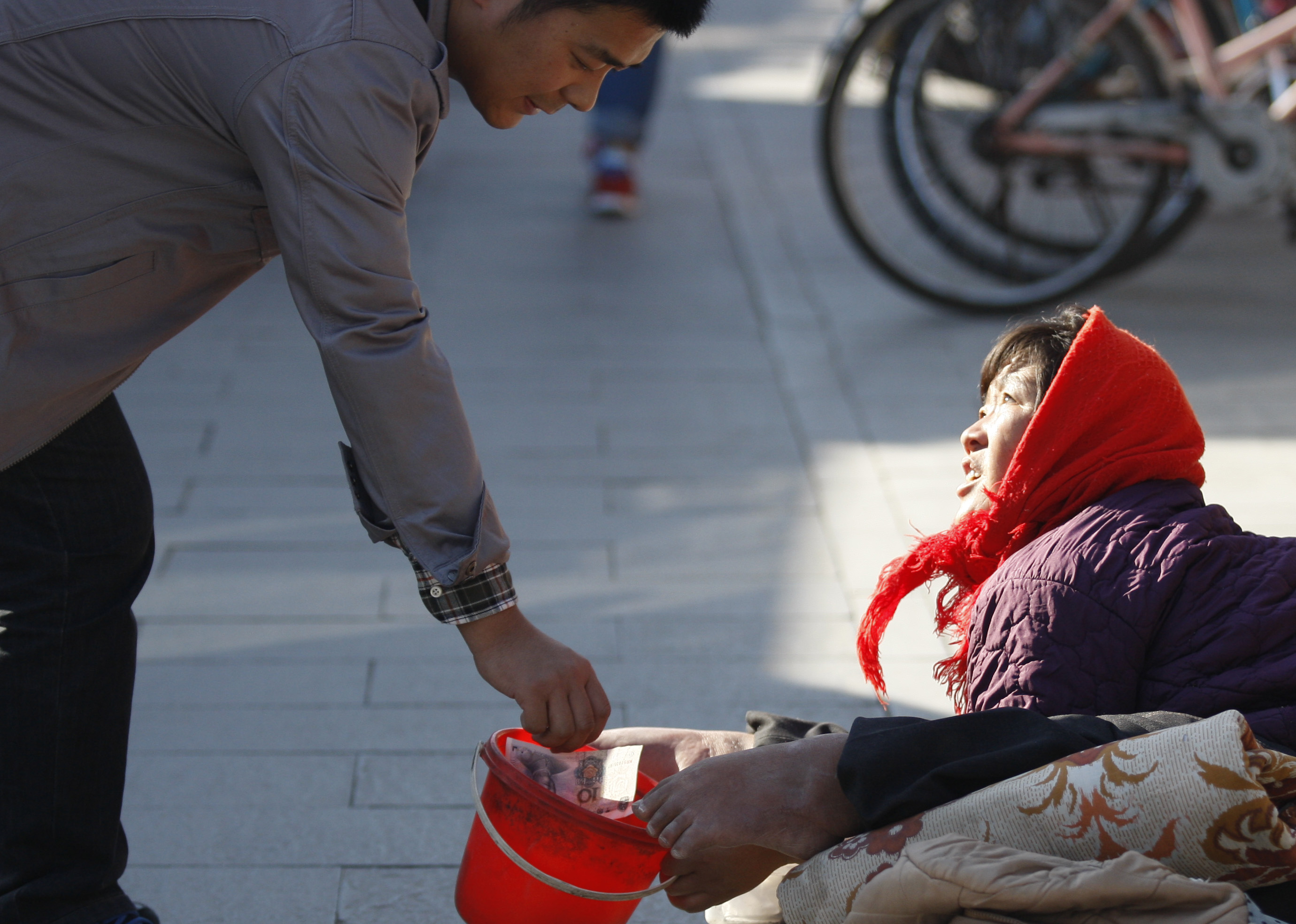
A resident gives cash to a beggar in downtown Beijing on Wednesday. China promised more funds and favorable policies for poverty-stricken populations on Wednesday, which marked the International Day for the Eradication of Poverty. [Photo/China Daily] |
The government has promised more funds and favorable policies for poverty-stricken populations after lifting around 250 million rural residents out of poverty over the past 30 years.
The country has also defined 11 regions, mainly the mountainous areas in the underdeveloped parts of China, as the key zones for poverty relief efforts.
"The Chinese government is pursuing a goal that is to sustain inclusive development and allow poor populations to enjoy equal opportunities to develop and better share the fruits of economic growth," said Vice-Premier Hui Liangyu when addressing a poverty reduction forum on Wednesday, which marked the International Day for the Eradication of Poverty.
The vice-premier said the Chinese government will allocate more funds and favorable policies to secure anti-poverty achievements and pull more people out of poverty.
About 12.7 percent of the rural population, or 122 million people, remain mired in poverty, earning less than 2,300 yuan ($370) annually, the poverty threshold set in 2011.
Fan Xiaojian, chief of the State Council's Poverty Alleviation Leading Group Office, who also attended the forum, said poverty reduction faces challenges.
"There are still a great number of people living under the poverty line and sometimes some people fall back into poverty again after being lifted out," he said. "The poverty reduction task is very arduous, especially in mountainous regions where poverty-stricken counties are concentrated."
The 11 regions include the Liupan Mountains in the Ningxia Hui autonomous region, the Wuling Mountains at the junction of Guizhou, Chongqing, Hubei and Hunan, and the Qinling-Bashan mountains.
"We will make those regions the major focus for poverty alleviation efforts and we will continue to boost their industrialization, informatization, urbanization and agricultural modernization," said Fan.
Fan said both central and provincial-level budgets will increase input into poverty-stricken areas and the government will give priority to those areas when arranging key State-level projects and industrial development.
Efforts will be made to help those areas fully use their resources and develop industries to increase farmers' income, he said. The government will also strive to improve infrastructure, a minimum living subsidy mechanism, education, healthcare and water safety in poor areas.
To alleviate poverty, Huang Chengwei, a researcher with Beijing-based International Poverty Reduction Center in China, suggests an improvement of the country's social security system.
Although the system has been basically established, it has yet to efficiently benefit the poor, he said.
"Currently, the poorer a place is the less social security benefits its people will enjoy. But those people are the ones who need such benefits the most," said Huang.
Huang called for more government funding for social security to make the system cover more people living in poverty.
In some Western and Northern European nations, 50 percent of the government budget is spent on social security and welfare. In the United States, the figure is around 30 percent, but in China, the proportion was just more than 16 percent in 2009, according to Huang.
Wang Sangui, an agriculture studies professor at Renmin University of China, said providing more job opportunities will be an efficient means to increase rural residents' income and help them get out of poverty.
"We still need to develop labor-intensive industries, especially in remote small cities and towns. That can help attract surplus rural laborers living in poverty to work in factories and raise their incomes," he said.
To raise the public's awareness about poverty, some media and social organizations called on the public to spend a day living off 6.3 yuan, or slightly over $1, on Wednesday.
The 6.3 yuan figure is the average daily income of Chinese farmers who just live on the poverty line.
Wang said spending 6.3 yuan a day will help people living in cities have a better understanding about poverty.
Contact the writer at chenxin1@chinadaily.com.cn.

 Toyota not to close China factories
 Audi: Local models, not price cuts, hold the key
 Overseas energy projects get green light
 Use of RMB as settlement currency rise
Copyright 1995 - 2010 . All rights reserved. The content (including but not limited to text, photo, multimedia information, etc) published in this site belongs to China Daily Information Co (CDIC). Without written authorization from CDIC, such content shall not be republished or used in any form. Note: Browsers with 1024*768 or higher resolution are suggested for this site.
License for publishing multimedia online 0108263 Registration Number: 20100000002731