Central bank's reverse repurchases to bolster confidence in economy
Worries about speculative capital inflows into China since the Federal Reserve's third round of quantitative easing, or QE3, have moderated, after China's central bank injected a single-day record amount of cash into the banking system on Tuesday.
The People's Bank of China, or PBOC, sank 395 billion yuan ($63 billion) into the market through seven- and 28-day reverse bond repurchase agreements.
The seven-day transaction of 290 billion yuan is at an interest rate of 3.35 percent, and the 28-day transaction of 105 billion yuan is at 3.6 percent, it said in an announcement posted on the central bank's official website.
"While the PBOC conducted a large amount of reverse repo operations last week, overall market liquidity appeared quite tight, as the amount of matured funds was much bigger," said the Australia and New Zealand Banking Group in a research note.
Liu Yuhui, director of the financial lab at the Chinese Academy of Social Sciences, said Tuesday's move dismissed market concerns of large amounts of capital flowing into China, which might have left the PBOC having to draw out liquidity, instead of injecting money.
"Instead of a capital inflow, the recent hike in the yuan against the dollar was mainly because the central bank didn't sell yuan and purchase foreign currency timely, when the demand for changing foreign currency into yuan by individuals and institutions had increased."
Liu added that although there was little evidence of "hot money" - the flow of funds or capital from one country to another, often to earn short-term profits on interest rate differences and changes - coming into the system, it was necessary for the PBOC to manage the market's expectations for the yuan, after its appreciation in recent days.
The central bank on Tuesday set the national currency's reference rate against the dollar at 0.06 percent lower at 6.3028 per dollar, weakening the mid-point for the first time in four days.
But the yuan still gained 0.05 percent to close at 6.2405 against the dollar.
It had touched 6.2398 earlier, close to Monday's high of 6.2371, the strongest level since the end of 1993 when the government unified the official and market exchanges.
The yuan has strengthened 0.7 percent in October, heading for a third straight monthly gain, according to data compiled by Bloomberg.
The China Securities Journal, the country's national securities newspaper, warned on Tuesday in a front-page commentary that the rapid appreciation of the yuan cannot be sustained and is likely to pose a threat to the country's financial system.
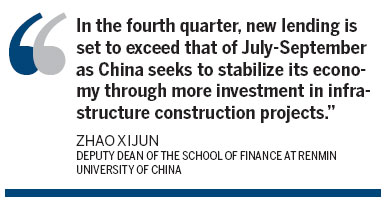
Zhao Xijun, deputy dean of the school of finance at Renmin University of China, said the main reason behind the central bank's reverse repo this time might be rising credit demand among commercial lenders, as economic growth gained momentum after it bottomed out in the third quarter.
"In the fourth quarter, new lending is set to exceed that of July-September as China seeks to stabilize its economy through more investment in infrastructure construction projects," he said.
However, he too warned that speculative capital inflows are likely to be a threat if the money flows into areas that are already overheating, leading to price surges, which would endanger the efforts being made by the authorities to loosen its stance and shore up the economy.
Pan Yingli, a professor at Shanghai Jiao Tong University, said: "China must adopt measures to curb any influx of 'hot money', which might increase inflation and further appreciate the yuan."
Meanwhile, a report from Citibank said that since the Federal Reserve confirmed QE3 in September - promising to flood financial markets with $40 billion of mortgage-backed securities per month and undertake additional purchases until the labor market improves substantially - large amounts of capital have been flowing from the United States to emerging markets. China has attracted 80 percent more capital since late September.
The Hong Kong dollar hit its strongest allowance level recently on the back of strong capital inflows, prompting the Hong Kong Monetary Authority to intervene by injecting more than HK$14 billion ($1.8 billion) into the market.
Thailand loosened its limits for domestic investors to make overseas investments last week to encourage capital outflows, while South Korea further lowered interest rates to narrow the space for risk-free arbitrage.
The US-based Institute of International Finance, the global association of financial institutions, has forecast that next year will witness the first increase in private capital flows to emerging economies since 2010, as economies such as the US, the European Union, Britain and Japan announce loosening measures, said a report released earlier this month.
Overall flows may reach $1.1 trillion, close to their 2010 level, but still around $200 billion below historic highs reached in 2007, it said, as a result of QE3.
"Global monetary policy settings are an important push factor for capital flows to emerging markets, because lower interest rates in advanced economies increase the relative returns earned on assets in emerging economies," said Philip Suttle, the institute's chief economist and deputy managing director.
"If the Fed purchases $1 billion of mortgage-backed securities, the previous owners of these assets will have to hold some other asset instead."
wangxiaotian@chinadaily.com.cn


Copyright 1995 - . All rights reserved. The content (including but not limited to text, photo, multimedia information, etc) published in this site belongs to China Daily Information Co (CDIC). Without written authorization from CDIC, such content shall not be republished or used in any form. Note: Browsers with 1024*768 or higher resolution are suggested for this site.
License for publishing multimedia online 0108263 Registration Number: 130349