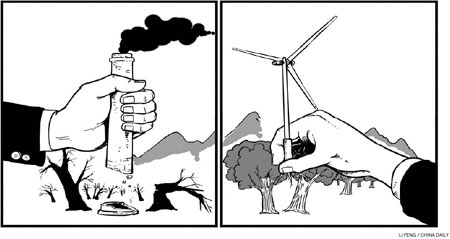
Many foreigners to China would be unable to say how this big country with the world's largest population has managed spectacular economic development for decades. What has led China, languishing in poverty for decades, to become the world's second largest economy with world-class infrastructure and an economic resilience that even the United States and the European Union envy?
If foreigners carefully read the speech delivered by the General Secretary of the Communist Party of China Hu Jintao at the opening ceremony of the 18th National Congress of the CPC on Nov 8, they may get the answer. "Socialism with Chinese characteristics" and its applications is the reason behind the unprecedented economic and social miracle that is China.
About 200 years after Adam Smith's "free market" theory launched colonialism and capitalism to rule the world, and more than a century after Karl Marx analyzed, appreciated, praised and then predicted the downfall of that theory, we have financial crises in the US and the EU. Only China's new development model - a socialist country with market economy - has been able to avoid such a crisis.
Despite that, Chinese leaders remain somber minded about their country's fast economic growth at the cost of cheap labor, environmental damage and over-exploitation of natural resources.
The term, "Scientific Outlook on Development", was written into the CPC Constitution during the 17th Party National Congress in 2007 and it will ensure that China's economic miracle continues in the coming decade.
What Chinese leaders realized after two decades of rapid development was that the Industrial Revolution model could not be wholly replicated in their country.
Because of their industrial process, Europe and America assumed that natural resources were free and inexhaustible. They were oblivious of the ecosystems that cleanse and maintain the planet. When resources depleted and pollution increased to alarming levels, the smoke stack industries moved, from Europe to the New World east coast to the Midwest to the west coast and finally to Asia. Don Henley of The Eagles got it right in the ambiguously titled Last Resort: "There is no new frontier, we have got to make it here".
The First Law of Thermodynamics says materials and energy cannot be produced, only transformed. The Second Law says only some parts can be transformed for the better (economic goods) but the net result is always, inviolably, an irreversible degradation of quality (environmental "bads"). This is obvious in a laboratory or a closed system like a spaceship. When economic processes were small compared to our world, it was okay to ignore or cheat and forget that we live on a materially finite planet.
As the last big space on Earth to develop, China needed to face up to scientific reality - that resources are limited and that pollution does not just "go up in smoke". Enunciating and striving for a "harmonious society" is an improvement on Keynesian acceptance of "disequilibrium". The result for China has been maintenance of 10 percent growth for the past decade and an unprecedented investment in new energies, clean production processes and modern infrastructure.
What is now increasingly evident is that our global economy and global environment are one and the same thing. The costs of production have nothing to do with some innate values in resources and commodities, but in the human costs of finding and processing them.
This perception can be termed the embodied human-used energy. (Stanford University researchers call this anthropogenic exergy). It is simply the Labor Theory of Value updated to be measured in joules, still a strange concept in Marx's time. A 1 kg ingot of copper seems like a "dead" inanimate object, but it embodies 2.1 megajoules of useful energy (approximately, depending on technology pathway) expended by humans. The production cost of all goods and services can be measured in embodied joules. What people, rich and poor, bid for them determines their price. But the costs are scientifically determinable.
Using this approach shines a whole new light on human economic activity and on the global community. And Scientific Outlook on Development fully stresses how important it is to keep development sustainable. The Industrial Revolution required taking more from the environment than all the dollar value of production boasted for in a nation's GDP. Now that we see a global environment, including global warming, and a global economy, including a global financial crisis, Scientific Outlook on Development will guide China to avoid repeating the developed countries' double crises of environment and economy.
Scientific Outlook on Development acknowledges the need for social consciousness (not "greed is good") and lays the foundation for society to go back to the subtle enjoyment of life, which looks beyond bland materialism and finds harmony in nature and communities - in short, a society with Chinese characteristics.
The author is an Australian researcher collaborating with Chinese academic and commercial institutions.


Copyright 1995 - . All rights reserved. The content (including but not limited to text, photo, multimedia information, etc) published in this site belongs to China Daily Information Co (CDIC). Without written authorization from CDIC, such content shall not be republished or used in any form. Note: Browsers with 1024*768 or higher resolution are suggested for this site.
License for publishing multimedia online 0108263 Registration Number: 130349