When bad weather keeps the workers confined to their shabby hut at the site, Zhao's smartphone provides entertainment, "For us, films and entertainment programs are good time-killers," he said.
Of course, there are times when he misses his family desperately, but the video function on his phone makes short work of the distance between Zhao and his home village in Henan province.
 |
|
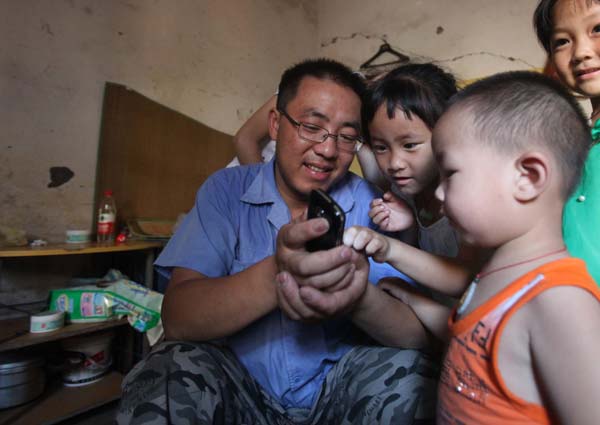
Bao Dayou, 34, a migrant worker from Anhui province, and his children play with his mobile phone at home. |
He has video chats with his family two or three times every week. Standing in the street and connecting with the Wi-Fi in a neighboring shop, Zhao talks to his wife "face to face", learns about recent events in the village and discusses the academic performance of their 6-year-old twins, a boy and a girl.
"The other day when I stood near the site, I had a video chat with them via my phone for almost half an hour. My wife sat on a chair and the kids stood on either side. They kept asking questions, like 'Dad, when are you coming home?' or 'Dad, we want birthday gifts'," said Zhao. The link helps to assuage his loneliness.
Back in 2010, before Zhao used a smartphone, family chats such as this only happened every couple of weeks. Sometimes contact was lost for longer if Zhao couldn't find an empty seat at a Internet bar, or his neighbor's computer was being used by someone else.
By the end of June, mobile Internet traffic in China had increased tenfold from the end of 2010, according to Wu Heshuan a member of the Chinese Academy of Engineering at a news conference for the release of a report on telecommunications in China.
Kuang said the migrant workers' lower educational background is no longer a communication barrier between them and the rest of society.
Although Zhao, whose formal education ended after middle school, has applied for jobs via his smartphone, he usually chats with strangers on a variety of Websites: "I never take it seriously, but it eases my loneliness," he said.
Still different
Around 230 million migrant workers across China benefit greatly from the improvements in life available through smarter handhelds, but experts said real change may be a long time coming.
A survey jointly conducted by Hong Kong Polytechnic University, the Chinese Academy of Social Sciences and Peking University in Beijing, shows that migrant workers didn't use high-end smartphones a few years ago. "You can't expect a small handset to change the world completely," said Shen Chonglin, a researcher at the Institute of Sociology at CASS, "and because making real, quantifiable change is not easy, the workers often engage in a mild form of escapism via the Internet".
"I feel I've caught up with the pace of development," said Ren Yanqiu, a 25-year-old migrant worker from Hunan province. "Since everyone has a smartphone now, I'd be embarrassed to take an ordinary one out of my pocket. Moreover, we migrant workers can afford smartphones now. Basically, all the young people around me have a high-quality smartphone." Ren bought a Samsung model for 2,000 yuan in Guangzhou in August.
However, mainstream society's view of migrant workers is unlikely to change anytime soon, according to Shen.
Tang Jianhua said discrimination against migrant workers is as strong as ever. "People still despise us, whether we are sitting in a restaurant or packed into a subway car like everyone else, I can feel it," she said.
A two-way understanding between society in general and the migrants is unlikely to be fully realized anytime soon, according to Kuang.
"I only posted a thread or two when I was in a bad mood, or I changed my 'profile'," said Ren Yanqiu, the middle-school dropout, who was born in 1987. He said that he makes sure his smartphone is close to hand whenever he's available to chat, but he rarely bothers about the social issues that generate heated discussion on micro blogs. In fact, very few of the migrant workers interviewed by China Daily displayed any interest in hot social topics because they don't feel fully integrated as members of society.
"They may be better referred to as 'floating workers', because their personal circumstances are quite unsettled," said Shen, the CASS researcher.
The younger generation, the most prominent consumers of developing mobile technology, are the group most likely to reap major benefits from societal changes over time.
"Even though they care little about significant political issues or events right now, they are deeply concerned about things that relate to themselves or members of their peer group," said Kuang. "Maybe their social interaction will become more prevalent as time passes and they begin to feel more integrated with mainstream society."
Contact the reporter at zhangyuchen@chinadaily.com.cn
Mo Jingxi, He Na and Jiang Xueqing contributed to this story.


Copyright 1995 - . All rights reserved. The content (including but not limited to text, photo, multimedia information, etc) published in this site belongs to China Daily Information Co (CDIC). Without written authorization from CDIC, such content shall not be republished or used in any form. Note: Browsers with 1024*768 or higher resolution are suggested for this site.
License for publishing multimedia online 0108263 Registration Number: 130349