Premier Wen Jiabao said on Monday China supports pushing forward an Asian free-trade area, which will cover 28 percent of world's total export volume.
Previous reports said China is expected to make announcements on Tuesday in Phnom Penh that it will join the talks for the Asian free-trade area, namely the Regional Comprehensive Economic Partnership, and join hands with Japan and South Korea to start trilateral negotiations on their own free trade area.
 |
|
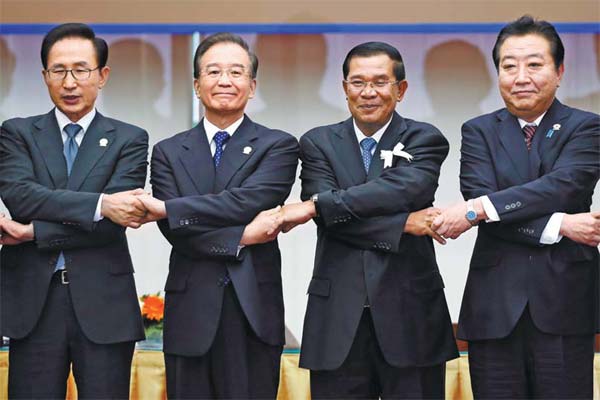
Premier Wen Jiabao, South Korean President Lee Myung-bak (left), Cambodia’s Prime Minister Hun Sen and Japan's Prime Minister Yoshihiko Noda (right) hold hands for a photo at the ASEAN Plus Three session of the 21st ASEAN and East Asia summits in Phnom Penh, Cambodia, on Monday. [Photo/Agencies]? |
The RCEP talks will help integrate ASEAN, which has been divided amid the progress of the US-led Trans-Pacific Partnership and elevated ASEAN's leading role in the region, experts said.
Wen said during the 15th ASEAN Plus Three Summit on Monday that "China supports pushing forward the Regional Comprehensive Economic Partnership".
The gathering involved the 10-member Association of Southeast Asian Nations as well as China, Japan and South Korea.
The RCEP is made up of 10 ASEAN countries plus China, Japan, South Korea, India, Australia and New Zealand.
Once built up, the RCEP will likely to cover half of the world's population and become the largest free trade area around the globe.
ASEAN has said it expects to start the talks at the beginning of next year and finish by the end of 2015.
Reports said that the RCEP grew out of a plan to launch trilateral trade talks between China, Japan and South Korea. Some ASEAN countries pushed for a wider deal.
Vice-Foreign Minister Fu Ying said earlier that the RCEP agreement, if reached, will give a strong impetus to the economic integrity of East Asia, as the initiative is expected to incorporate the economic power of 16 nations.
The objective of the RCEP is to attain a comprehensive and mutually beneficial economic partnership agreement that involves deeper engagement than the existing ASEAN FTAs.
"As the international financial crisis continues and trade and investment protectionism start to grow, regional economic integration has become the common choice of many countries," Fu said at a news conference last week.
It is widely believed that China's support for the RCEP is a reaction to US progress in forming the TPP that excludes China. Fu said that China has an open attitude toward any cooperation initiative that is conducive to economic integration and common prosperity.
"It is a reality that there are different paths of establishing free trade areas in the Asia Pacific region. And under current circumstances, we shall give full consideration to the differences in and diversity of the economic development in the region.
"We shall insist on principles of openness, inclusiveness and transparency to gradually push forward the economic integration in the Asia Pacific," she said.
Compared with the high standards of the TPP, the RCEP is more energetic and enables a more generous consideration of each state's needs, experts said.
ASEAN is actively pushing the RCEP as the TPP talks have divided ASEAN nations and weakened its leading role in regional cooperation, said Lu Jianren, an expert on ASEAN studies at the Chinese Academy of Social Sciences.
Brunei, Malaysia, Singapore and Vietnam have joined the TPP while some other ASEAN nations have expressed interest in it.
"The TPP is no good to the ASEAN integration, and the RCEP can be a counterbalance to it," Lu said.
Besides, the ASEAN also expects the RCEP to strengthen cohesion inside the bloc, which aims to finish building the ASEAN community by 2015 and elevate the bloc's status in the region, he added.
"But we have to be prepared that the RCEP talks will not be easy," Lu said, citing various levels of development in the region and the TPP, which provides an alternative.
China, Japan and South Korea will likely hold ministerial discussions on Tuesday in Cambodia, and are expected to reach an agreement on the launch of three-way free trade talks.
"I am optimistic that China, Japan and South Korea can reach a consensus to commence the three-way free trade talks. ... But I don't have a timetable for when they will conclude the negotiations," Foreign Ministry spokesman Qin Gang also told reporters on Sunday in Phnom Penh.
Because of the tensions, economists and trade officials had been pessimistic that the three-way FTA talks would start this year.
"Moreover, the tense ties between China and Japan are likely to force Japan to join the TPP rather than advancing the China-Japan-South Korea FTA," said Zhang Yunling, director of the division of international studies at the Chinese Academy of Social Sciences.
However, "after many years of preparation, the time is right for the three countries to start the three-way trade talks and then narrow their differences during negotiations", said Song Zhiyong, a researcher at the Chinese Academy of International Trade and Economic Cooperation, a Ministry of Commerce think tank.
Contact the writers at qinjize@chinadaily.com.cn, lixiaokun@chinadaily.com.cn and lijiabao@chinadaily.com.cn


Copyright 1995 - . All rights reserved. The content (including but not limited to text, photo, multimedia information, etc) published in this site belongs to China Daily Information Co (CDIC). Without written authorization from CDIC, such content shall not be republished or used in any form. Note: Browsers with 1024*768 or higher resolution are suggested for this site.
License for publishing multimedia online 0108263 Registration Number: 130349