Preciseness and patience were the most valuable lessons that Xu Jiakun received during his four-week training in Germany in November last year.
Xu, 40, a senior mechanician at Hangzhou Iron and Steel Group in East China's Zhejiang province, participated in an overseas training program that the province's labor authorities arranged for local skilled workers.
Xu does high-pressure pipe and furnace repair work so he received welding training at a technical training center in Berlin.
 |
Xu said in China, workers always begin welding when two metal plates are matched not too far off.
The training had taught him that in Germany, both managers and technicians pay closer attention to product quality and craftsmanship, and that there are very strict steps to follow when making every kind of product.
"In Germany, there are only two judgments of a product ― qualified and unqualified. But in many Chinese factories, products are tagged first grade, secondary grade and defective," he said. "German workers would even treat practices at the training phase as if they were at a real production line. Such preciseness and patience are what Chinese workers should learn from."
Sending workers abroad
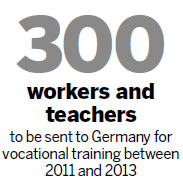
Zhejiang Provincial Human Resources and Social Security Department plans to send 300 skilled workers and vocational school teachers to receive overseas training between 2011 and 2013.
The bureau planned to send 100 workers to Germany and Italy to receive training in fields such as mold processing and mechanical and electronic device maintenance and repair.
In 2011, 95 workers, in four batches, participated in the program. Some went to Germany and received four weeks of training on mechatronics, welding and vehicle maintenance and repair; and the others received three weeks of training in the United States on animation design and production, according to the bureau.
"The provincial budget subsidizes a major part of the expense, and our aim is to let workers learn overseas advanced techniques and teaching methods, so as to help train more local highly skilled workers in accordance with the upgrading of industries," said an official with the department's Office of Vocational Skills Development, who requested anonymity.
The three-year program will cost the provincial government around 15 million yuan ($2.4 million), China Business News reported.
"Such a trial is good, and we encourage provinces and cities that have the conditions to carry out such overseas training programs to help raise more highly skilled workers, and it will do good to promote industrial upgrading," said Yin Chengji, spokesman for the Ministry of Human Resources and Social Security, on the sidelines of a news conference in October.
Zhejiang was home to about 6.5 million technicians by the end of 2011, with highly skilled workers accounting for only 18.7 percent, according to local labor authorities.
The province plans to make the number of highly skilled workers hit 2.3 million by 2020, according to its 2010-20 talent development plan.
Shortage of technicians
"In recent years, manufacturers in Zhejiang have found it difficult to recruit workers, especially skilled technicians. Apparently, the government has realized that," said Chen Shida, a researcher with an institute under the Zhejiang Provincial Human Resources and Social Security Department.
Chen estimated that the province has only about 50 percent of the highly skilled workers that it needs.
"We may have the world's most advanced facilities, but we are still not able to make first-class products because many of our workers are not skilled enough to efficiently run them," he said, "So we desperately need to improve workers' skills and make our industries transfer from investment-driven ones to more human capital driven."
In fact, the overseas training project Zhejiang is undergoing has made workers better understand the urgent need.
Impressed in Germany
Yan Jun, executive director of Berlin-based GFBM Akademie Vocational Training Group, the Zhejiang Provincial Human Resources and Social Security Department's German partner of the overseas training project, said they started to contact the department in 2010, and the training program was tailored with the province's labor market demand and talent development plan in mind.
"Workers will not only receive professional training at German enterprises' training centers or bases, they also have a chance to pay visits to Volkswagen's factories and see production lines and advanced technologies they use," she said.
Li Tingbin, 38, is a teacher who teaches auto and mechanical repairing at Zhejiang Highway Technicians College. Li went to Germany in February for training.
Li said what impressed him the most is the practical vocational education in the European country.
"In Germany, vocational-school students spend two-thirds of their time in internship at factories, and spend one-third of their time in classrooms. In China, 70 percent of the time is spent on learning theory," he said.
In Germany, vocational schools cooperate with enterprises closely and their courses are determined by requirements of work at enterprises, Li said. "Knowledge comes from practice, and that's what we should learn from."
Chen Yu, director of the China Institute for Occupation Research at Peking University, said that in fact, China introduced the vocational education mechanism from Germany about 20 years ago, but it's not been that successful.
Chen said Germany has written the school-enterprise cooperative way into laws, and the government budget shoulders some of the fees.
"Currently, in China, workers graduated from vocational schools do not well match with the needs of the labor market, and a majority of laborers in manufacturing are low-end ones who could only do simple and repetitive work," he said, "There is only one way to meet the country's massive need of highly skilled workers, and that is to more efficiently make schools and enterprises cooperate."
The government should create more favorable policies to help boost such cooperation, Chen said.


Copyright 1995 - . All rights reserved. The content (including but not limited to text, photo, multimedia information, etc) published in this site belongs to China Daily Information Co (CDIC). Without written authorization from CDIC, such content shall not be republished or used in any form. Note: Browsers with 1024*768 or higher resolution are suggested for this site.
License for publishing multimedia online 0108263 Registration Number: 130349