

 Comments
  Print
Print  Mail
Mail  Large Medium Small
|
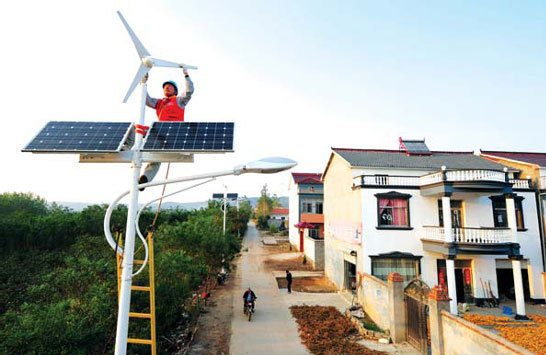
A worker maintains a solar-powered street lamp in Laian county of Anhui province. The county is developing more wind and solar energy. Xu Bin / For China Daily |
Yet China already the leader in hydro and solar energy
As the biggest producer and consumer of energy in the world, China faces many challenges. The pressure to ensure the supply of energy is increasing and so is the pressure to deal with the associated environment issues.
In response, the Chinese government has been calling for a transformation in the way energy is developed and adjusting the structure of related industries, especially the use of renewable resources.
Since 2005, China has promulgated a series of regulations to support the development of renewable energy, including the law on renewable energy. In the meantime, it has also established a development fund system and attracted investment from diversified sources which has helped speed up the development pace of the country's renewable energy industry.
In 2011, China's installed hydropower capacity reached 230 million kW, the top in the world. The nation's installed wind power capacity of 47 million kW was also the biggest globally. The country also achieved progress in the application of solar and geothermal energy.
Challenges ahead
Although the momentum is strong, the development of China's renewable energy industries is still at an early stage.
Among the myriad of challenges is the cost of renewable energy, which remains much higher than the conventional sources. Wind power costs 30 to 50 percent more than traditional fossil energy, and solar energy is much higher yet, some two to three times more.
Support for renewable energy industries will put more burden on the consumers and require more government subsidies.
Also, China's low-carbon energy technologies lag far behind developed countries, except in the use of solar heated water and methane. The technological disadvantage results in higher costs and less market acceptance.
Last but not least, China's geography makes it hard to develop new energies. Wind and solar power resources are rich in the west, yet the demand in those regions is not that big - instead the enormous demand is in the highly industrialized and populous east where resources are scarce.
Huge potential
Chinese government has set a target of 11.4 percent of non-fossil energy in total consumption by 2015 and 15 percent by 2020. It also pledged to lower the carbon dioxide emission per unit of GDP by 17 percent from 2010 to 2015, and further reduce it by 40 to 45 percent by 2020.
The potential for renewable energy remains huge. Currently, less than 30 percent of the water resources are used for generating electricity. Installed capacity of hydropower in China is expected to be 290 million kW in 2015.
Like hydropower, wind power is one of the renewable energies that has the best potential for large-scale use currently. By 2015, installed wind power capacity will surpass 100 million kW, among which 5 million will be from offshore wind farms.
The 2015 target for solar power is to have installed capacity of above 21 million kW. The country plans to build large-scale photovoltaic power stations on the sprawling western lands, while in the middle and eastern regions it plans to integrate photovoltaic power systems in buildings.
The government also plans to accelerate construction and upgrade of the electricity grid in rural areas.
A number of new energy facilities including solar power stations will be built in the remote farms and pastures. By 2015, the nation aims to have 200 demonstration counties for green energy and 1,000 demonstration villages for solar power.
Through vigorous development of new energy and renewable energy resources, the country is expected to increase its total usage of renewable energy equivalent to 478 million tons of standard coal by 2015. This means the reduction of 1 billion tons of carbon dioxide emission, a great contribution to environment protection and sustainable development of the country's economy.
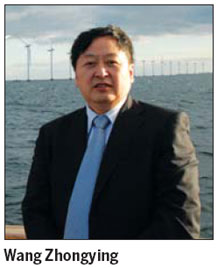
The authors are Wang Zhongying, deputy director general of the Energy Research Institute at the National Development and Reform Commission, and director of the China National Renewable Energy Center; Zhao Yongqiang, director assistant of the center, and Gao Hu, deputy director of the center.
 Top 10 Chinese internet companies
 Fun time for children at international toy expo in Beijing
 Huawei launches new smartphone P9 in Vietnam
 Top 10 box office movies on China market in H1
 Woman resigned from high salary job to make notebooks
 Hurun publishes Global Chinese Big Philanthropy Report 2016
 Top 10 new economy issues in China
 Wetland helps preserve ecology of Dianchi Lake

 Sports star Ivanovic, Schweinsteiger holds wedding in Venice
 Relive the glories and defeats in France-Germany rivalry
Copyright 1995 - . All rights reserved. The content (including but not limited to text, photo, multimedia information, etc) published in this site belongs to China Daily Information Co (CDIC). Without written authorization from CDIC, such content shall not be republished or used in any form. Note: Browsers with 1024*768 or higher resolution are suggested for this site.
License for publishing multimedia online 0108263 Registration Number: 20100000002731