Comments()
  Print
Print  Mail
Mail  Large Medium Small
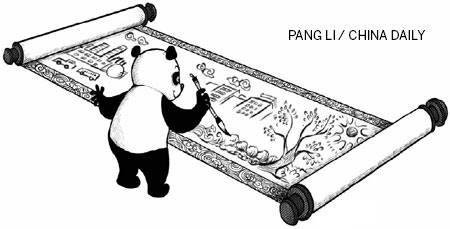
If China's success in the past 10 years is about considerably expanding the middle class, the next decade should be about making it feel happy, respected and secure. And a clean environment certainly counts big in the formula of happiness of the middle class.
This is probably what was implied by General Secretary of the Communist Party of China Hu Jintao's opening speech at the 18th CPC National Congress on Nov 8. Hu said we should "reverse the trend of ecological deterioration and build a beautiful China". Beautiful is the new green.
Under the leadership of Hu, China maintained an average annual economic growth rate of 10.7 percent from 2002 to 2011, the envy of most of the other major economies that are still suffering from the repercussions of the global financial crisis. During the same period, China's per capita GDP rose from $1,000 to $5,432. Also, under the current leadership, China surpassed Japan to become the world's second largest economy.
This is an achievement that deserves applause, just like the one Premier Wen Jiabao received when he unveiled these figures at the 2012 summer Davos summit. Observers are already saying China has reached a tipping point where a large number of people will enter the middle class. According to the Brookings Institute, by 2021 China will have 670 million middle class consumers.
Rising affluence is often accompanied by rising environmental awareness. As has been seen in other parts of the world, when income level hits a certain threshold, mounting public pressure drives down the emission of pollutants. This is already happening in China. Beijing residents' campaign to reduce PM2.5, particulate matters largely responsible for the city's hazy air, is just one example.
With rising income, people become less satisfied with promises of top-down clean-up actions. They also want to be part of the process that gives them clear skies. For the newly emerged middle class, the integrity of procedures, such as information disclosure rules, access to courts and the right to participate in the decision-making process, is as important as the end results. This is a system that not only delivers environmental benefits that the middle class wants, but also speaks directly to middle class values.
Does this mean that the economy has to be "sacrificed" to accommodate these needs? Will the fact that industries will have to increasingly negotiate their way into a middle class community increase their costs? I would argue that in the long run, a stable and secure middle class would only benefit the economy.
Demands of the middle class, if addressed properly, will help accelerate the much needed structural change of the Chinese economy, which is heavily reliant on investment (often in resource-intensive industries) and exports for growth. The service industries and high-tech sectors will certainly gain ground and have the potential to become China's next growth engines.
But this is not to assume that the environment will automatically improve after the needs of the middle class are met. Affluence does also bring about a lifestyle that may result in higher per capita greenhouse gas emissions or more wasteful consumptions. The emergence of "fast fashion", for example, results in an even shorter life span of textile products, which end up at an alarmingly increasing frequency in landfills as garbage. In Shanghai alone, 130,000 tons of clothing is discarded every year. So technology innovations and better manufacturing practices are needed to reduce the environmental footprint of consumer goods throughout their life cycle. And obviously, the government has an important role to play in this aspect.
It is therefore encouraging to find in Hu's address to the 18th Party Congress indications that the top leadership is committed to setting up a full range of conservation mechanisms, including the integration of resource and environmental indicators into economic development appraisal systems and reforming the pricing and taxation systems for resource products.
For sure, when it comes to promulgation of environmental policies, China has a distinct advantage over its Western counterparts. There is no "entrenched opposition" to the environmental agenda in China, something which decades of highly polarized debates have created in countries like the United States.
This broad consensus is an opportunity that the new leadership should harness when it embarks on a great journey to build a country that is not only beautiful, but also full of happy, energetic and healthy people.
The author is head of Toxics Campaign of Greenpeace East Asia.
 Kiwi cows arrive in Ningxia
 Harbin Int'l Ice and Snow Festival kicks off
 Overseas yuan gets nod in mainland PE market
 World's largest spokeless Ferris wheel under construction
 Blazing a trail in the workplace
 Antique car investment set to boom in China
 Super sports car makers to ignite passions on the mainland
 Wanda Group ventures onto the global stage
Copyright 1995 - 2010 . All rights reserved. The content (including but not limited to text, photo, multimedia information, etc) published in this site belongs to China Daily Information Co (CDIC). Without written authorization from CDIC, such content shall not be republished or used in any form. Note: Browsers with 1024*768 or higher resolution are suggested for this site.
License for publishing multimedia online 0108263 Registration Number: 20100000002731