Comments
  Print
Print  Mail
Mail  Large Medium Small

China needs to come up with new ideas to advance as population grows older
China is in danger of losing its title as the world's factory. The threat does not seem to be coming from the West through higher productivity and more innovation from the United States and Europe, but from China itself. The threat is nothing else but China's demographic time bomb.
China's "demographic dividend", the availability of a young workforce, is starting to erode. The overall population is starting to grow faster than that of working age. Currently, 8.2 percent of China's total population is over 65, compared with 13 percent in the US. By 2050, that number will be 26 percent for China, higher than in the US.
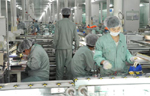
As China's inexpensive and young labor force is quickly disappearing, many multinational companies have to rethink their manufacturing strategy in China.
"There's no doubt China will be old before it is rich," according to Cai Fang, director of the Chinese Institute of Population and Labor Economics of the Chinese Academy of Social Sciences.
It will take only nine years for China to make the transition from when the supply of cheap agricultural labor for city factories started to decline in 2004, to the point this year where the non-working-age population is growing as fast as the working-age population.
The same demographic shift took 30 years in Japan and 40 years in South Korea. Chinese demographics show similarities to those of Japan 20 years ago. However, Japan was already a very wealthy country (with per capita income exceeding that of most other Western nations) when its demographic problems exploded. China's per capita income is currently well below those of the West, which makes the transition much more challenging.
China's ageing problem is mainly due to the family planning policy, which based on estimates, has prevented more than 400 million births since coming into effect in 1979. The country's working-age population grew from 66 percent of total population in 1990 to 72 percent in 2010.
Over the past 30 years, China's fertility rate went from 2.6 to 1.56 children. Modifying the family planning policy would probably not make a big difference in the next decade or so. Chinese couples have small families mainly because children are expensive. Shanghai's fertility of just 0.6 is probably the lowest in the world.
Known as the "4-2-1 phenomenon", young couples, most likely without siblings, will have to take care of four parents and will have only one child. The wise thing to do is to start saving for the future, but that goes against the government's efforts to shift the economy toward more consumption.
China set up a national pension fund in 2000, but the system is already in trouble, as the country's unfunded pension liability is about 150 percent of the country's GDP. The official age of 60 for men and 50 for women (55 for civil servants) has not changed since 1951, when average life expectancy was 46 compared with today's 73. An increase in the retirement age is unavoidable.
Despite a surplus of underemployed people in its countryside, China already faces labor shortages. According to Manpower, a business-recruitment firm, by 2030 China will be importing workers from other countries. The Chinese government's latest five-year plan (2011-15) calls for wage increases averaging 13 percent annually, much higher than the target for GDP growth.
As a result, in some low-tech, labor-intensive industries, multinationals are employing a "China Plus One" strategy, opening factories in another country, such as Thailand, Vietnam or Bangladesh. Companies are also shifting inland from the east coast of China, where the industrial clusters exist. The reasons are cheaper labor costs and growing demand in inland China.
While some manufacturers are moving out of China, others are increasing their level of automation to compensate for the lack of cheap, available workforce. Chinese carmaker Great Wall is using robots to make its car frames. Foxconn has announced that it will install a million robots in its Chinese factories in the next two years.
According to Deloitte's Global Manufacturing Competitiveness Index 2013 Report, "multinational companies recognize that making sourcing decisions in order to simply gain access to low-cost labor ... is neither a strategic benefit nor a sustainable strategy over the long term. Moreover, lower cost destinations like China ... now have large middle-class populations and significant domestic consumer demand. Hoping to seize these growth opportunities, many multinational companies are expected to continue to expand and grow operations in these markets."
The car market is a great example of that. Audi plans to expand its production in China to 700,000 vehicles annually in the next five years, from 300,000 currently. Mercedes-Benz will open a new engine plant in China this year to supply locally produced Mercedes-Benz passenger cars and vans.
China still has several more years before the economic impact of an ageing population becomes apparent. China's Commerce Minister, Chen Deming, said in March 2010 that the country could still enjoy another decade of "demographic dividends". There is a workforce surplus of about 80 to 100 million in the countryside. Also, we must not neglect the potential productivity gains from education, technology and innovation.
Innovation is indeed crucial to China's manufacturing future. The biggest challenge for Chinese manufacturing and for the country's economy overall is to manage the transition to an innovation-led, knowledge-creating economy. The government's recent five-year plan acknowledges this task. The country's leaders are trying to accelerate the transition from a low-cost manufacturing powerhouse to an innovation engine - as signaled by the government's increased spending on research and development.
Also, we must not forget that China is not the only country facing these problems. All developed Western countries are facing rising pension costs.
China's demographic problem will most likely result in higher taxes in the future in order to fund its welfare system.
It seems highly unlikely that China will stop being the world's factory any time soon. On the other hand, it is certain that its population problem will contribute to the slowdown of its economic growth.
The author is a professor at the China Europe International Business School. The views do not necessarily reflect those of China Daily.
 'Cat model' to dazzle Shanghai auto show 2013
 Models at Tokyo modified car show
 Shanghai Fashion Week focuses on domestic brands
 Angel-dress models at Shandong auto show
 Safe and Sound
 Theater firms scramble for managers
 Premier pledges closer ties with Brunei
 Volkswagen's all-new GTI at New York auto show
Copyright 1995 - 2010 . All rights reserved. The content (including but not limited to text, photo, multimedia information, etc) published in this site belongs to China Daily Information Co (CDIC). Without written authorization from CDIC, such content shall not be republished or used in any form. Note: Browsers with 1024*768 or higher resolution are suggested for this site.
License for publishing multimedia online 0108263 Registration Number: 20100000002731