China's central bank on Friday reiterated its "prudent" monetary stance for 2013 while pledging to strengthen financial reform and avoid risks amid rising inflationary pressures.
The central bank will maintain consistency and stability in its policies, while helping credit supply and total social financing grow steadily, the People's Bank of China said in a statement published on its official website.
The statement was released at the end of the central bank's annual work conference, which set the policy tone for 2013.
The PBOC's focus this year will also be on containing financial risks and promoting reform of the financial system.
"We will strengthen monitoring over financial risks and firmly hold the bottom line of no systemic and regional risks," the PBOC said in the statement, adding that it will enhance supervision over non-financial institutions of funding capability, and accelerate establishment of a deposit insurance system.
But analysts said that as the central bank set lower-than-expected growth targets for monetary supply while more investment projects need capital backup this year, the unavoidable rising dependence on non-bank financing, such as trust loans and bond sales, might pose greater risks for the economy.
The conference set a new yuan-lending target throughout 2013 at 8.5 trillion yuan ($1.37 trillion), while M2 — a broad measure of money supply that covers cash in circulation and all deposits — is targeted to grow by 13 percent year-on-year, the Beijing-based China Securities Journal reported on Friday, citing anonymous sources.
In 2012, when economic growth slowed for the seventh consecutive quarter, new yuan lending stood at 8.2 trillion yuan with a M2 year-on-year increase of 13.8 percent.
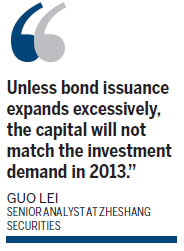
"If the 8.5 trillion yuan plan is strictly implemented, unless bond issuance expands excessively, the capital will not match the investment demand in 2013," said Guo Lei, senior analyst at Zheshang Securities.
The ideal scenario for this year would be making monetary policy more flexible, such as lowering the reserve requirement for commercial lenders in a timely way, added Liu Yuhui, director of the financial lab at the Chinese Academy of Social Sciences.
Chang Jian, China economist with Barclays Bank, said the PBOC's prudence in 2013 is related to its expectation of lower potential growth in China and concern about medium-term inflation and asset-bubble risks.
Part of the PBOC's caution on monetary easing is also likely related to the rapid expansion in non-bank financing in the second half of last year, she said.
The strong total financing, which includes loans, bond issuance and stock sales, would provide some comfort with regard to the growth recovery, but risks are piling up, Chang said.
"In 2013, improved government regulation and supervision could lead to some decline in non-bank financing, which in turn would require appropriate functioning of the banking system to ensure appropriate financing," she said.
Wang Tao, head of China economic research at UBS Securities, said increasing dependence on non-bank financing suggested that new yuan loans and M2 data can no longer reflect the real monetary and credit condition in the system.
"This year total social financing might exceed 16 trillion yuan, with the outstanding amount up by 17 percent year-on-year, which could support a GDP growth of more than 8 percent," she said.
To provide enough financing supply and contain risks, developing more fixed-income products in the securities market might be a good choice for the government, as over-rapid expansion of debts usually leads to economic crises, Wang said.
Louis Kuijs, chief China economist at the Royal Bank of Scotland Group, said the desire to support growth will continue to influence monetary policymaking in 2013, but in the specific case of interest rates, a key consideration for policymakers is to ensure that, with inflation rising, the real deposit rate does not fall too much.
"This is especially so amid a move of savings out of bank deposits into wealth management products that offer higher rates of return," he said.
Contact the writer at wangxiaotian@chinadaily.com.cn


Copyright 1995 - . All rights reserved. The content (including but not limited to text, photo, multimedia information, etc) published in this site belongs to China Daily Information Co (CDIC). Without written authorization from CDIC, such content shall not be republished or used in any form. Note: Browsers with 1024*768 or higher resolution are suggested for this site.
License for publishing multimedia online 0108263 Registration Number: 130349