China banks on blue economy to build sustainable, strong maritime future
"A strong nation faces the sea while a weak one turns its back on it," is how Lin Zexu described Britain's victory and China's defeat in the First Opium War (1839-42).
Lin, a Chinese scholar and Qing Dynasty (1644-1911) official then, was well known for his crusade against opium smuggling in Guangzhou. His confiscation of more than 20,000 chests of opium and their destruction is believed to have been the trigger for the First Opium War.
China's ocean dreams date back to the Ming Dynasty (1368-1644) and the seven voyages led by Admiral Zheng He in the early 1400s. The high point of Zheng's voyages was when he reached the coast of east Africa, a maritime milestone in China's history.
But sadly, the momentum pursued by Zheng was not maintained by his successors, and China remained completely shut to the rest of the world until its defeat in the Opium War.
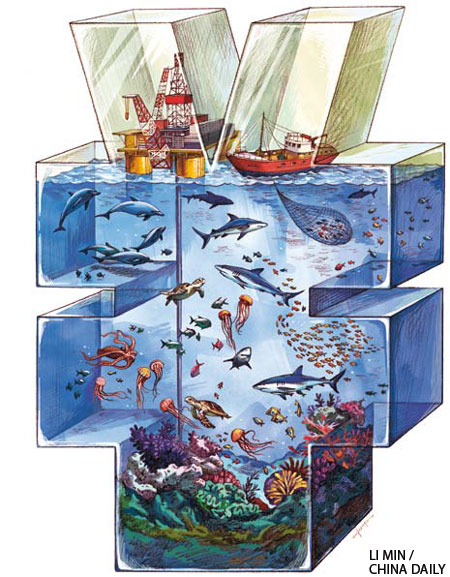
Two centuries later, Lin's words seem more than relevant, as China's blue economy is not only giving a new impetus to the marine and fisheries sector, but also providing the blueprint for China's sustainable development in the future.
With the global financial crisis showing no signs of receding and the vulnerable economic climate putting further strain on sustainable development plans, policymakers have come to realize that the blue economy, while opening up new avenues of growth and employment, also has answers for how natural resources can be used in an efficient and environmentally friendly manner.
The importance of the maritime sector can be gauged in the keynote address of President Hu Jintao during the 18th National Congress of the Communist Party of China in November. Hu pledged that China would enhance its capacity for exploiting marine resources, develop the marine economy, protect the marine ecological environment, and "resolutely" safeguard China's maritime rights and interests.
His statement represents the broad policy consensus among the Party leadership on the course of China's future development, and the importance of China being a maritime power.
More importantly, what this also means is that the more than 3 million square kilometers of marine area in China is poised to play an increasingly important role in the nation's economic future.
In line with these objectives, policymakers have envisaged that China's marine output will account for 10 percent of GDP by 2015, which, given current growth, is estimated to reach 6.5 trillion yuan ($1.04 trillion; 800 billion euros) by then.
The State Council, or China's cabinet, in October cleared zoning plans for eight major coastal regions during the 2011-20 period. Maritime zoning will provide a workable basis for the effective protection of China's ocean environment, as well as for the rational exploitation of related resources.
The gross output value of the marine economy reached more than 4.55 trillion yuan in 2011, up 10.4 percent year on year, according to the State Oceanic Administration.
The numbers indicate that the marine economy accounted for 9.7 percent of the country's total annual GDP in 2011, up from 3.8 percent in 1993, according to SOA statistics.
Though the numbers provide a sense of comfort, there are still several challenges before China can transform into a formidable maritime power, an SOA spokesperson says.
"The marine economy is mostly external in nature and as such affected by the international economic situation. China's marine economic growth has slowed due to the global economic crisis, and low domestic demand," the spokesperson says.
Slowing exports is another challenge for the industry and something that could hit marine economy growth rates this year, the spokesperson says.
"We are a big marine power, but not yet a strong one. A key reason for this is that we are still relatively weak in technological innovation. Technology contributes to about 30 percent of the whole marine economy in China, compared to 70 or 80 percent in some developed countries," the spokesperson says.
"We are a big marine power, but not yet a strong one. A key reason for this is that we are still relatively weak in technological innovation. Technology contributes to about 30 percent of the whole marine economy in China, compared with 70 or 80 percent in some developed countries," the spokesperson says.


Copyright 1995 - . All rights reserved. The content (including but not limited to text, photo, multimedia information, etc) published in this site belongs to China Daily Information Co (CDIC). Without written authorization from CDIC, such content shall not be republished or used in any form. Note: Browsers with 1024*768 or higher resolution are suggested for this site.
License for publishing multimedia online 0108263 Registration Number: 130349