|
 |
|
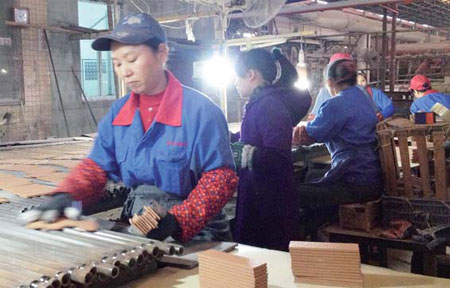
The workshop of Hengda Ceramics Co Ltd in Jinjiang, Fujian province. The company listed on the Nasdaq in 2010. [Photo/ China Daily] |
Crossing downtown Jin-jiang, in Fujian province, and passing by the headquarters of Hengan International Group Co, two similar names catch the eye.
Two advertising slogans for two architectural ceramics makers are both printed on a billboard on the main road of Anhai town. It's little wonder why the billboard cleverly combines ads from the two different companies: Each is owned by brothers: Huang Jiadong (Hengda) and Huang Jiazun (Tengda). Each has developed into the most well-known manufacturers in the region, specializing in the ceramic tiles for exterior walls.
But three years ago, Hengda went one step further. In November 2010, Hengda listed its shares on the Nasdaq under the name China Ceramics Co Ltd. It has since January of that year been traded on the Over-the-Counter Bulletin Board in the United States.
Hengda did not take the usual path of going public by putting out an initial public offering and the way forward is still fraught with challenges as China puts forward tough policies for the real estate industry, says Su Weifeng, director of Hengda. "We know that it is difficult for a small business like us to become listed on the A-share market. As the threshold in the United States is lower and our partners recommended US to us, we finally made the decision (to secure a listing on the Nasdaq)," Su says.
As China clamps down on the real estate sector, fewer construction projects will be approved, meaning less business for both ceramics makers. The switch from the OTCBB to Nasdaq wasn't easy because the OTCBB has no assets and no revenue requirements. Many small companies go public first on the OTCBB, which has many penny stocks that are offered from companies with bad credit records, and then move up to the Nasdaq later.
In going public, the company benefited greatly in terms of internal controls over financial reporting, business growth and improving profit margins. Revenue for the second quarter that ended June 30, 2012, was 441 million yuan ($69.5 million; 52.96 million euros), up 18.5 percent from 372.3 million yuan for the same period in 2011.
The increase in revenue was primarily driven by a 19.9 percent increase in the average price of ceramic tiles to 32.5 yuan per square meter in the second quarter of 2012 (from 27.1 yuan per sq meter in the same period of 2011) and an increase in sales of Hengda' higher-priced rustic series of ceramic tiles, according to the company's financial report.
The high-end products are mainly produced by the Hengdali production facility in Jiangxi province, which was acquired in January 2010 and has an annual capacity of 30 million sq meters as of 2012.
"The company invested most of the money from the stock market to expand the factory in Jiangxi," says Su, who claims that productivity at the factory has increased 90 percent from 2010.
Administrative expenses for the same period were 7.1 million yuan, down 26 percent from 9.6 million yuan in the second quarter of 2011.
But the company's overseas market, which Su says accounts for 5 percent of its total sales, has been stagnant over the past two years.
"I think the IPO has helped us in building the brand in the international market," Su says.
And as the Chinese economy slows, the company is looking for ways to improve. In one of the company's recent workshops, located next to the company's exhibition and sales room, two of three product factory lines were humming in the warm winter of South China.
"We are still learning how to save costs, improve management and expand sales channels," Su says.
The company director points out that most of the local companies in Jinjiang are family-owned, where the line between ownership and management is often blurred. But at Hengda, Su says it has strict supervisors in the capital market, which has been beneficial for the long-term growth.
Contact the writers at yaojing@chinadaily.com.cn and humeidong@chinadaily.com.cn


Copyright 1995 - . All rights reserved. The content (including but not limited to text, photo, multimedia information, etc) published in this site belongs to China Daily Information Co (CDIC). Without written authorization from CDIC, such content shall not be republished or used in any form. Note: Browsers with 1024*768 or higher resolution are suggested for this site.
License for publishing multimedia online 0108263 Registration Number: 130349