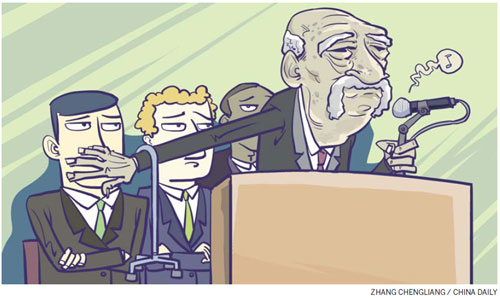
As the World Economic Forum gathers in Davos, it becomes clear that advanced countries prefer the status quo
Each year late in January the World Economic Forum brings together leaders from business, government, academia and the media at its headquarters in Davos, Switzerland, to meet and engage in five days' of lectures and discussions about issues of global importance.
Each meeting has a theme aimed at capturing important current events. Since 2008, when the US financial crash changed the way the world works, the themes have related to key aspects of the post-crash landscape. January 2009's conference was billed "Shaping the post-crisis world", and in 2010, it was "Improve the state of the world: rethink, redesign, rebuild". In 2011 "Shared norms for the new reality" signaled acceptance of the new global balance of power. Last year's theme was "The great transformation: shaping new models".
This year's theme, "Resilient dynamism", suggests that perhaps the encouragements of previous years, to "shape", "rethink", "rebuild" and "transform" have not had as much impact as was hoped. This year's call for resilience to endure and overcome continued economic difficulty in developed countries suggests a hint of desperation, and "dynamism" joins the other words of encouragement from Davos in the recent past, such as "reshape" and "transform". After four years in which the expected global economic recovery has failed to materialize, perhaps the World Economic Forum is running out of ideas. If so, what does that say about the world in which we now live?
The most important global issue today is how to manage the transition from an old world controlled by the so-called developed economies to the new multilateral world in which it is clear that China, with other emerging countries such as Brazil and India, is already playing a leading role. The forum's problem in dealing with the key issue of a changing, post-crisis world stems from the fact that it is controlled by the 35 so-called advanced countries that are gradually losing their influence over the global economy.
The following economic statistics from the International Monetary Fund tell the story of the developed world's declining economic power. In 2002, as a proportion of the world economy measured in current dollars, the US accounted for 32 percent, and the advanced countries for 80 percent. Using the same measurement, by 2012 the US share of world economic output had fallen to 22 percent, and the advanced countries' share had fallen to 62 percent, while developing Asia's share had risen from 8 percent to 18 percent. Within Asia, China's share of global GDP rose from 5 percent to 12 percent over the decade, and global economic output grew from $33 billion to $71 billion (53 billion euros). Obviously, this more than doubling of global GDP has been due largely to the economic growth generated by countries that a decade ago were not an important part of the global financial system, and were therefore not much affected by the US financial crash of 2008.
The IMF projects that by 2017 the advanced countries will account for 56 percent of world GDP, measured in current dollars. Adjusted for different countries' purchasing power, the share of advanced countries is 46 percent. In other words, using the standard measure of purchasing power parity, in five years' time the contribution to world economic output of the advanced countries will be less than half.
But despite these big underlying changes in the way the world works, the West, led by the US, still controls the main institutions that set the global agenda. When the top jobs at the IMF and the World Bank came up for renewal last year and in 2011, once again the candidates were chosen by horse-trading between the US and Europe. In return for supporting the candidature of the French businesswoman-turned-bureaucrat Christine Lagarde to the IMF in 2011, the Europeans supported Jim Yong-kim, a Korean-American medical academic, to become the new head of the World Bank.
Following two rounds of restructuring IMF voting rights (only one round of which has been fully ratified so far), the US still maintains just over 15 percent of voting shares at both the IMF and the World Bank. This is enough for the US to block any motion in the IMF and the World Bank, by virtue of the founding articles of these institutions, which were written nearly 70 years ago by the US and its close ally Britain.
Although under the latest IMF restructuring China has increased its share of voting control to 6.1 percent, the Americans can still block any proposal it dislikes. Even the combined voting power of the so-called BRICS - Brazil, Russia, India, China and South Africa - in the IMF is still not enough to match the voting power of the US. In five years, when the advanced countries' global economic share falls to less than 50 percent, how will the leadership elections of these important global institutions be conducted? Doubtless, once again the Europeans and Americans will fight to hold onto their controlling positions, despite their dwindling power. Will the upcoming newly emerging countries, of which China is the largest, start to look for other ways in which to make their growing influence felt?
The World Economic Forum describes its annual meeting at Davos as "the foremost creative force for engaging leaders in collaborative activities focused on shaping the global, regional and industry agendas". But those attending the conference this month will not take part in sessions with titles such as "Major shifts in global governance", but instead will be treated to vaguer statements such as "An interconnected, interdependent and complex world".
Like the IMF and the World Bank, the economic forum recognizes the powerful underlying economic trends shaping our global economy and society. But it is unable to tackle them head-on because it owes its origin and support to the advanced countries, not the newly emerging ones. Its supporters are not ready yet to yield control of the global agenda.
The nearest that the Davos conference gets to addressing the fundamental shift in the world's economic structure is a discussion titled "China 2020", which attempts to forecast what China will look like and what impact it will have on the world in eight years' time. Otherwise, the Chinese sessions at Davos this year cover topics that have been discussed for years within and outside the Chinese government, for example "adding value in manufacturing and services", "the meaning of 1.3 billion consumers", and "the sustainability of China's growth".
We can all see the transition to global multilateralism that is going on. In fact, the "resilient dynamism" envisaged by the Davos conference, a world of greater economic confidence and of shared prosperity, depends on the new world that is emerging from the wreckage of the Western financial collapse. But only if the developed countries can give up their ideas of controlling a world in which they are no longer the masters, and can turn instead to the emerging countries in a spirit of true partnership and shared enterprise can the aims of the Davos 2013 meeting - building resilient institutions, improving decision-making and establishing shared norms - be realized.
The author is a visiting professor at Guanghua School of Management, Peking University. The views do not necessarily reflect those of China Daily. Contact the writer at gileschance@yahoo.com.


Copyright 1995 - . All rights reserved. The content (including but not limited to text, photo, multimedia information, etc) published in this site belongs to China Daily Information Co (CDIC). Without written authorization from CDIC, such content shall not be republished or used in any form. Note: Browsers with 1024*768 or higher resolution are suggested for this site.
License for publishing multimedia online 0108263 Registration Number: 130349