Comments
  Print
Print  Mail
Mail  Large Medium Small
Provinces across China delivered stronger economic growth in the final quarter of 2012, according to the latest GDP figures from local governments.
But experts have warned the growth could be halted if local structural issues are not addressed.
Of 18 regions to release their annual GDP figures so far, 16 have beaten the national economic growth level, which slowed to 7.8 percent, the slowest since 1999.
National figures are not necessarily a compilation of local data.
Tianjin led the nation with 13.8 percent year-on-year GDP growth, while Guangdong province retained its top spot after a 10.2 percent growth to 5.7 trillion yuan — which indicated (exact figures for its Q4 were not individually released) a particularly strong fourth quarter for the southern province as GDP growth in the first three quarters was 7.9 percent.
Guangdong's figures put an end to speculation that its GDP would be surpassed by Jiangsu province, where GDP in 2012 grew 10.1 percent to reach 5.4 trillion yuan ($868 billion).
Lin Jiang, a professor with Lingnan (University) College, a business school of Guangzhou's Sun Yat-sen University, said the upsurge in the fourth quarter was mainly the result of a boost in fixed-asset investment, and an acceleration of export tax rebates paid to exporters during the third and fourth quarters.
China's vast central and western regions also accelerated their growth in the final quarter.
Growth in Shanxi, Hunan, Hubei and Anhui provinces rose 0.1 percentage points higher than in the first three quarters.
In Yunnan province, in western China, Q4 growth was 0.4 percentage points higher.
Peng Zhimin, an expert with Hubei Academy of Social Sciences, said: "Inland regions are less exposed to the international economy than the coastal regions.
"Besides, inland regions are in the midst of fast industrialization, while coastal regions have a larger service economy.
"The service sector generally grew slower than industry, which is why the inland regions grew faster."
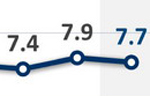
The only two regions that delivered lower-than-average growth were Beijing, with a growth rate of 7.7 percent and Shanghai, with a rate of 7.5 percent.
However, economists remain worried by the quality of growth in some areas of the country.
"Guangdong should stick to its historical strength, as a market-oriented economy. Direct intervention from government should be kept to a minimum," Lin said.
GDP generated from private companies accounted for 60 percent of the province's total. Even so, Guangdong's fixed-asset investment to GDP ratio is among the lowest nationwide, according to Luo Tianhao, an independent researcher who has tracked China's regional growth for years.
He said Guangdong and Zhejiang are the only two provinces that recorded a lower than 50 percent investment to GDP ratio, and that he was concerned by the economic growth models being used by many local governments in inland regions.
Their growth is highly dependent on fixed-asset investment, and they continue to concentrate on central and provincial level State-owned enterprises, at the cost of private sector development. "Local governments should disclose more detailed data related to the quality of growth, such as energy consumption per GDP of unit," Luo said.
Lu Ming, an economics professor with Shanghai Jiaotong University, added that he thought the fast growth of some regions with good natural resources, such as Tianjin and Chongqing, was understandable, but that many other regional expansions were worrying.
"In pursuit of GDP growth, local governments rely too heavily on fixed-asset investment. The result is homogeneous industrial structures," said Lu.
Meanwhile, analysts have called for putting quality ahead of the growth rate.
"Guangdong must accept the fact that the double-digit growth era is gone," Lin said. "It's time to tolerate a slower growth while giving priority to quality."
 'Cat model' to dazzle Shanghai auto show 2013
 Models at Tokyo modified car show
 Shanghai Fashion Week focuses on domestic brands
 Angel-dress models at Shandong auto show
 Safe and Sound
 Theater firms scramble for managers
 Premier pledges closer ties with Brunei
 Volkswagen's all-new GTI at New York auto show
Copyright 1995 - 2010 . All rights reserved. The content (including but not limited to text, photo, multimedia information, etc) published in this site belongs to China Daily Information Co (CDIC). Without written authorization from CDIC, such content shall not be republished or used in any form. Note: Browsers with 1024*768 or higher resolution are suggested for this site.
License for publishing multimedia online 0108263 Registration Number: 20100000002731