China eyes market forces to drive forex reform agenda


|
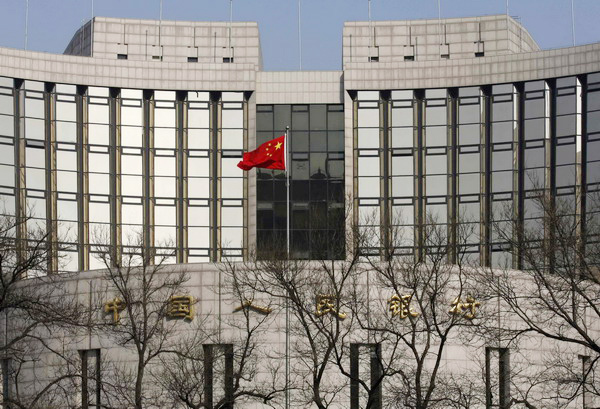 A Chinese national flag is seen at the headquarters of the central bank of China in Beijing Feb 20, 2013. [Photo / Agencies] |
China is set to use swelling offshore holdings of its tightly-managed currency worth around 1 trillion yuan ($160 billion) to justify a landmark shift in tactics to relax capital controls.
The shift means the People's Bank of China, or?PBOC, will abandon a time-table approach to liberalizing capital controls, favoring instead a series of reforms tied to soaring foreign demand for yuan to give more freedom to invest offshore currency deposits on the mainland.
Sources with knowledge of the latest PBOC thinking say the bank believes the strategy shift would shield the economy from the risk of a 1997/98-style Asian currency crisis that could be triggered in the wake of liberalization.
"Responding to foreign demand for renminbi products would be the best way of maintaining momentum for capital market and capital account reforms," a former top official in the PBOC's international division told Reuters, on condition of anonymity.
"The bank is very worried about opening up the capital account because when it does, it knows that anything could happen," the former official said.
"But if you give investors a market-based reason to hold renminbi (yuan) they will."
Investors expect China to make its currency basically convertible by 2015, or 2020 at the latest, and have anticipated that monetary authorities would do so according to a series of time-tabled steps. The new approach adds more uncertainty to the route Beijing may take to full currency flexibility.
A more flexible approach to currency liberalization widens the range of possibilities for policy tweaks, such as raising quotas for offshore yuan to be invested onshore, making changes to asset allocation rules for such investments and widening participation in domestic money markets.
"This would clearly be a way for technocrats to sell it to the government," said Zhang Zhiwei, chief China economist at Nomura in Hong Kong. "Allowing more foreign investors to come in and introduce capital inflows to balance out capital outflows. And it responds to market forces."
Foreign firms already hold about four times more Chinese currency than they can invest in the country, based on Reuters calculations of official data on cross-border trade settled in yuan, which leapt 41.3 percent to 2.9 trillion yuan in 2012.
But that belies the risk of sudden capital flight, particularly if strict currency rules are rapidly lifted, which worries the PBOC.
By the textbook definition of "hot money" - the change in foreign reserves minus net exports and foreign direct investment - China suffered a $214 billion outflow in 2012, twice as big as that during the 2008 global financial crisis when funds flocked to safe havens, according to one external adviser to China's monetary authorities.
Last year was also the first year that China suffered a capital account deficit since 1998, the height of Asia's crisis.
Volatility storm
These forces are at work even with strict currency controls and the PBOC worries that a build-up of yuan stranded offshore would further discourage foreigners from holding the Chinese currency if a storm of volatility were to hit.
China's efforts to promote the yuan as a settlement currency for cross-border trade in goods is part of the solution, designed to make the yuan more desirable globally.
The inability of foreigners to freely invest currency on the mainland that they accumulate offshore is becoming an obstacle to Beijing's efforts to make the yuan a true dollar alternative.
"Improving international access to domestic capital markets is key. Without this, there is no chance for the yuan to become a true reserve currency," said a second former PBOC staffer, now researching the yuan's role in the global financial system for a think-tank linked to the central bank.
"The Chinese government takes this issue very seriously. I think new measures will come after the NPC," the source added, referring to the annual meeting of parliament, the National People's Congress, which begins on March 5.