Comments
  Print
Print  Mail
Mail  Large Medium Small
The State Council has unveiled a series of changes designed to reflect recent changes in society and maximise administrative efficiency. Report by Hu Yongqi, Lan Lan, and Fu Jing in Beijing
As China's new leadership prepares to take charge, the nation has embraced the opportunity to deepen administrative reform by transferring power from the government to market forces and public opinion, via a restructuring plan announced by the State Council on Sunday.
 |
|
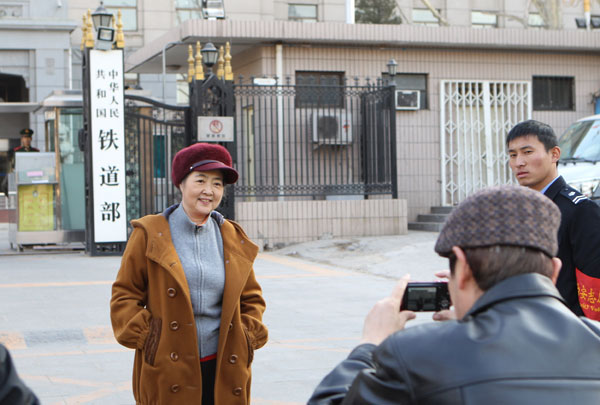
Staff members take photographs at the entrance of the Ministry of Railways, which will be dissolved. Zhu Xingxin / China Daily |
The move is the latest step in an ongoing, long-term transition. In 1981, the central government comprised 100 ministries and departments that employed 51,000 officials. Since 1982, there have been six major rounds of government restructuring and staff reductions, occurring roughly once every five years. As a result, only four government departments have not seen their names change in the past three decades, while the average State Council department has gone 13.6 years between major reshuffles, said He Yanling, a professor at the School of Government at Sun Yat-sen University in Guangzhou.
"There are now fewer departments involved in economic management and there is greater focus on social management. The focus of the departments has also shifted from control to regulation," she said. After the reforms, the 27 departments of the State Council will be reduced by two to 25.
|
 |
By streamlining the way it functions, the government is on track to further transform its role by allowing the market to play a bigger role in economic activity, said Chi Fulin, an economist and director of the China Institute for Reform and Development in Haikou, the capital of Hainan province.
For many years, the government-dominated economic growth model saw strong GDP as a top priority and invested heavily to achieve that result, resulting in an imbalance between investment and consumption and other issues such as overcapacity, resource waste and environmental pollution, he said.
To change the situation, a clear boundary has to be set between the market and the government, monopolies have to be broken, and the process of administrative approval needs to be simplified, he added.
|
 |
Meanwhile, the central government needs to strengthen its function as a watchdog, to implement and enforce strict regulations to supervise the market, especially in areas such as food safety and employment, said Jia Xijin, a professor at the School of Public Policy and Management at Tsinghua University.
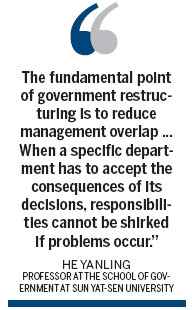
That view was echoed by He in Guangzhou. "The fundamental point of government restructuring is to reduce management overlap and allow each department to take control of its own field," she said. "When a specific department has to accept the consequences of its decisions, responsibilities cannot be shirked if problems occur."
Removing obstacles
Previous reshuffles were governed by the same logic. In 1993, steps were taken to increase the power of the market after former leader Deng Xiaoping vowed to build a "socialist market economy" on his tour of South China in 1992, said Zhao Chenggen, a professor at the School of Government at Peking University.
However, by 2008, several ministries in the industrial sector were obstructing market forces and their influence needed to be either removed or reduced so that the market could play its role efficiently, said Zhou Zhiren, also a professor at the School of Government at Peking University.
That led to the establishment of the Ministry of Industry and Information Technology and the disappearance of two other ministries in the industrial sector. As part of a series of reforms in 2008 - the most recent of the six previous reshuffles - three departments were merged to create the National Energy Administration to tackle China's soaring energy demand.
 'Cat model' to dazzle Shanghai auto show 2013
 Models at Tokyo modified car show
 Shanghai Fashion Week focuses on domestic brands
 Angel-dress models at Shandong auto show
 Safe and Sound
 Theater firms scramble for managers
 Premier pledges closer ties with Brunei
 Volkswagen's all-new GTI at New York auto show
Copyright 1995 - 2010 . All rights reserved. The content (including but not limited to text, photo, multimedia information, etc) published in this site belongs to China Daily Information Co (CDIC). Without written authorization from CDIC, such content shall not be republished or used in any form. Note: Browsers with 1024*768 or higher resolution are suggested for this site.
License for publishing multimedia online 0108263 Registration Number: 20100000002731