Humble bean brews up a success story


|
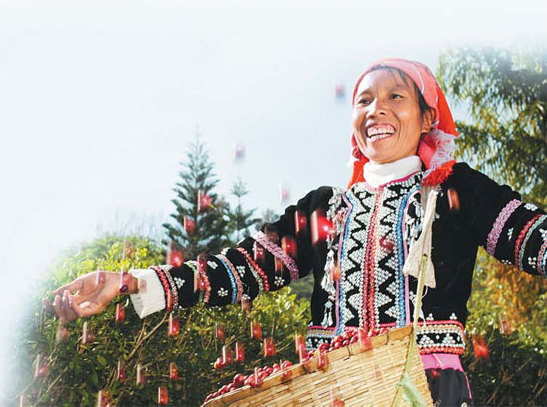
A coffee farmer in Pu'er, in Southwest China's Yunnan province. The Chinese mainland market for packaged coffee products has increased 18 percent year-on-year since 2007. It is expected to rise another 75 percent to 16 billion yuan ($2.5 billion) by 2017.[Photo/China Daily] |
But sceptics ask whether it can overtake tea as the nation's favorite refreshment
Xiao Wei, 35, enjoys visiting coffee shops not just for the taste of the stimulating drink but also for the ambience.
"The coffee is just an excuse," said Xiao. "I like the coffee aroma in the air. I like the buzz of strangers around me. I like to relax on a sofa or read a favorite book."
Xiao said she is usually busy from Monday to Friday so she likes to relax and enjoy a few hours to herself during the weekend.
Art director Guo Cong, 30, also likes to spend time in coffee shops, with her boyfriend.
"We like to sit on a cozy sofa while watching a movie on a laptop together or just talking while our favorite coffee brews," said Guo.
Xiao and Guo are typical of a growing number of Chinese who prefer Western-style caf culture.
According to research firm Mintel, the Chinese mainland market for packaged coffee products has grown at a compound annual growth rate of 18 percent a year since 2007 and could rise another 75 percent to 16 billion yuan ($2.5 billion) by 2017.
The value of coffee sales in China increased by 20 percent in 2011 from a year earlier, reaching 6.25 billion yuan, according to market research firm Euromonitor International.
The surging consumption has pushed up demand for coffee beans, especially in Pu'er city in Southwest China's Yunnan province. Coffee industry giants such as Nestl SA and Starbucks Corp have invested in the area and have been increasing their purchases of Pu'er coffee.
Nestl joined forces with the Yunnan provincial government and local coffee farmers to develop the local coffee industry in the late 1980s, becoming the first foreign giant to provide technical assistance to cultivate coffee in China.
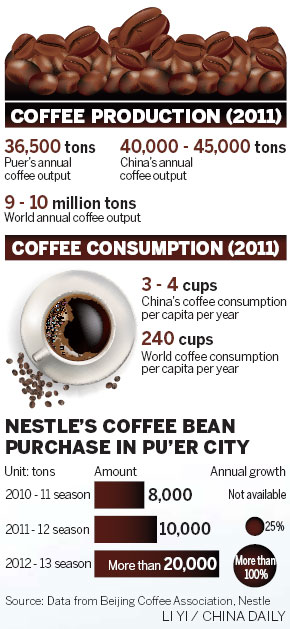
During 2011 and 2012, Nestl bought more than 10,000 tons of premium Arabica coffee beans from farmers in Pu'er, a year-on-year increase of 25 percent. The company plans to purchase more than 20,000 tons in the 2012-13 season.
Starbucks said it has increased the quantity of coffee it buys from Yunnan by more than 20 times since 2007, when it first started purchasing the beans. The increasing purchase of Yunnan coffee is in pursuit of its aggressive expansion plan to have 1,500 outlets in China by 2015.
Following the increase in local sourcing, the two coffee giants both introduced new products boasting about their oriental origin.
Nestl said in January it is introducing a new instant coffee named after Pu'er that will go into production later this year.
Starbucks unveiled a coffee called "South of Clouds Blend" that comes in a package featuring a phoenix, a mythical bird that represents virtue and prosperity.
"With Pu'er coffee's delicacy, richness and original flavor, the new products will surely catch the attention of people who have a preference for fashion and quality," said Adrian Ho, senior vice-president of coffee and beverages at Nestl Greater China Region.
Nestl China's food and beverage sales have risen by a 16 percent compound annual growth rate since 2008, with coffee sales growing faster than that, said Roland Decorvet, head of Nestl China. China's per capita coffee consumption is only three to four cups a year compared with 240 worldwide. Nestl currently sells two out of every three cups of soluble coffee on the Chinese mainland.
China is now the fifth-biggest global coffee market for Nestl measured by sales. The Switzerland-based company said it expects the traditionally tea-drinking country to become its biggest market by 2020.
"With years of consumer education and effective marketing, the coffee market experienced a strong volume of growth in China, both for instant and fresh coffee. The boom in specialist coffee chains in major cities also helped cultivate a coffee-drinking habit, especially among young adults and office workers," said Euromonitor.
The surging demand for coffee beans, both in the instant and fresh markets, has led to more coffee plantations being cultivated in Pu'er. Rows of green coffee trees with their dark red beans dominate the hillsides around the city.
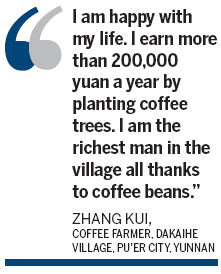
"I am happy with my life," said Zhang Kui, a 35-year-old farmer from Dakaihe village, Pu'er city. "I earn more than 200,000 yuan a year by planting coffee trees."
Zhang said he used to make just a few hundred yuan a year by planting corn. Now he runs a coffee farm of 3.33 hectares, lives in a well decorated three-floor villa and has two cars parked in his yard, both full of dried coffee beans.
"I am the richest man in the village all thanks to coffee beans," he said.
Peng Yuanguo, vice-mayor of Pu'er, said: "Coffee has become one of the pillar industries of Pu'er city."
The city produced 36,500 tons of coffee beans in 2012. A total of 43,300 hectares were planted for coffee last year. Pu'er produces most of China's coffee beans.
"More than 80 percent of Pu'er coffee beans are exported. We hope more and more Chinese coffee lovers will enjoy the premium taste," said Lu Han, director of the Pu'er Coffee Industry Federation.
So, how does one persuade a nation of tea drinkers to buy into coffee culture?
Belinda Wong, president of Starbucks China, said there are huge differences between residents of first-tier cities and those from smaller urban areas in terms of shopping habits.
While first-tier city coffee brewers are appraising new designer interiors and upgrading their outlets, people in lower tier cities have yet to try their first cup of coffee, said Wong.
Wong said Starbucks plans to get more space and couches in its Chinese outlets because the Chinese like to meet people and do business inside them.
In addition to its local, customized design, Starbucks also introduced many products tailored specifically for Chinese customers, such as black sesame green tea and red bean frappuccinos.
British chain Costa Coffee introduced hot chocolate and peach juice for Chinese customers who don't want coffee.
In 2011, Starbucks opened its first store in the lower-tier Chinese city of Shijiazhuang in Hebei province. Local people flocked there after hearing about it.
"I had to wait around 15 minutes to place my order," said local resident Xiong. "Whether it's Starbucks, Costa or Pacific Coffee, the words do not only mean coffee. They represent a fashion,"
In first tier cities such as Beijing and Shanghai, coffee shops are often found in luxury shopping malls and modern office buildings. They have developed a cachet as the place to dine, to linger in, to socialize and to do business.
Coffee is indeed changing lives in China. Back in Pu'er, which changed its name from Simao back to its historical name to mark the origin of the famed tea leaves and which last year was honored as the capital city of Chinese Pu'er tea, it's now the coffee business that is calling the shots.
Liwoke@chinadaily.com.cn