Official says China won't take part in currency wars



|
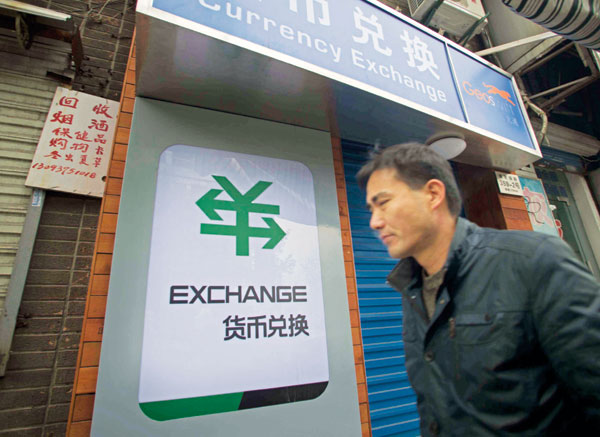
A currency exchange service outlet in Hangzhou, Zhejiang province. Yi Gang, the central bank's deputy governor, last week urged major economies to avoid the competitive devaluation of their currencies. [Photo/China Daily] |
China won't engage in any "currency wars" by depreciating the value of the yuan through monetary easing policies to shore up the economy, as some major economies have done, said a former deputy central bank governor on Tuesday.
"The yuan will continue to fluctuate in both directions as the central bank strengthens market-oriented reforms," said Wu Xiaoling, who is still closely connected to the People's Bank of China and is now the vice-chairman of the National People's Congress Financial and Economic Affairs Committee.
The easing policies conducted by some major economies, such as Japan, are similar to "quenching thirst with poison", she said at a press conference.
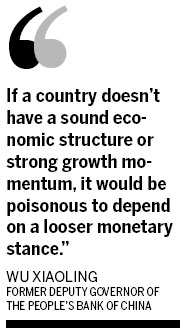
"Printing more money and devaluating the currency could be useful to promote economic growth over a certain period. But if a country doesn't have a sound economic structure or strong growth momentum, it would be poisonous to depend on a looser monetary stance," Wu said.
Her remarks come after a report in Japan's leading economic daily Nikkei said that the Bank of Japan's recently appointed leaders might launch fresh easing measures before their first policy meeting next month.
The yen was under pressure in Asia on Tuesday as the US dollar strengthened, with 96.7 Japanese yen against the greenback, the highest level since August 2009.
The yen has depreciated about 20 percent since the new Japanese government took office at the end of last year. In January, the BOJ announced plans to undertake "unlimited" easing policies to fight against the country's lingering deflation.
"Instead of intervening in the currency market to contain appreciation and stimulate exports, China needs to create a fair and competitive financial environment for domestic companies, and continue to promote the reform of the international monetary system," Wu said.
She said the yuan's exchange rate is already very close to its equilibrium level as the difference between the onshore rate and its non-deliverable forwards on the offshore market is narrowing.
PBOC's deputy governor Yi Gang last week urged major economies to avoid the competitive devaluation of their currencies and said that G20 countries should comply with the group's joint statement and reach a consensus.
He added that China takes global liquidity levels into full account when making policy decisions, and will hold on to its prudent monetary stance.
The PBOC will maintain its "stable" policies, with tighter control over credit growth and a more open attitude toward financial markets to encourage direct financing, according to Wu.
"As the ratio of money supply against total GDP remains high, it's vital for the authorities to tighten the reins on lending activities, which would amplify the money injections," Wu said.
Liu Mingkang, the former chairman of the China Banking Regulatory Commission, said that this year China will face a "substantial" rise of capital inflows.
China's consumer price index jumped to 3.2 percent in February, a 10-month high and up from January's 2 percent, as capital inflows accelerated.
The country's lending pace slowed in February as new-yuan loans extended by banks fell to 620 billion yuan from 1.07 trillion yuan in January.
The PBOC's recent shift to a policy-tightening bias and growing official concern over inflation pressures mean that a stronger yuan will be part of the policy response, said Irene Cheung, a strategist at the Australia and New Zealand Banking Group Ltd.
However, the depreciation of the yen would have a limited impact on China's economy, especially in terms of trade and capital flows, said Peng Wensheng, chief economist and managing director of China International Capital Corp Ltd.
He said that if the yuan strengthened 20 percent against the yen, the real effective exchange rate of the yuan will go up 1.5 percent, leading to a decline of 2.5 percentage points in China's exports.
wangxiaotian@chinadaily.com.cn
- China asks major economies not to sharply devalue currencies
- Regulator sees yuan stable, opposes currency war
- China well-prepared for currency war: official
- From 1st paper currency to world success story
- Currency's global role takes huge step closer
- Developed nations should stop devaluing currencies
- Currency expands its reach