Domestic demand holds key to China's growth


Leading IMF official says transition will be driven by quality of growth and further economic reform
A top International Monetary Fund official warned on Tuesday of the need for China to follow through on plans to shift its economy from an investment-driven model to one that relies on domestic consumption.
Zhu Min, one of the IMF's three deputy managing directors, said the key to this transition is economic reform and the quality, rather than the rate, of growth.
Chinese GDP grew 7.8 percent in 2012, higher than the government's adjusted forecast of 7.5 percent. Although it was China's slowest rate of economic expansion since 1999, the performance was among the strongest in the world. This year, GDP is expected to grow 8 to 8.25 percent.
Zhu pointed out that China's economy has been moving from a long-established focus on exports to investment. However, the 48 percent of Chinese GDP that investment accounted for last year was far too high, he told a seminar at Johns Hopkins University's Paul H. Nitze School of Advanced International Studies in Washington.
Overcapacity is a major challenge in China, where utilization of manufacturing resources has dropped to 60 percent, a level Zhu described as risky.
"Over-investment is a big concern and the quality of growth is a big concern," he said.
Zhu, who assumed his current post in July 2011, blamed over-investment for constraining the wages of Chinese workers. Household income remains a very small share of the country's economy, he said.
To maintain growth at or near current levels, China needs to keep moving toward consumption as its key economic driver, the IMF official said.
This goal is stressed in the 12th Five-Year Plan (2011-15), as well as the Government Work Report delivered last week by Premier Wen Jiabao at the National People's Congress.
The transition has sparked heated debate in China, and Zhu said on Tuesday that how people talk about it is important.
The lesson learned from the world economy is that consumption shouldn't be supported or stimulated by government spending, or by issuing debt or credit, according to Zhu, a former vice-governor of the People's Bank of China.
"I think this is a very risky issue," he said.
The government poured 4 trillion yuan ($643 billion) into its stimulus plan about four years ago, helping revive China's economy amid the global slowdown. In recent years, China has surpassed Germany and Japan to rise from fourth to second on the list of the world's biggest economies.
An IMF paper released in November estimated that China has over-invested by 10 percent to 20 percent of GDP.
Since the beginning of 2013, investment has continued apace, as seen in the sums of money that continue to pour into China's reinvigorated real estate market.
Zhu said he believes there are several things the central government could do to boost domestic consumption.
"Number one, you should give people more opportunities to work and then to earn more money, so they will be able to consume more," he said. "I think this is the most important thing and will be the driving force for China's growth strategy in the next few years."
Zhu suggested that China further open its service sector to allow more competition while crafting supportive tax and fiscal policies, particularly for small and medium-size enterprises. These measures, he said, would go a long way toward raising individual incomes.
The IMF official also said Beijing should increase spending on health, education, pensions and other social programs, which would help allay public concerns about the economy and encourage people to spend more.
Zhu said the government should have a policy to discourage investment. Interest rates on loans are too low, while necessities such as energy, transportation, water and electricity are extremely cheap, fueling excessive expansion of certain parts of the economy.
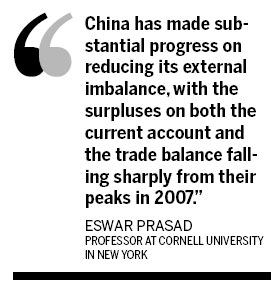
However, Eswar Prasad, a professor at Cornell University in New York and a former China division chief at the IMF, suggested last month that it's wrong to think of Chinese GDP growth as continuing to be driven by exports and investment.
"China has made substantial progress on reducing its external imbalance, with the surpluses on both the current account and the trade balance falling sharply from their peaks in 2007," Prasad said at a hearing of Congress' US-China Economic and Security Review Commission.
He also pointed out the major challenges for China: implementing reforms to improve the quality and efficiency of growth, continuing to shift from capital-intensive production, creating jobs and helping more of the benefits of growth to reach Chinese households.
chenweihua@chinadailyusa.com