The impressive rise of South


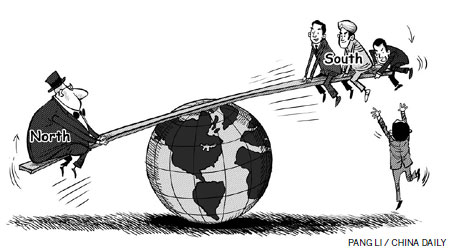
This year's UN Human Development Report is simply titled "The Rise of the South". It illustrates the immense power of a bloc of countries whose economic prowess is now chiefly responsible for propelling the world economic engine.
China, India and Brazil are the big players, but represented in that South bloc are 40 developing countries whose growth has been an antidote to the economic malaise infecting the developed North.
This tectonic shift in the South's economic power has led to millions of people being lifted out of poverty; millions more have been buoyed into the middle class. "The South as a whole is driving global economic growth and societal change for the first time in centuries," the UN report emphasizes.
But that surging economic tide in the South is not matched by a similar realignment in political power, a realignment whose time may well have passed its due date.
The facts and figures furnished in the 2013 Human Development Report make a compelling case. It estimates that "by 2030 today's developing countries will be home to four-fifths of the world's middle class, with the great majority in Asia."
Though their counterparts in the industrialized North have higher incomes and better standards of living, the middle class in the South - with its rising education levels and unprecedented access to information - is demanding greater effectiveness and responsiveness from local and global institutions, says the report.
If we pay heed to those demands, it will help meet the goals of eradicating poverty, spreading democracy, preventing conflicts and sustaining the environment.
The report projects that by 2020 "the combined output of three of the leading developing economies - China, India and Brazil - will surpass the aggregate production of Canada, France, Germany, Italy, the United Kingdom and the United States."
South-South trade itself has risen dramatically, "from less than 10 percent to more than 25 percent of world trade in the past 30 years". The rising trade volume between China and India, and sub-Saharan Africa is a case in point.
If this historic global shift is recognized and reflected by international institutions, it will make them more representative and reshape the world as we know it.
This argument is discharged by the report. "China, with the world's second largest economy and the biggest foreign exchange reserves, has but a 3.3 percent share in the World Bank, less than France's 4.3 percent.
"India, which will soon surpass China as the world's most populous country, does not have a permanent seat on the UN Security Council. And Africa with a billion people in 54 sovereign nations, is underrepresented in almost all international institutions."
The report also says that there are alternatives to the Washington Consensus - policy prescriptions that adhere to a market-based approach - as a way to bring about effective human development.
Turkey, Brazil, Indonesia, China and Bangladesh among others have made impressive gains in human development by conceiving innovative social policies tailored to fit their peoples. And cash transfer programs in Mexico, Brazil and India have helped narrow income gaps and improve health and education in poor communities.
While the North can gain much from these diverse approaches, the report acknowledges that human development is a symbiotic process. While the North learns from the South, the South too has much to gain from the knowledge and expertise of the North. If global institutions become more representative, they could facilitate a better and faster exchange of ideas, innovations and solutions.
Centuries ago adventurers, explorers and nations came seeking the South, to countries such as China, India and Brazil. From Marco Polo to Alexander the Great, from the Spanish to the British to the French and the Portuguese, they came drawn by gold, spices and silk, as well as by the mystique of these nations.
Now as time comes full circle and countries beat a new path to the rising South, it may serve the world well if trading partners are also better political partners.
The author is UN assistant secretary-general, UNDP assistant administrator and director of the UNDP's Regional Bureau for Asia and the Pacific.