Quality concerns over bottled water


A debate over the production standards adopted by bottled water giant Nongfu Spring has aroused safety concerns.
Several bottled water retailers in eastern China approached by China Daily said they have yet to see a major setback in sales of Nongfu Spring's bottled water, but some consumers remain skeptical about the quality of its products.
 |
|
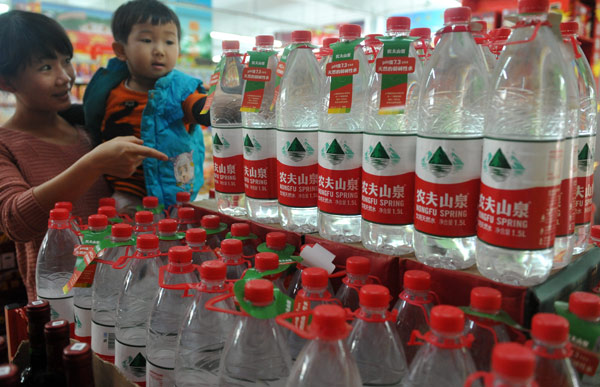
A bottled water display in a supermarket in Qionghai, Hainan province, catches a child's interest on Saturday. [Meng Zhongde / for China Daily] |
More than two-thirds of 9,500 people polled by eastmoney.com said they believe the criteria Nongfu Spring uses is less strict than the national levels. And 86 percent of respondents said they will not buy the company's bottled water.
Nongfu Spring, which produces 21.8 percent of all bottled water in the Chinese market, has been under fire for allegedly having looser criteria on a number of chemical elements than the national tap water standards.
The Drinking Water Committee at the China National Health Association - a Beijing NGO supervised by the National Health and Family Planning Commission - accused Nongfu Spring of using criteria set by the government of Zhejiang province in 2005, which failed to be updated to meet the national tap water standards that were upgraded in 2007.
Research by China Daily found Nongfu Spring adopted the regional DB33/383 standards - as it is printed on its products' packages - rather than a national standard on "bottled natural drinking water".
In this standard adopted in Zhejiang from 2005, quality indexes in a number of elements are looser than GB5749-2006, a national standard the central government released in late 2006 for drinking water quality, or the quality of tap water.
For instance, the permitted amount of arsenic, which can cause skin cancer if ingested by humans, is no more than 0.01 milligrams per liter in the national standard. But in DB33/383, the allowed maximum amount is 0.05 mg/liter.
Dong Jinshi, secretary-general of the International Food Packaging Association in Hong Kong and a food safety expert, said that a company is allowed to adopt regional or industry criteria when a national standard is missing, as in the case of Nongfu Spring.
The national standards cannot always cover all products in the market because product innovation is very fast, he said. "But GB5749-2006 is currently the bottom line for regional governments and industries to formulate their own standards for drinking water.
"When drafting a regional or industry standard, all indexes should be stricter than the national level."
Li Shuguang, a professor at Fudan University's Public Health Institute, said the products could be "unsafe" if they fail to meet national standards.