Cabinet acts to reduce red tape


Approval needed for some items to be delegated to lower levels
The State Council, China's cabinet, on Thursday published a list of items that no longer require central government approval, or have been delegated to lower-level authorities.
The cabinet's list follows Premier Li Keqiang's pledge to streamline the government since he took office in March.
|
Timeline ? March 17 Premier Li Keqiang vows to cut more than a third of some 1,700 items on issues relating to central government administrative examination and approval within five years. ? April 24 State Council cuts and delegates 71 administrative examination and approval items to lower level. ? May 6 State Council cuts and delegates another 62 such items. ? May 13 Executive meeting of State Council cuts and delegates 133 items. Promises more steps to be taken. ? May 16 State Council publishes list of the 133 items. |
Approval required for 133 types of undertakings was either surrendered to the market or delegated to lower levels.
Of the 133 approval requirements to be canceled, 117 were posted on the government website, while the remaining 16 are pending law amendments or remain State secrets.
Approval is no longer required from central government agencies for activities ranging from foreigners touring China in their own vehicles to companies investing in large oil and gas fields.
Investors will also no longer need to gain administrative approval for exploration and development of new oil and gas fields.
The changes were welcomed by economists as an effort to lower the threshold for investors to enter more industries, which may in turn raise their enthusiasm and help spur economic development.
Niu Li, senior economist with the State Information Center, a government think tank, said reduction and decentralization of approval is a key part of the government's roadmap for progress on China's economic reform.
Thursday's announcement "is a good sign for both domestic and international investors", and is likely to "unleash new energy at corporate level," Niu said.
Ding Ningning, researcher with the State Council Development Research Center, said cutting the central government's approval power will help it become more efficient in macroeconomic management, and will provide a better service to the market and society.
Government ministries have only limited staff and limited time to do their jobs. Too many approval papers will use resources that should have been committed to policy-level research, he said.
The National Development and Reform Commission saw the deepest reduction in its approval authority, relinquishing 26 business activities, including expansion of civilian airports, ethylene or paraxylene plants, paper pulp manufacturing, and the production of sugar and polyester.
Such projects can still be regulated by industrial policies, technology standards and economic laws, a commission official said.
A host of items previously subject to central government approval are to be delegated to local governments, including investment in wind power plants, hydropower stations on some rivers, potash fertilizer plants, rare earth processing mills and construction of oil and gas pipelines within a province.
The items also include charging of administrative fees and conferring of government awards.
Premier Li said earlier he will cut at least one-third of the State Council's 1,700 approval requirements in five years.
On May 13, in his speech at a high-level videophone conference, he insisted that streamlining of the cabinet will continue — just as "an arrow sees no return once it is shot from the bow".
Political scientists also applauded the move. Xue Lan, dean of Tsinghua University School of Public Policy and Management, said although all types of administrative control have helped China in the planned-economy era, many of them have had a negative effect on the economy and society now that a market economy is being built.
 Some officials have even sought personal gain through the power they hold for administrative approval. To crack down on corruption by officials, the government had to perform the "urgent task" of transforming its functions, Xue said.
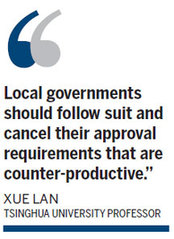
"Local governments should follow suit and cancel their approval requirements that are counter-productive to good social management," he proposed.
Song Guojun, director of Renmin University of China's environmental policy and environmental planning institute, did not view the change as an increase in the environmental protection authorities' power.
The primary beneficiaries of government streamlining are the enterprises, he said. They can now save time and reduce costs.
Environmental authorities' power is not increased under the process because their power is defined by law. No business project is allowed to ignore the existing law on environmental impact assessment.