Starting with the urban-rural divide



|
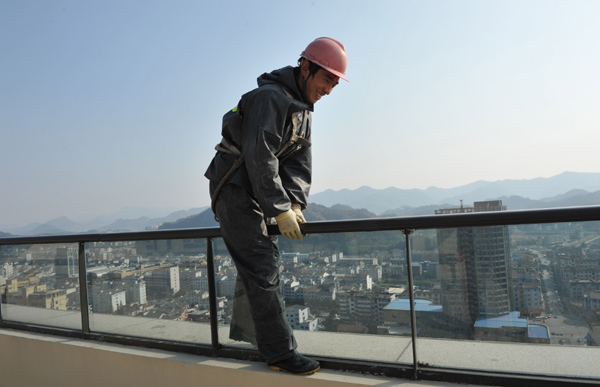 A construction worker atop a 26-story building in Lin'an, Zhejiang province. [Photo/China Daily]
|
Experts, officials urge changes to the household registration system
While urbanization has been one of the key batons conducting the new leadership orchestra, there are divided views on the measurements of its scale and effect.
The United Nations has defined urbanization as the physical growth of urban areas, as a result of rural migration and even suburban concentration into cities.
But according to analysts, at least three sets of gauges are applied in China: spatial expansion, the hukou (household registration) system and rural migration.
By Dec 31, 2012, China's nominal urbanization rate had risen to 52 percent, meaning that more than half of the country's 1.3 billion population had been moved out of the countryside.
But Huang Yasheng, a professor in international management at the MIT Sloan School of Management, said the figure is based on the calculation of massive land acquisitions, or spatial expansion, rather than the free flow of personnel, as well as a relaxation of hukou controls.
In background research for the Organization for Economic Cooperation and Development, Huang referred to rural residents who have migrated to cities to work, but who don't have an urban hukou, as "rural migrant workers".
China's urbanization process is a composite process of two opposing forces.
One is relatively market-based and is driven by cumulative decisions made by hundreds of millions of individuals to move from rural to urban areas.
The other is less market-based and is more political and has to do with the spatial expansion of the urban boundaries.
But even though China's expansion of urban boundaries that encroached upon previously rural areas is intriguing, the urban population rate remained just 35 percent in 2011, according to the National Bureau of Statistics - lower than the world average of 52 percent.
Today's "urban" dweller is generally ruled by residence. That is to say, an individual is considered an urban resident should he or she reside in an urban area for more than six months.
However, many urban residents in China suffer long periods of separation from family members, still left in the country, said Jia Kang, director-general of Institute of Fiscal Science under the auspices of the Ministry of Finance.
"About 70 percent of migrant rural workers in China are married, but just one-fifth of them manage to live with their spouse, with less than 10 percent of those bringing their children with them.
"These are serious issues causing social upheaval over the long term," Jia said.