Pros and cons of rising labor costs


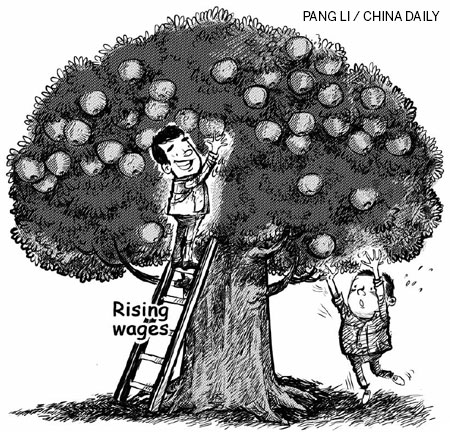
Rising wages and slowing productivity, coupled with declining demographic dividends, have stirred concerns that China's competitiveness in manufacturing is eroding. Structural changes are certainly taking place, notably in the cheap labor segment, shifting dynamics along the value chain and across provinces. These changes, however, are positive in terms of the strived-for shift in China's economic growth model.
China's working-age population (based on the Chinese definition of people between the ages of 15 and 59) fell by almost 3.5 million in 2012. This striking demographic development threw into sharp relief the limits of China's growth model of the past three decades.
Structural changes in the labor market actually started a few years ago. Wages in the manufacturing sector increased significantly while labor productivity started slowing. Some observers and investors interpret these developments as a serious erosion of China's cost competitiveness.
Indeed, since China's entry into the World Trade Organization in 2001, real wages paid in the manufacturing sector have risen by almost 200 percent in US dollar terms, surpassing the rate in Thailand and closing the gap with the Philippines. Strikingly, wages in China continued to increase during the 2009-11 period, even as other countries in the region felt the dampening impact of the global financial crisis.
Until recently, wage increases went along with rapid labor productivity gains. Surplus labor absorbed by the non-agricultural sector led to rapid improvements in output per person employed, lifting China's labor productivity level above those of Indonesia and the Philippines within a decade. Nevertheless, China's real GDP per worker remains below Thailand's and Malaysia's, not to mention South Korea's. And over the last couple of years, labor productivity growth has started to slow down.
In 2012, China's productivity grew the least since 1999 (although it outpaced the rest of Asia). Worryingly, a similar slowdown was observed in total factor productivity, which takes into account efficiency gains such as managerial competence and technology diffusion. As a result of these developments, China's unit labor costs (ULCs) - the ratio of wages to real output per person employed - trended up considerably in 2011-12, to a larger extent than for example in ASEAN economies.
But there is a silver lining to these seemingly negative developments. The increase in ULCs in the industrial sector may contribute to the needed shift in China's economic growth model. Three structural trends are supportive of this aim.
First, labor shortages have begun to loom large in China's increasingly fragmented market not only because of a decline in the supply of labor, but also because specialization in production requires workers with specialized skills. In addition, the shift of enterprises to the inland has led to creation of jobs closer to migrants' homes. In 2011, workers getting employment in their home provinces accounted for more than half of total migration. Proximity to inland urban households could soon be of greater relevance beyond the labor cost issue, given the prospects of higher incomes and, hence, consumption in China's inland cities.
Second, the services sector is to a large extent underdeveloped and has the potential to contribute to job creation on a wider scale. Services account for the largest share in employment but for less than half of GDP growth.
Third, ULCs are rising fastest in labor-intensive sectors. ASEAN countries have been the main beneficiaries of this development through closer integration into China's supply chains - although ASEAN's advantages are not without limits. In Vietnam, for example, real wages in the manufacturing sector increased 9.7 percent a year from 2006 to 2011, not far behind China's wage growth, while its labor productivity was only 26 percent of China's. Other countries, like Indonesia and Thailand, have increased minimum wages in key industries not unlike the increase in China's minimum pay.
In conclusion, the structural changes taking place are sometimes masked by the sole focus on China's diminishing cost advantage. Wages are sure to increase , and are in fact a political imperative, but increasing efficiency can offset them at least partly. The labor market can be a contributor to growth if urbanization and reform of the hukou (house registration) system allow for a better matching of skilled labor with specialized demand in higher value-added industries.
The author is an economist with Deutsche Bank.
Related readings:
Wages reach point of no return
Rising wages reach a milestone
China waging war against online rumors
Report: Wages on the rise
Wage growth for migrant workers set to accelerate