Commercial viability key to success


The road traveled by Tesla Motors, a game changer in the global electric car industry, reminds Chinese automakers that they should think outside the box by exploring commercially viable ways to promote new energy vehicles.
After the Silicon Valley-based electric car maker reported its first profitable quarter in early May, its stock doubled to around $90 within one month, increasing the company's total market value to around $10 billion.
Tesla also raised its 2013 sales target to 21,000 units of its high-end model S cars, up from the previous sales target of 20,000 units.
If it manages to reach this goal, it could exceed China's total electric vehicle sales in 2012, which stood at 11,375 units, according to figures from the China Association of Automobile Manufacturers.
Such a comparison would eclipse all Chinese automakers' efforts in this respect, including Warren Buffett-invested BYD Auto, which only sold around 1,690 E6 electric cars last year, mainly to taxi companies. Tesla delivered 4,750 Model S cars in the first quarter of this year.
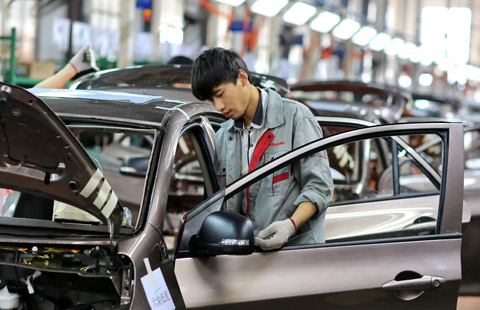
Chinese automakers need to rethink their strategies to gain a concrete market share for electric cars in the world's largest auto market. Otherwise, they may squander the huge investment made in electric car manufacturing and research and development in the past few years.
The relatively high price of electric cars has been a major obstacle in terms of attracting consumers, but the Tesla Model S costs at least $70,000, without taking into account tax breaks for electric cars.
In many ways, Tesla's products are constrained by the problems facing all electric carmakers such as limited driving range, the high cost of batteries and an inadequate charging infrastructure.
Such a success story akin to that of Tesla should also have a chance in China, the world's largest and most dynamic automotive market. Around 19.3 million vehicles were sold in China in 2012, some 5 million more than in the United States.
China, which in 2009 launched perhaps the most extensive program in the world to promote electric cars, has a more serious energy security problem and there's a more urgent need to curb emissions from the transport sector.
Tesla uses lithium-ion battery packs in its Model S vehicles. China is a major player in lithium-ion battery manufacturing, supplying about half of the world's lithium-ion batteries for phones, smartphones and laptops.
The Model S is a stylish and well-designed car. Chinese automakers should learn from this by hiring a world-leading design company to design a car like that. In addition, China has no lack of eager luxury-car buyers.
Tesla is also leading the way by synergizing electric cars with fresh and innovative ideas from Silicon Valley.
An iPhone and iPad fan could easily become a Tesla car fan, whether or not they could afford such an expensive car.
The Model S has the largest monitor, a 17-inch touch screen, which is bigger than two iPads, and drivers get full access to the Internet while they drive.
Tesla software knits together Google Voice, Slacker Radio and the Gracenote music database, and streams over 3G, said Elon Musk, Tesla Motors chief executive.
But if Tesla wants to remain successful, it needs to provide affordable models to consumers. However, its current success also shows that there will always be a niche market if products are appealing enough to customers.
Zero emissions is a laudable concept, but automakers also need other selling points to help consumers make the decision to buy a greener car at a higher cost, as there is little prospect of batteries getting much cheaper before large-scale production gets into full swing.
Sales of electric cars remain lackluster in China despite active government support.
At the recent Shanghai Auto Show, automakers were noticeably less keen to discuss plans for the commercialization of their electric models.
The government has said it will renew its incentives for new energy vehicles for an additional three years, but industry insiders said that the dividend for electric cars is likely to end soon, and the new policy will be shifted to supporting vehicles' fuel efficiency, which means regular hybrids may get more subsidies.
According to the previous policy, the government offered 60,000 yuan ($9,680) for an all-electric car and 3,000 yuan for a plug-in hybrid car.
With the expiration of the special protection period, it's time for automakers to spark their own vitality and innovation not only in technical expertise, but also in business models and market strategies. Only those able to think outside the box will last the pace.