Comments
  Print
Print  Mail
Mail  Large Medium Small
|
A map of Shanghai as shown by Space Syntax analysis software. [Photo / Provided to China Daily] |
Scientific research will become increasingly important as the emphasis in urbanization in China is put on quality rather than quantity, an urban planner says.
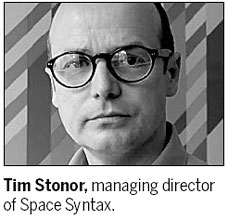
"In the past 10 years, China has been building a huge amount, often without sufficient attention to quality, and sometimes the quality of construction has not been good enough," says Tim Stonor, managing director of the urban planning company Space Syntax.
"China is now reconsidering this approach., Stonor says.
This rethinking has led Chinese urban planners to increasingly value research, and the emphasis attached to research in China in some cases is "even more than in the UK".
"In my discussions with Chinese municipalities, they are all concerned about the social outcomes of urbanization, and this provides opportunities for the human-focused approach that we take at Space Syntax."
Space Syntax is a spin-off company of Bartlett Faculty of the Built Environment of University College London. The company provides architectural and urban planning services using technology built on a theory of spatial layout and social behavior.
The theory, pioneered by Professor Bill Hillier and his colleagues at Bartlett in the 1970s, has since helped architects and urban planners worldwide to incorporate scientific research into their creative design projects.
"By analyzing the mathematical properties of street networks it is possible to calculate how some are more connected than others and more likely to be used by people flowing in cars, on foot and on bicycles," Stonor says. "You can build a mathematical graph of streets in the city and this graph is the secret to understanding the way that streets flow."
The process creates highly graphic maps of cities in which more spatially accessible streets are depicted with warmer colors than less well connected ones. Hence, well used streets tend to be the most spatially connected. Because they are easier to get to, people use them more, attracting retail and commercial uses to them. Successful urban areas have a mix of colors since people need both busy and quiet spaces to enjoy complete urban lives.
"These techniques can be used at every scale, and we're working throughout the world, including China, to apply them. We are leading the design process or supporting the process, in cooperation with many architects in China now."
One project Space Syntax took part in was expanding the central business district of Changchun, capital of Jilin province, a few years ago. Changchun's government asked a Beijing architecture company to help with the project, and the company then took on Space Syntax as an adviser.
"The city had planned to grow massively over the next few years, and there was the question of where the CBD should be, and indeed how many CBDs should exist," Stonor says.
"We realized that some of the original locations where the CBDs were planned to be were not ideal. Our Space Syntax analysis showed that they were not in the most accessible locations, where you would naturally tend to find them. We therefore suggested different locations, which were just slightly away from the locations in the original plan, and our suggestions led to a change."
This example, says Stonor, demonstrates the importance of academic, science-based research in solving practical problems. To encourage this process, his team is now providing training in Space Syntax techniques to many academic staff members and students in Chinese universities.
These include Tianjin University, Shenzhen University, China Central Academy of Fine Arts, Tsinghua University, Peking University, South China University of Technology, and Tongji University, he says.
"Working with these Chinese academic institutions has made me realize that Space Syntax's theory and software are already very widely used and well regarded in China," Stonor says.
Space Syntax software can be downloaded from the Internet free of charge and, Stonor says, his team is working on an online training platform that will deliver basic training on the software free. Clients can then pay for more in-depth training.
"We wish to train academic institutions and professional practitioners to be as skilled as they wish to be. There are useful textbooks that they can learn from, but face-to-face interaction can bring great value," says Stonor.
Recalling a recent training session he led at Shenzhen University with master's degree students, Stonor says Chinese architecture students are very realistic about their career paths, perhaps because they are growing up in an environment that is urbanizing quickly.
"They have a sense of reality. They have a sense of what the city is for. They know that when they qualify, whatever job they get, they are going to be building huge amounts," Stonor says.
But as China rapidly grows, Stonor says, it is important that its architects and urban planners remember to look to history, which demonstrates how human beings and landscape interact naturally.
 Models at Ford pavilion at Chengdu Motor Show
 Brilliant future expected for Chinese cinema: interview
 Chang'an launches Eado XT at Chengdu Motor Show
 Hainan Airlines makes maiden flight to Chicago
 Highlights of 2013 Chengdu Motor Show
 New Mercedes E-Class China debut at Chengdu Motor Show
 'Jurassic Park 3D' remains atop Chinese box office
 Beauty reveals secrets of fashion consultant
Copyright 1995 - . All rights reserved. The content (including but not limited to text, photo, multimedia information, etc) published in this site belongs to China Daily Information Co (CDIC). Without written authorization from CDIC, such content shall not be republished or used in any form. Note: Browsers with 1024*768 or higher resolution are suggested for this site.
License for publishing multimedia online 0108263 Registration Number: 20100000002731