Coca-Cola seeks to connect with young customers


The world's largest beverage company, the Coca-Cola Co, has launched a series of marketing campaigns in order to meet the demand of the younger Chinese generations.
Last month, the soft drink giant announced its introduction of "nickname bottles", a set of eye-catching bottles with innovative labels.
 |
|
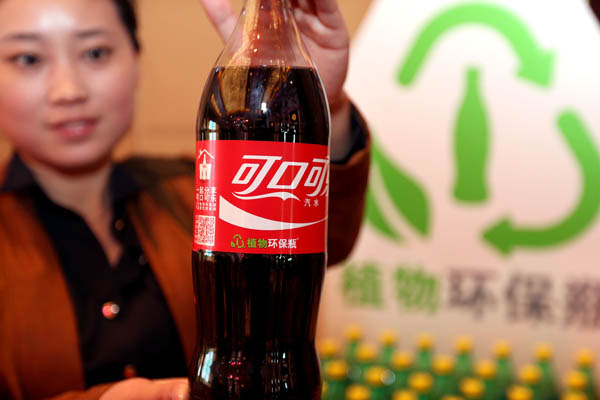
A worker displays a plant-based "green" bottle of Coca-Cola in Shanghai. The Coca-Cola Co launched the green bottle, made of renewable raw material, on the Chinese market recently. The source of the raw material is the by-product of processing sugarcane into sugar, and is 100 percent recyclable, the company said. Fan Jun / Xinhua |
The nickname bottles bear the marks of the social media generations, and the first batch of bottle designs pick ups on more than 20 buzzwords or phrases, including "Sweetie", "Best Buddy", "Stylish Man" and "Happy-Go-Lucky".
Last year, Coca-Cola also launched its 300-ml mini-packs, as research showed that usually, its Chinese consumers can drink 300 ml at one time. The mini-pack is also very convenient for people to put in their pockets and keep their hands free.
"Speaking to our consumers in their language will help the brand establish a strong bond with consumers. It enables consumers to relate nicknames on the bottles with their friends and loved ones and makes sharing a coke actually fun," said Coca-Cola's Integrated Marketing Communications Senior Director Stephen Drummond.
In addition to innovative marketing strategies, the Fanta and Sprite maker is also dedicated to water conservation.
Coca-Cola China, China's Wetland Conservation and the Management Center of the State Forestry Administration and World Wildlife Fund recently announced a water conservation project involving the Yangtze River, which accounts for 34 percent of the fresh water resources of China.
The "Yangtze Water+" project, which will run through 2020, will go beyond fresh water conservation and the experience accumulated in the first phase of the partnership in the Yangtze River Basin, to tackle all the forces that affect fresh water to achieve greater scale and impact.
The project will focus on three key components: freshwater conservation, the value chain and valuing nature.
"At Coca-Cola, we are deeply committed to work with partners to address our collective environmental challenges and responsibly manage the planet's resources," said Ahmet C. Bozer, president of Coca-Cola International.
"This is part of our endeavor to seek solutions that seek a balance between economic development and environmental protection, and eventually grow with China to build a more beautiful homeland and green future."
"The wetlands in China maintain 2.7 trillion tons of fresh water, accounting for 96 percent of available freshwater resources in China. Effective protection of wetlands not only has great environmental benefits but significant economic benefits as well," said Li Lifeng, freshwater program director at WWF International.
"Collaboration among the government, civil society organizations and communities will not only help business to expand sustainability but also amplify the impact of the engagement."
Since 2007, the Atlanta-based company has been working with the WWF to conserve seven of the world's most important freshwater basins, including the Yangtze.
In the past seven years, Coca-Cola has invested more than $10 million in China's partnership project focusing on water conservation, sustainable agriculture and public awareness improvement. The efforts resulted in a total of 800 million liters of clean water being replenished back to nature and the community.
Since re-entering China in 1979, Coca-Cola has invested more than $5 billion in the market, including $3 billion from 2009 to 2011.
As of the end of March 2012, the company had established 42 plants in China.