In modern business, going mobile is the key to success



Mobile technologies are transforming enterprises, industries and the world.
With the surge in the use of smartphones and tablets and mobile Internet access in China overtaking the use of desktop computers, we are seeing a sea change in consumer behavior and demand in business and in social networking of how people work together.
Across the globe, market leaders are seeing mobility as something that can give them a competitive edge and that can help transform their businesses. Chinese enterprises have told me they wish to stay ahead by becoming more mobile, but how prepared are they?
To discover how Chinese companies and their global peers are dealing with the growing importance of mobility, Accenture recently conducted an online survey of more than 400 chief information officers and other IT professionals in 14 industries and 14 countries about their development and deployment of mobility solutions.
Globally, companies are all increasing their focus and spending on mobility, but Chinese enterprises are leading the world in a number of ways, in terms of their focus on: prioritizing mobile initiatives; incorporating mobility into business processes; supporting a range of mobile devices, including bring-your-own-device options, with which Chinese employees enjoy more freedom to use their own preferred mobile devices to connect at work.
More than nine out of 10 Chinese enterprises also prefer a centralized, company-wide mobile strategy and governance to guide longer-term investment but prefer to deploy in-business units that will realize the most immediate value and demonstrate early success - for instance in sales or in the field force. In short, Chinese companies are showing the highest business enthusiasm toward mobility in the world, with a strong desire to equip their workforce with mobile devices and a mobile experience that have the highest impact.
Why? The reason is historical but simple: Small devices have become very, very big. The last groundswell this huge was in the late 1990s and it was called the Web. Indeed, according to our survey, 90 percent of the Chinese chief information officers said that mobility would affect their business as much as or more than the Web did. The number was significantly higher than 73 percent globally.
Given the enormous market size and population, Chinese enterprises cannot afford to lose the opportunity that mobility provides in the country - to increase their customer base, earn more and leapfrog their global peers. Our survey found that Chinese chief information officers are keen to experiment with mobile technology to discover new solutions for customers and employees. Among them, we see a higher level of investment in trials of mobility technology in China compared with other countries on average (33 percent for China, 30 percent globally), which suggests Chinese enterprises are testing the potential benefits of increased efficiency, reduced costs and new revenue streams.
Much more than their global peers, chief information officers of Chinese business-to-consumer enterprises include targeted promotions, social sharing and access to content for customers as features in their mobility strategies. Looking at the enterprise side, Chinese chief information officers include features such as mobile-device management, collaboration and knowledge-sharing in their mobility strategies to a larger extent than the average chief information officer globally.
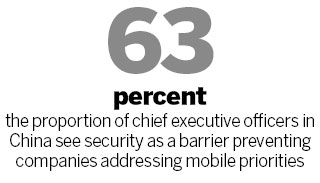
However, Chinese enterprises must overcome a number of challenges before realizing the full efficiency, cost, or revenue potential that a mobility-enabled business brings, including allocating mobility budgets to the highest-priority initiatives, deploying applications that have a big visual impact to attract and retain customers and strengthening the governance of the mobility strategy across business units.
Companies are rightly giving priority to high-value initiatives in select functional areas. For instance, we see sales units launching tablet-based sales toolkits to unleash the sales force, or executive suites deploying mobile management dashboards. However, if attention is not focused on a unified platform to support the strategy, the value propositions of new technology adoption will slow down because of disparate tools, data repositories and governance processes. That will mean extra costs and effort later to get the most from mobility technology and the strategic outcome.
We are also seeing the silo effect in other cases, where economics and mobility are disconnected in Chinese enterprises. Their projects aimed at reducing costs and improving efficiency remain largely traditional and are undervaluing the additional, and sometimes substantial, supply chain, field service and office automation benefits that can be enabled by mobile technologies.
To highlight the disparity of China versus other nations, our findings show that Chinese enterprises are lagging behind when it comes to creating customer-facing applications - those that drive revenue through customer engagement or transactions - and developing new mobility-focused marketing channels.